



home | metro silicon valley index | movies | current reviews | dvd review
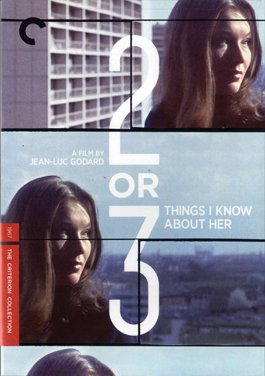
2 or 3 Things I Know About Her
One disc; Criterion Collection; $29.95
By Michael S. Gant
The story—but that's not really what's at stake—of Jean-Luc Godard's 1967 feature 2 or 3 Things I Know About Her follows a Frenchwoman named Juliette (Marina Vlady) through 24 hours of domestic chores, errand running, shopping and freelance prostitution. The "her" of the title is also Paris, but not the sentimentalized tourist Paris of Amélie. Godard is interested in the soulless ring of high-rises on the outskirts of Paris, where working-class women find themselves buffeted by a cold, hard form of modern capitalism represented by the many bright, flat advertisements full of primary colors that Godard abruptly cuts into the film. In one exemplary shot, the camera starts on Vlady's blank face, makes a 360-degree pan around the indistinguishable rows of apartment cubes only to return to Vlady. This camera movement tells you everything you need to know about the constraints of Juliette's world. But Juliette isn't really a character in a drama—she's a construct in Godard's philosophical ramblings. As both the printed article by critic Amy Taubin and the commentary by Adrian Martin indicate, 2 or 3 Things is really a filmed essay rather than a film (although not a documentary—a form Godard felt was lacking). Segments are accompanied by Godard's own whispered musings on the meaning of language and art: "How do you describe an event?" Godard asks as he shows us the same sequence from slightly different angles; "Why do all these signs make me doubt language?" he wonders as he fills the screen with isolated letters from billboards. The banal snippets of Juliette's daily rounds are mixed with characters addressing the camera directly about their lives and strangely beautiful widescreen vistas of road projects and construction work. Godard very cannily butts up unexpected passages of classical music against raw industrial sounds and abrupt silences. Since this was made in the heat of the late '60s, Godard throws in some comic agit-prop about the United States and Vietnam; to satisfy an American journalist, Juliette and her friend take off their clothes and don Pan Am and TWA flight bags as symbols of American global hegemony. There is some perverse genius at work here—having beautiful women reciting philosophy obviously makes the cogitation go down easy. The conceit runs out of steam toward the end, but Godard scores some strong points against social "reformers" who really serve capitalist masters. At times, the film, thanks to Raoul Coutard's cinematography, rises to a near-transcendental level. A passage in a cafe begins with some thoughts about the ultimate failure of humans to truly connect (the conflict between "crushing objectivity" and "expelling subjectivity") while the camera closes in on a cup of espresso to contemplate the swirling froth. The bubbles in the foam fill the screen until they look like galaxies forming and exploding in deepest space. I first saw 2 or 3 Things nearly 40 years ago, and that shot has stuck with me ever since. Although the film benefits from the big screen, there is a lot to be said for having it on DVD where it can be studied closely, like a textbook. This Criterion edition comes with a booklet, commentaries, an interview with Vlady, footage of Godard arguing with a government bureaucrat and more.
Send a letter to the editor about this story.
 |
 |
 |
 |
 |
