



home | metro silicon valley index | news | silicon valley | news article
Photograph by Felipe Buitrago
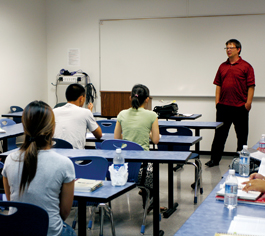
LESS IS MORE: Mark Dowdy teaches an English 1B composition class in SJSU's Clark Hall. Beginning next semester, he will face more students per class and receive a de facto pay cut.
Second-Class Students
San Jose State endures brunt of state's budget cuts
By Jessica Fromm
THE FACT that every eligible resident can attend a state university, long a source of pride in California, will soon be a distant memory as a result of massive state budget cuts. As the fall 2009 CSU semester approaches, thousands of college students will return to campus to find fewer instructors, slashed classes, empty dorms and diminished services. Some will be denied university admission altogether.
In a teleconference two weeks ago, California State University Chancellor Charles B. Reed said the 23 campuses of the CSU system will be experiencing an unprecedented $584 million reduction in state funding. That number represents 20 percent of the CSU's total income.
"I have never seen a massive reduction come so fast in the 40 years that I have been doing this business," Reed said. "It is nothing short of a mega meltdown financially."
Reed's statements were a precursor to the official announcement last Friday that Sacramento is chopping $2 billion from the state's higher education budget to help close a $26 billion budget gap.
The chancellor outlined a controversial plan that includes hiking undergraduate student fees by $672, bringing the average cost of attending a CSU campus to $4,827 a year. This is the seventh fee increase students have seen in the last seven years.
The CSU system, which educates 450,000 students a year, will also be cutting enrollment by 40,000 in the next two years, and instituting systemwide bimonthly furloughs for its 47,000 employees.
The California Faculty Association voted on July 24 in favor of Reed's purposed furloughs by a margin of 54 percent. Later, John Travis, chair of the CFA bargaining team and a professor of political science at Humboldt State University, said the chancellor should be doing more to advocate for the CSU in the face of the devastating budget crisis.
"This vote has been an extremely painful exercise," Travis said at a press conference last Friday morning. "The choices were frankly awful. Many of the faculty are angry about voting 'yes' under these conditions.
"Nevertheless, when it came time to vote on whether to accept a furlough, they voted for the students and their colleagues."
In that same vote, 80 percent of CSU faculty said they had no confidence in the leadership of the CSU system or Reed himself.
Liz Cara, president of the SJSU chapter of the California Faculty Association and a professor of occupational therapy, agrees.
"They just seem to acquiesce," Cara says, "like, 'Oh, we can cut more, we can cut more, we can cut more,' when we really don't feel like we can because we have been cut so much since 2002."
Cuts Hit Home
San Jose State will be struggling with a $41 million shortfall in the coming year, along with absorbing a disproportionately large share of the systemwide enrollment cuts.
Because the university has been exceeding its 2.5 percent growth enrollment target for several years, SJSU will now have to decrease enrollment by 2,500 fewer students, most of whom would have been incoming freshman. There will also be more students in each class, and fewer instructors.
Though Reed has said on many occasions that maintaining the quality of education provided by the CSU system is a top priority, many CSU faculty and staff members see a significant downturn in service provided to students in the 2009/2010 academic year.
"I know the Chancellor likes to throw out there that we are really maintaining our high quality, but I don't think its possible anymore," Cara says. "I think a lot of high-quality students will be left out.
"It's become less accessible essentially, and this is the university that educates the middle- and working-classes. So, they are really the people who are screwed, I think. And, we also educate a large amount of minorities, so it's also going to be very devastating for them."
In the July 16 teleconference, Reed emphasized that all CSU campuses will be feeling the hurt, but that slashing campus budgets and upping costs is the only way for the CSU to remain functioning.
"Let me just say that this is going to be tough on everybody," he said.
"Everybody that is part of the California State University family is going to feel the pain; everybody is going to share in the pain."
Many in the university system believe that with such massive budget cuts, the CSU's money crisis has not gotten the amount of attention it deserves, from either state representatives or the media.
"I don't know if anybody has really stood up and said that we deserve more," says Pat Lopes Harris, director of media relations at SJSU. "But on the other hand, nobody has stood up and said that we deserve less. So, we've flown under the radar a bit.
"What I think is, the governor decided on the maximum pain he could inflict on us, and everybody agreed. And now, we're living with it."
Assemblyman Ira Ruskin says that with all state funding gutted, he worries how CSU's severe enrollment reduction will impact the future of California's workforce.
"It will become more and more competitive to get into a community college or state university, and that is a challenge we have to face," Ruskin said in an interview minutes after California lawmakers signed off on the state budget deal last Friday evening. "We've had to make cuts across the board. We've had to be thoughtful about how we make the cuts, but we've had to make very significant cuts in all areas of higher education. It puts an enormous strain and stress on the CSU system.
"It will negatively affect the ability of the state of California to educate its young people. That will seriously affect the ability of the state to fill the jobs that need to be filled to meet the demands of the economy and to grow the economy."
Poor Grades
As a member of the State Committee on Higher Education, Ruskin says he hopes that a solution for the CSU's budget problems will come in the review of California's Master Plan for Higher Education this fall.
California's Master Plan for Higher Education hasn't been evaluated in more than a decade, and as co-chairman of the review, Ruskin says that it's long overdue for some significant changes concerning priorities and the way state money is distributed.
"One of the most important aspects of the master plan that I want to review in a series of hearings will be on how California needs to recommit itself to the concept that every eligible person who wants a college education should be able to receive one in California. There is a very serious situation on the matter of accessibility, and eligibility, and this has been exacerbated by the current worldwide recession."
Dr. Lillian Taiz, president of the California Faculty Association, and history professor at Cal State Los Angeles, had stronger words for representatives in Sacramento during the CFA's July 24 press conference.
"We have to make sure that every person in this state knows about their leaders in Sacramento and what they are doing to destroy the greatest university system in the nation," Taiz said. "A whole generation of Californians will not have an opportunity that previous generations have had ... and I think every one of our faculty members along with students and staff should be standing shoulder to shoulder to ensure that we don't go quietly into that good night."
With the fall 2009 semester drawing near and SJSU's first planned furlough day taking place on Aug. 10, San Jose State staff and faculty are bracing themselves for a year unlike any the University has ever faced.
"Everybody will see and feel the changes," Harris says. "It will affect everybody, whether it's in their paycheck or in the number of hours they spend in the classroom."
Still, federal stimulus funds are expected to drop off after 2010, and many in the CSU system anticipate that the worst is yet to come.
"This is not a cut that we asked for or that we wanted, but it's a cut that is coming," Harris says. "And at this point, we need to work together and figure out how to deal with it because classes are beginning next month and we owe it to our students."
Send a letter to the editor about this story.
 |
 |
 |
 |
 |
