


home | metro silicon valley index | music & nightlife | san jose jazz festival
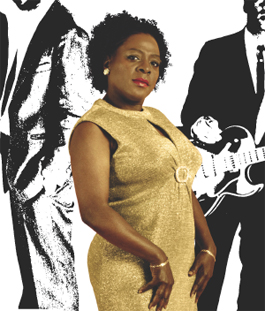
SHARON JONES AND THE DAP-KINGS: perform Friday (Aug. 7) at 8:30pm on the Main Stage in Plaza de Cesar Chavez Park.
All That Jazz
Big names and new talents overflow downtown for annual at&t San Jose Jazz Festival
By Metro Staff
Finally Soul'd Out
Sharon Jones & the Dap-Kings bring their brand of authentic funk and soul to San Jose
THIS FRIDAY, Sharon Jones & the Dap-Kings will play a rare set at this year's AT&T San Jose Jazz Festival. And while South Bay residents aren't too tuned in to retro-soul, they'll get a sharp introduction once the stage is lighted, cymbals crash and horns blare.
Sharon Jones & the Dap-Kings are a funk soul troupe from Brooklyn, New York, though most of their time is spent touring. Ms. Jones' stage energy—dancing and singing with ridiculous vibrancy—has been as equally heralded as her killer vocals. Her band, the Dap-Kings, consists of go-to studio musicians who famously backed Amy Winehouse on her acclaimed album Back to Black.
The group's 2007 album, 100 Days 100 Nights, sold more than 100,000 units, a huge feat for a band without major-label funding. Sharon Jones & the Dap-Kings are currently perhaps the largest, most authentic funk and soul group in the country.
In a New York Times interview, Sharon Jones said she was deemed "too short, too fat, too black" and, after turning 25, "too old" to be in the music industry. Yet Jones, now 53, is at her busiest ever. Here's a quick talk I had with Jones as she and the mighty Dap-Kings were en route to San Jose.
METRO: What is it about funk and soul that's grabbing people's attention again?
SHARON JONES: Well, it's real music. It's none of this digital or synthesized stuff you hear all over the radio. You can hear the grit in the singers' voices as they're singing in key to real musicians and live instruments. I think that has a lot to do with it. Nowadays, not everyone wants to go out and sing soul music—but many can't even if they wanted to. Pure soul music is hard to do.
Your live show doesn't seem easy either, working your butts off onstage every night. How do you maintain that energy level?
I don't sit and think about what I'm gonna do, that's probably why I'm still able to do it. We don't have routines planned out like everyone thinks we do. We just go out and do songs. We know which songs allow room for certain segments of the show, but that's about it. I feed off the audience, but other than that, when I bring people onstage, I'm just having a good time.
Has bringing people onstage ever gone wrong?
Oh, I've had some incidents [laughs]. I've had guys be too drunk and fall off stage. I've had women who I've invited onstage turn around and call all their friends up! Then I have to be like, 'Hold on, did I invite you up here?' The stage is like my home for the time I'm up there, so it'll be like if I just walk up in your home and invited my friends. So, I guess the worst thing is when I have to kick people off stage 'cause I don't like doing that.
What's the hardest part about performing day in and day out, especially doing all those big music festivals you guys do?
The traveling and not getting enough sleep is the most difficult part. Some of these festivals we play at only have Port-a-Pottys, which is terrible. Others don't have proper dressing rooms; I'm usually stuck in small rooms where curtains are hitting my head. Other than that, I look forward to it. A lot of these Dap-Kings are younger, so their perspective might be different. But for me, I'm 53 years old and don't know how many more years I have of running around and jumping on stages around the world.
You had time to act too? How was being in that Denzel Washington movie, 'The Great Debaters'?
It was just a short little part. I played a singer named "Lila." I had some music on the soundtrack too. Denzel was so nice, and it looks good on my resume [laughs]. I'd like to act some more, it was a fun experience.
Real quick—who are some of your personal favorite soul singers? What about them struck you?
Basically, I'm a fan of anyone who was on Stax or Motown. Everyone from James Brown to Otis [Redding], Aretha [Franklin], Patti [LaBelle], I could just go on. Back in the '60s, I was just 10 years old, but I remember liking it back then. That music is just natural and good—that's why we call 'em classics.
Speaking of icons, what were you doing when you found out about Michael [Jackson]?
My god, I was walking onstage to do a sound check for that evening's show. Someone texted me, and I ran off stage and told the rest of the guys. The last few shows, I made the guys do "I Want You Back." I think when you look at Michael, we should remember the talent—at least I do.
What can San Jose expect from Sharon Jones & the Dap-Kings?
Expect to see a band really enjoying what they're doing. I'd rather get paid less money and have a good time onstage than get paid a ton and hate it up there. A lot of people say we take them back in time too. What can I say? Be prepared [laughs].
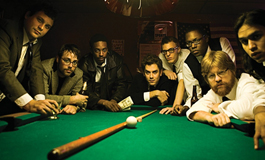
BLACK JOE LEWIS: performs Saturday (Aug. 8) at 2pm on the Main Stage, Plaza de Cesar Chavez Park, San Jose.
Meet Black Joe
Black Joe Lewis is on a mission to make the blues cool again. Just relax about his name.
BLACK JOE LEWIS just wants everybody to tell him what his name is. But despite the supposed Obama Effect, in which all of America is suddenly, magically cool talking about race, his white fans often get a little uncomfortable with the fact that Black Joe Lewis is, in fact, black.
"A lot of people think it's a racial thing, they're scared to say it," says Lewis, from his home in Austin. "It's pretty funny." So what is the name, really? A joke. And one conceived by the same friend who wrote the Black Joe Lewis fan favorite "Bitch, I Love You," which says a lot. All of Lewis' band members, with whom he's just released his second album, Tell Em What Your Name Is!, have similarly meaningless monikers: Sugarfoot Watkins, Big Show Varley, Wild Bill, Rooster Andrews, Slyder, McKnight the Night Train and Sleepy Ramirez.
But even though it may be meant as comic relief—"We used to do all this comedy stuff," says Lewis—the name Black Joe Lewis is fitting, too. It harks back to a vanished era of great blues nicknames for legendary players like Howlin' Wolf and Lightnin' Hopkins, who were big influences on him. Half of this guy's Top 8 MySpace friends are in fact dead bluesmen with great nicknames: Wolf, Hopkins, Slim Harpo and Bunker Hill (OK, no one is sure if Bunker Hill is actually dead, but that's another story).
With one foot in the blues, the other in driving rock & roll, and hips firmly in funk, it might be fair to wonder what makes Lewis' band a good match for the San Jose Jazz Festival, or any jazz festival. He shrugs—such distinctions have little to do with the reality of festivals any longer.
"I think they just call festivals 'jazz' sometimes," Lewis deadpans. "It's just a word to make it sound cool."
But there is a side to Lewis' music that fits in the jazz camp—his ensemble is clearly influenced by the masters of rhythm and improvisation who surrounded James Brown. Lewis has no doubt why his band gets so many comparisons to Brown's.
"Because we were trying to copy them," he admits.
It took him a long time to get his musical style on the good foot, as J.B. would say. Growing up in a small Texas town, Lewis heard some blues and soul, but he was almost old enough to drink before he even picked up a guitar.
Even then, it was out of idle curiosity; he worked in a pawn shop frequented by musicians putting their six-strings in hock. Eventually, he started fooling around with them. His first band was straight blues, and he admits it was mostly just a chance to learn how to play.
"My first shows were so bad. I'm surprised they let me come back," he says. "We never practiced, and we played the same songs every Sunday night for two years. It was ridiculous."
It did, however, bring him together with guitarist Zach Ernst, who asked Lewis to open for Little Richard. Sensing he was destined for bigger and better things, Ernst pretty much stole him away to be the frontman for Black Joe Lewis & the Honeybears, who hit the stage just a month later and continue in nearly the same form today.
"We had our first practice," says Lewis, "and almost everybody [from it] is still there."
Over time, he developed his distinctive singing voice. When he started out, he says, it was more like a nervous mumble. Now, it's a roar that recalls his blues idols, although he realizes that most of his fans probably haven't heard of Lightnin' Hopkins.
"That's why I gotta bring him back," he says. It's part of his mission, along the lines of what the Rolling Stones did for Howlin' Wolf. "If it weren't for them, the blues wouldn't have been rediscovered in America. Sometimes you need a fresher version of something to get people to remember it's actually cool."
Surrounded by top-notch players and now signed to a major label, Lewis is suddenly cool himself. The new album is a short, sharp rave-up that draws on stacks and stacks of Stax, a little R.L. Burnside, Brown and plenty of excellently nicknamed greats.
"We've been getting a lot of attention lately. We went to Europe, and there were people coming out left and right," he says. "It's 'cause all they got is that electronic crap."
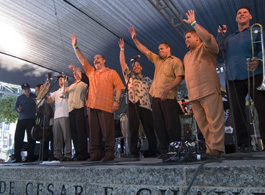
Photograph by Peter Maiden
THE SPANISH HARLEM ORCHESTRA: performs Sunday (Aug. 9) at 6pm on the Main Stage in Plaza de Cesar Chavez Park.
Harlem Calling
After a lifetime of music, Oscar Hernandez and the Spanish Harlem Orchestra are taking salsa worldwide
THE 47th Grammy Awards were good to Oscar Hernandez. Held at Los Angeles' Staples Center in February 2005, it wasn't the first time Hernandez found himself strolling the red carpet, but it was his most memorable. Compared to his inaugural campaign in 2002, which yielded a nomination for Best Salsa Album, the 2005 Grammys represented an unparalleled career milestone.
That evening, the bandleader and pianist for the Spanish Harlem Orchestra was handed popular music's highest honor: a Grammy Award for the group's 2004 album, Across 110th Street.
"To finally get that recognition after 30 years of living my life through music was an incredible experience," Hernandez reflects. "I've been paying my dues as a musician in all aspects of life, persevering through the good times and the bad times. Now I'm able to have success traveling the world, playing the music I want to play with the musicians I want to play with. It's really a blessing."
Three decades ago and a continent away from the star-studded threshold of Los Angeles lies the place closest to Hernandez's heart: Spanish Harlem, or simply El Barrio. Spanish Harlem was once the epicenter of a Latino culture populated primarily by emigrants or descendents of emigrants from the Caribbean isles of Puerto Rico, Cuba and the Dominican Republic. Although waves of new immigration and the constant changes that characterize contemporary American society have since eroded much of what was once considered one of the most artistically vibrant neighborhoods on earth, the nearly mythical wonders of Spanish Harlem still dwell in the souls of people like Oscar Hernandez.
"Spanish Harlem is as important to Latino culture as black Harlem is to black people," Hernandez says. "These are places where people came together to develop cultural identities through art and especially music. I grew up in the Bronx, but I spent so much of my time [in Spanish Harlem], going shopping, visiting family, going to social events—everything took place there. I think El Barrio became a microcosm for Latinos in New York City."
Surrounded by the music of greats like Latin jazz player Tito Puente, bandleader Tito Rodriguez and salsa icon Willie Colon, Hernandez quickly found himself drawn to music with astonishing force. At every turn, it seemed the pulsating rhythms of El Barrio beckoned him closer.
"I would hear [Latin music] constantly—from every house window, every club. I realized that there was a certain richness and beauty in the music that, to this day, makes me think that [Latin music] is the best music in the world."
In 1966, Hernandez began playing trumpet in the local Boys Club before switching to piano two years later. Aside from a few pointers given to him by friends and local musicians, Hernandez learned the instrument on his own accord, developing enough precision and flair to earn a spot in several local bands, including Joey Pastrana's La Conquistadora.
The group went on to record an album, and in 1972, the vocalist and composer Ismael Miranda recruited Hernandez to play in his band, which catered to the growing trend in Latin Boogaloo. From Miranda's group, Hernandez moved on to Ray Barretto's jazz band, where he was introduced to the music of Charlie Parker and Dizzy Gillespie, both of whom would continue to influence Hernandez throughout his career.
After six years with Barretto, Hernandez hooked up with salsa singer Ruben Blades and joined his group Seis Del Solar. While playing in Blades' band, Hernandez enrolled in the City University of New York, earning a Bachelor's Degree in Music a few years later.
For the next two decades, Hernandez embarked on a music career that branched from pianist to composer, and eventually to arranger and producer. As his demand as an instrumentalist and producer grew, Hernandez found himself working with a veritable who's who of Latin stars, from the Queen of Salsa Celia Cruz to pop star Julio Iglesias. But at the turn of the millennium, Hernandez began to crave the childhood passion that had become his lifelong love: salsa.
In 2000, Hernandez set out to put together a group that only a well-connected member of the Latin music community could hope to assemble. The resulting 13 members of the Spanish Harlem Orchestra are among the most talented musicians ever to play the clubs of Spanish Harlem, and the band's 2002 debut album, Un Gran Dia en el Barrio, launched them toward greatness. The goal was straightforward: buck the pop-salsa trend and revive the classic sound of the '50s, '60s and '70s. In other words, bring salsa back to its roots.
Led by vocalists Frankie Vasquez, Herman Olivera and Ray de la Paz, the debut captivated a worldwide audience and earned Hernandez his first Grammy nomination. The group's 2004 follow-up, Across 110th Street, once again delivered a batch of irresistible throw-back salsa tunes, spiked with a contemporary flair that earned the Spanish Harlem Orchestra a Grammy Award. On the heels of their newly gained superstardom, the Spanish Harlem Orchestra toured the globe incessantly, playing shows all across Europe, Australia, and even places as unobvious as Israel and Ireland.
The band's latest release, 2007's United We Swing, explores new territory while still remaining firmly entrenched in the rhythm and melody of classic salsa. A handful of contributors found their way onto the disc, none more intriguing than Paul Simon. Hernandez and Simon, who became friends while working together on a Broadway musical in the late '90s, collaborate on a rendition of Simon's "Late in the Evening." "I was talking to Paul one day, and I asked him if he'd like to get in on a record I was putting together, not really expecting that he'd have much interest," recalls Hernandez. "He said, 'Absolutely, what do you have in mind?' We wrote the arrangement two weeks later. The beauty of the song is that it not only represents him, but it manages to represent the Spanish Harlem Orchestra at the same time."
In between work on a new and as yet unnamed album, the Spanish Harlem Orchestra will embark on a U.S. tour, beginning at the San Jose Jazz Festival. No stranger to the Bay Area, Hernandez says that he has played at a number of local venues, though never the San Jose Jazz Festival.
"Some of our biggest fans are in the Bay Area," he says, "and it's always a great place for us to play. I love the area in general; it's similar to New York in that there's a lot of culture and art, and just a lot of energy."
Asked if audience members should remember to wear dancing shoes, Hernandez showed the seriousness in his devotion to salsa: "You know, a lot of people think of salsa as purely dance music, but it's so much more than that. We played a venue once where the crowd wasn't allowed to dance, and they got upset and started complaining. I had to tell them that it's OK to sit down and listen—you can still appreciate it."
Of course, nobody will blame you for wanting to jump up and dance at Sunday's show—least of all Hernandez.
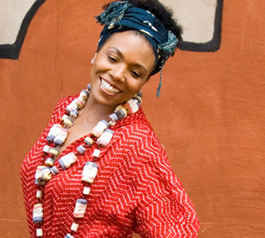
Photograph by Peter Maiden
THE SPANISH HARLEM ORCHESTRA: performs Sunday (Aug. 9) at 6pm on the Main Stage in Plaza de Cesar Chavez Park.
The Rest of the Best
Dee Dee Bridgewater
Sunday, 4pm, Main Stage
Sort of like Eartha Kitt without the purring, Dee Dee Bridgewater has followed jazz music around the world. Her last three albums covered the music of Mali, France and Kurt Weill—if there's a country or composer she hasn't paid tribute to in song, please sit tight and she will get to you. And yet, Bridgewater is perhaps best known for her Broadway work, especially as Glinda the Good Witch in 'The Wiz' and as the first African American woman to play Sally Bowles in 'Cabaret.' But her unofficial position as ambassador of jazz is clearly job one.
Allen Toussaint
Saturday, 6pm, Main Stage
This guy is a true legend; he pretty much owns New Orleans R&B. His writing and producing made the Neville Brothers what they are today, and his songs have been covered by the Rolling Stones, the Who and dozens of others. Recently, he collaborated on a post-Katrina album with Elvis Costello.
Supertaster
Saturday, 10pm, Jazz Beyond Stage
San Francisco's Jazz Mafia collective is like a factory for fresh ideas. Supertaster is the newest group to come out of it. The incarnation for the festival features Adam Theis on bass, brass and electronics, Joe Bagale on drums and Karyn Paige on vocals. Their two-part Jay-Z medley is incredible, but they're currently working on an album of all-original songs.
Midival Punditz
Friday, 8pm, Jazz Beyond Stage
Jazz has a lot of niches, but there's nothing this weekend quite like the MIDIval PunditZ, who play Indian electronic music. Chances are their audience at the Jazz Beyond stage has never heard a sitar or a sarangi sound like this before. They will perform with New York's Karsh Kale, who's also found fame mixing traditional Indian music with electronica.
The Bay Area Latin All-Stars
Sunday, 6pm, Latin Jazz Stage
The festival offers lots of options for lovers of Latin jazz, and it would be morally wrong not to give Pete Escovedo (Saturday, 4pm, Main Stage) a mention. But one of Escovedo's own favorites is tromponist Wayne Wallace, who will perform solo (Saturday, 6pm, Latin Jazz Stage) as well as with the Bay Area Latin All-Stars, a group of top players like flutist John Calloway, percussionist and vocalist Jesus Diaz and pianist Murray Low. They blend their expertise in everything from Afro-Caribbean to salsa to timba and more.
Send a letter to the editor about this story.
 |
 |
 |
 |
 |


