



home | metro silicon valley index | movies | current reviews | film review
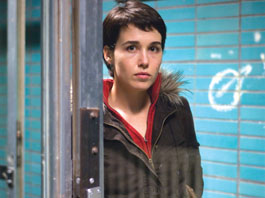
Photo by Christine Plenus, © Courtesy of Sony Pictures Classics
KEEPING IT TO HERSELF: Arta Dobroshi plays the troubled heroine of the Dardenne Brothers' 'Lorna's Silence.'
Love for Sale
In 'Lorna's Silence,' a foreigner gets caught between dangerous men and her own feelings.
By Richard von Busack
LORNA (Arta Dobroshi), the heroine of Lorna's Silence, seems to be an average poor young girl in urban Belgium, a part-time employee at a dry cleaning plant. But Lorna is Albanian, not actually Belgian, and she has married a citizen for money. She has been sponsored in this citizenship racket by dangerous Russians. They have further plans for her. Lorna's husband is a shambling addict named Claudy (Jérémie Renier)—a perennially junk-sick blond scarecrow, unable to clean up. She treats Claudy like a messy and disliked child. The marriage is in the final days, since her citizenship will be official soon. Complicating matters further, Lorna has a boyfriend waiting in line for her marital life to end.
Once she has her citizenship, Lorna decides the best way out of the marriage is to get an automatic divorce under a law that grants one to a battered wife. But if Claudy can't control his habit, he's also not violent; he can't bring himself to hit her, even if she tells him to do it. He cares for Lorna, his wife in name only. And reacting to his emotional turmoil, Lorna makes an impulsive gesture. She tries everything she knows to save Claudy from his drugs, at the risk of dooming herself.
The state of the summer's movies being what they are, I'd love to announce that the new Dardenne Brothers offering is a major film, but it's just a good—sometimes damned good—story, based on an authentic-sounding criminal scam that hasn't made it into the movies before. Telling it, Jean-Pierre and Luc Dardenne violate their previous furtiveness and subtlety—those qualities that made them, by miles, the most interesting filmmakers alive when charting the troubling demands of a Christian ethos. In an interview, co-director Luc says that Lorna's Silence is about "a religious believer of sorts, even if God is dead." That the theme can be made just this explicit is the problem. People who say this kind of thing don't believe God is dead. And they don't throw much of a bone to those who never thought God was alive in the first place.
One wonders if the Dardennes are taken by the Romanian New Wave, or if Lorna's Silence might be an answer movie to 4 Months, 3 Weeks and 2 Days. Dobroshi does a terrific job; she's just remote—and silent—enough to make us almost believe Lorna's turnaround. Ideally, we'd like to have it both ways. The Christian viewers could feel that they were seeing a miraculous softening of a hard heart. Worldly viewers could feel that they were watching a tale of how kindness is a virtue only the well-fed can afford. It's always best never be able to tell whether a person is holy or crazy. One way to see Lorna's Silence is this: It's about a girl who cracks under the strain of a dangerous scam and manifests this crack-up by acts of compassion. But the film teeters into behavior we have to take on faith because it's absurd: a sudden sacrifice, a sudden conversion to belief in the sanctity of all life (even unborn life). It's a sharp turn this movie can't quite execute, and it means that for the first time the Dardennes can be accused of melodrama.
 LORNA'S SILENCE (R; 105 min.), directed and written by Jean-Pierre and Luc Dardenne, photographed Alain Marcoen and starring Arta Dobroshi and Jérémie Renier, opens Aug. 7 at Camera 12 in San Jose.
Send a letter to the editor about this story.
 |
 |
 |
 |
 |
