



home | metro silicon valley index | music & nightlife | band review
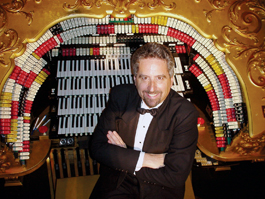
KEY FIGURE: The silent era never sounded better with Dennis James providing music and effects.
The Sounds of Silents
Organist Dennis James adds swashbuckling sounds to a special screening of Douglas Fairbanks' 'The Black Pirate'
By Richard von Busack
CERTAINLY, we are always looking for those experiences we can tell our grandchildren about. There is one this very Friday that costs only $5. Dennis James appears at the California Theatre's Wurlitzer organ in downtown San Jose, accompanying the first great pirate movie: Douglas Fairbanks in 1926's The Black Pirate.
Fairbanks was the premier action star of the 1920s, the image of the suave adventurer, the avatar of James Bond and Jackie Chan. In this family-friendly tale of disguise and revenge, Fairbanks plays the duke of Arnoldo, avenging his father's murder by infiltrating a band of cutthroats.
"Pirates demand color," Fairbanks said at the time. "Stories of modern life, war stories, even romances like Robin Hood and The Thief of Baghdad might be told in black-and-white, but what pirates needed was something more vivid. It was impossible to imagine them without color." The Black Pirate is in two-strip Technicolor, with burnished antique tones meant to recall the oil paintings of the 1700s.
An anonymous, misguided IMDb fan of The Black Pirate notes that here is "about as good a pirate movie as you can make without sound." Silent is one thing this movie won't be, when James works the Wurlitzer.
James has restored the original full orchestra score of The Black Pirate by Mortimer Wilson. He notes, via email, "I'll be incorporating several of the Wilson themes in my own solo-organ compilation score ... adding generic silent-film music published compositions to make up the rest for the San Jose performance next week."
After some 40 years, James is secure in his reputation as the No. 1 silent-film organist in the world. The praise for James goes far and wide. He has taken on monumental silent films: Abel Gance's Napoleon and Fritz Lang's Dr. Mabuse trilogy and Nibelungen epics, grueling four- and five-hour marathons.
But James is also an expert in the delicate touches necessary for tragedy. The silent star Lillian Gish once said that James' playing of the score for King Vidor's La Boheme, a story of love and loss, "brought tears to my eyes ... his score was just what we intended it to be when we made the film."
James "is without doubt the greatest practitioner of the art of solo silent-film accompaniment," wrote the expert Stephen Salmons of the San Francisco Silent Film Festival. Among James' accomplishments is being the house organist at Hollywood's El Capitan Theater. Even with a touring schedule that takes him from Australia to Oklahoma, James has a side interest—the sonorities of eclectic glass instruments like Ben Franklin's armonica and the cristal de bachet.
But it is on the Wurlitzer—a church organ on steroids, with ranks of pipes and powerful electric lungs—that James is most popular. In its day, there were some 2,000 of these Wurlitzers used to accompany the images in movie theaters.
These massive organs contained many sound effects. Mary K. Miller in Smithsonian magazine catalogued them: "Train and boat whistles, car horns and bird whistles. ... Some could even simulate pistol shots, ringing phones, the sound of surf, horses' hooves, smashing pottery, thunder and rain."
The music itself whispers and screams. It ranges from breathy airs to the spine-rattling crescendos necessary for the biggest moments in silent cinema: images of unmasking, of romantic declaration, of death.
Think of Fairbanks' Zorro revealing himself to be the man least suspected, Don Diego; the Phantom of the Opera unveiling his disfigurement, or a locomotive's plunge into the river in The General. Now think of the sounds that go with them. To paraphrase Mark Twain, the difference between a silent movie with live Wurlitzer accompaniment and one without is like the difference between lightning and a lightning bug.
THE BLACK PIRATE (1926), silent with organ accompaniment by Dennis James, screens Friday (Aug. 7) at 7pm, with the Laurel and Hardy short 'Two Tars' before the feature, at the California Theatre, 345 S. First St., San Jose. Admission is $5. (408.792.4194).
Send a letter to the editor about this story.
 |
 |
 |
 |
 |

