



home | metro silicon valley index | movies | current reviews | tv review
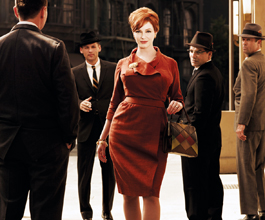
FORCE OF NATURE: Christina Hendricks' Joan navigates the changing mores of 'Mad Men' with panache.
Mad About 'Mad Men'
Season 3 finds the men and women of 'Mad Men' in free fall that echoes our own era
By Richard von Busack
DUPLICITY. Mad Men (Sundays at 10pm on AMC) continues its examinations of the human urge to keep the public and private face separate. Its third season is an exploration of covertness, with a depth and humor we're not getting much in the movies—at least not with this kind of juice and this kind of cruelty. The series focuses on a group of advertising executives in early 1960s Manhattan, but like everything else that happens on this show, there's a reverse angle on even this simple description. The talent is embattled. The firm of Sterling Cooper is layoff-ridden, and the British ad agency with which they've merged has placed a boss (Jared Harris) on-site to begrudge the cost of every paper clip.
No one in the show has solid ground under his feet. Thus the show's titles, a nod to Saul Bass' graphics for the titles of Hitchcock's Vertigo. Accompanied by a theme that sounds like a house-music version of Sibelius' Valse Triste, a man's silhouette plummets down a canyon of cartoon skyscrapers, flickering with advertising images.
I want to double back again: I've just written that no one has solid ground under their feet. There are two who, at first glance, seem to be grounded, and they are the agency's two namesakes. One is Bertram Cooper (Robert Morse), the lofty, elderly shogun. Then again, Cooper recently turned up asking for a drink in Don Draper's office with no good reason for sitting down when he should be off on his errands—this kind of pause in any serial drama flags us that Cooper himself may be dead soon.
The younger partner, Roger Sterling (John Slattery), is in the midst of marrying a girl way too young for him. This maneuver comes too soon after a serious divorce, and he has previously suffered a heart attack. More unforgivably, he was cheating on both previous wife and mistress in a sense, because of having seduced and abandoned the red-haired secretary/juggernaut Joan (Christina Hendricks).
Joan's recent ooh-la-la accordion performance of Cole Porter's "C'est Magnifique" has been a YouTube hit. Joan is a work of artifice, an array of larger-than-life curves, glazed with a scarily "ladylike" demeanor. Who knew that there was something in her that wanted to be someone's pampered French poodle? On the other side—always the reverse angle in every scene—Joan flashed a more customary mute look of anger at her fiance for pushing her to play music in front of his parents.
Duplicity is also all over the ad business itself. Clients are wooed when they're there and then subject to all kinds of contempt after they leave. The smartest person at the agency has to find his own equilibrium. Don Draper (Jon Hamm) has the most to hide—a rural background so squalid he can only hint at when unbuttoning himself with strangers. And he has a few other secrets. Hamm is one of the few inarguable reasons to own a television set today. To longtime TV watchers, there's something in Hamm's Draper inherited from Rod Serling of The Twilight Zone: he, too, is a sardonic smoker with a slightly choked voice, Brylcreemed hair and a chronic wince at the human condition—may be just the smoke getting in his eyes. The show's ever-slipping center, Draper is attuned to trouble. It is 1963 in the third season; something is happening, and Draper almost knows what it is. As a covert man himself, he harbors a sneaking sympathy with the growing American underground—the people left out of the Ivy League scheme of things.
The show insists that the single most important difference between 2009 and 1963 is the sexual politics. The sharp, lean writing brings us the alienation of the past—what a different country it was, how frightening it was. Again and again, we register the samurai-like expressionless-expression of the women, verbally slapped down every time. What goes on here is the exact opposite of the chortling deference to power in Billy Wilder's comedies of the early 1960s.
The obviously gay Sal (Bryan Batt) has his own role to play in these sexual politics, and he is on the verge of being found out and ruined. The striving Peggy (Elisabeth Moss) is trying to free herself, to seize male privilege. Joan's own pushiness can gets her so far but no further. As for Betty (January Jones), Don's wife: one episode was an essay in what you could call "unnatural childbirth"—Don kept from the delivery room, the child pushed out of her when she's conked out on opiates.
While this unpredictable show gives no clues, it's clear that the trauma of the Kennedy assassination will be catalyzing matters in the year's wrap-up. Hearing all this, a younger viewer may just moan, dear Jesus, not the 1960s again. But in watching Mad Men, one final reverse angle suggests itself. The show's essence isn't about the Kennedy era but about all the 2009 questions: the struggle between the progressive and the regressive, between those who take the current and those who swim backward against it. There are no paragons on Mad Men, but the show does argue that the tide is won not by the strong but by the sensitive.
Send a letter to the editor about this story.
 |
 |
 |
 |
 |
