![[Guide to the Tech]](gifs/techhead.jpg)
[ The Tech | Metroactive Central ]
Behind the Scenes
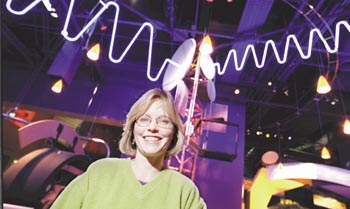
Well-Connected: Exhibit developer Rachel Hellenga says the communication gallery is designed to show visitors how networks affect their daily lives.
Tech exhibits cover everything from cell division to cell phones
By Jeff Kearns
Ever since Wayne LaBar joined The Tech's staff more than four years ago, he's been developing and assembling a collection of exhibits to make the museum the perfect expression of Silicon Valley's strange intersection of technology and culture.
"We're trying to show the special side of the valley," LaBar said, standing in the open atrium in the middle of the new building as hard-hatted construction crews and exhibit developers scurried around not too long before opening day.
LaBar, The Tech's director of exhibit implementation, and his staff have been researching the exhibits by immersing themselves in the culture of techno-fetish. Their product, in turn, will literally put people inside the machines. At one exhibit, which LaBar says is unique to The Tech, visitors will be able to stick their hands into a tub of water and perform an ultrasound on themselves. And as visitors pass into the life sciences section of the building, images of their bodies will be projected onto screens strung from the ceiling. Elsewhere, visitors can create a 3-D computer-generated model of their own heads.
The four galleries--Communication: Global Connections; Exploration: New Frontiers; Innovation: Silicon Valley and Beyond; and Life Tech: The Human Machine--all aspire to be a kind of killer app in visitors' lives by changing the way they think about technology.
"The goal is to inspire the innovator within," LaBar says. "It could be for a school kid to come here and get hooked on this stuff ... or for adults who might realize they can hook up their computer by themselves."
Downstairs in the communication gallery, exhibit developer Rachel Hellenga says it's all about "revealing what's normally invisible and showing how your daily activities are often connected by networks that you normally don't see, or see completely."
The entrance to the gallery is dominated by a 12-foot dish antenna attached to a joystick, which visitors must to align with a scale-model satellite hanging in the rafters in order to hook up the signal for a "live" news feed on closed-circuit television.
Next to that, visitors can do their best to approximate the millions of choices a cell phone network has to make every few seconds by determining which antenna is closest to the signal. Visitors check the signal strength of the transmission, then ring one of the three cell phones (worn by a classy, lime-colored trio of mannequins) they believe is closest to the signal.
Although it may cause confusion among phone-toting visitors, Hellenga says the point is to show that hitting the "send" button on a mobile phone doesn't send out a signal that travels magically through the air to another handset; rather, the signal travels through an intricate labyrinth of electronic systems before reaching a distant ear.
Hellenga also set up a digital studio where visitors use a bar code on the back of their ticket stubs to set up their own multimedia presentations by traveling between stations that let them record their voice and photo, edit a movie and act out the motions of an animated monkey in a digital world.
The gallery also includes an ethics display on media issues such as the V-Chip and Web-filtering software.
Ethics issues are also hardwired into the Life Tech gallery, where designer Adam Aronson makes a point of showing off the same gee-whiz types of medical innovations that help the medical ethicists keep their jobs.
In the gallery, visitors can practice a simulated version of "keyhole surgery," which is the latest minimally invasive operating technique--and strangely suggestive of a 21st-century version of the Operation board game--or play detective and solve a murder by working with DNA samples taken from biological "clues" found at the scene of the crime.
Visitors can also use the familiar interface of the scroll bar to travel through something rather unfamiliar: the inside of a human body. Specifically, it's the body of a prisoner (a.k.a. Mr. Baloney Man) executed on Texas' infamous death row who agreed to leave his body to science. His corpse was frozen and sliced away one millimeter at a time and scanned into the computer, leaving a 3-D cyber corpse medical professionals have called one of the most useful tools yet devised for viewing the human body.
Mr. Baloney Man will be ready to show himself off when The Tech opens on Halloween.
[ The Tech | Metroactive Central ]
Copyright 1994-2025 Weeklys. This page is part of Metro Silicon Valley's historical archive and is no longer updated. It may contain outdated information or links. For currently information, please go to MetroSiliconValley.com home page, e-edition or events calendar.
![[whitespace]](/gifs/whiteline2.gif)
Photographs by Christopher Gardner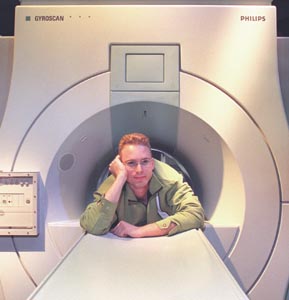 Scanning the Limits: Designer Adam Aronson made sure the exhibits in the Life Tech gallery address the ethical issues surrounding advances in medical technology.
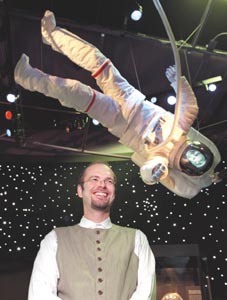 Inner Space: Tech exhibit director Wayne LaBar and his staff have developed four galleries where visitors can literally put themselves inside the machines.
Special addition to the October 29-November 4, 1998 issue of Metro.