![[Guide to the Tech]](gifs/techhead.jpg)
[ The Tech | Metroactive Central ]
A Mountain of a Movie
IMAX master presents a chilling experience
By Steve Enders
People who have been lucky enough to see it say Greg MacGillivray's new IMAX epic Everest leaves nothing to the imagination.
Even temperature-controlled theaters feel cold during the film, they say, as the camera takes audiences to 29,028 feet. Few can breathe here, and temperatures average below zero.
The visuals are left to the imagination in Jon Krakauer's best-selling book, Into Thin Air. But they're brought to life in this 44-minute thriller.
Everest, made by MacGillivray Freeman Films, opens this week at The Tech's Hackworth IMAX Dome Theater.
Although MacGillivray's crew in 1996 wasn't with Krakauer, who nearly lost his life in a storm that killed some climbers he was documenting, the team was just below, waiting out the same storm.
Statistically, one in every four climbers dies trying to conquer the mountain that, many believe, has a spirit that's angry with the climbers who choose to defy her face.
"With the kinds of films we make," MacGillivray says of the opportunity to film the tragedy, "we use a story as the framework. As other things happen that are more compelling, then we get it on film."
David Breashears and crew, hired by MacGillivray to shoot the film, ditched the cameras and helped with efforts to rescue Krakauer's team. Eventually they made it to the summit and recorded the event with a specially designed 42-pound IMAX camera.
MacGillivray says he would have ordered his crew to shoot the tragedy if the cameras had been there. Instead, the film carries a series of still shots with voice-overs by the few members of Krakauer's team who lived to tell about it.
The film won recognition around the world as a physical accomplishment and technological achievement because of the cameras that were used in the cold, high altitude.
Everest partly follows Jamling Norgay, a Himalayan sherpa who longs to ascend the world's highest mountain in the crampon-prints of his father, Tenzing, who summitted with Edmund Hillary in 1953.
Everest is one of 22 films made by MacGillivray's company, and might top the mark set by his film To Fly, the highest-grossing documentary ever made. The film still plays regularly at IMAX theaters, including the Smithsonian Air and Space Museum in Washington, D.C.
An estimated 15 million people have spent $60 million to see Everest. Since its debut in March, the film has been one of the top 20 highest-grossing films in the nation, each week competing with big-budget Hollywood movies. Right now it's at No. 14.
"Yeah, our little documentary is up there competing with these guys," MacGillivray says, laughing.
MacGillivray, 53, first picked up a camera when he was 14 years old, as his fascination with still photography was overrun by an urge to shoot motion pictures.
A surfer himself, MacGillivray began documenting the exploding Southern California surf scene. His first film, The Cool Wave of Color, debuted when he was an 18-year-old physics freshman at UC-Santa Barbara.
At UCSB, he made The Performers, a technically groundbreaking surf film that garnered a small profit.
"People came to it, and it was at that point that I realized I could make a living at that," he says, explaining that he saw those films as an artistic and technical challenge, not just shooting a sport he was interested in.
Since then, along with the documentaries he's made, MacGillivray has been involved with shooting films including Big Wednesday and The Shining.
It was after The Performers, though, that he met and teamed up with Jim Freeman, who never surfed but was involved in Hollywood.
Their vision led to unique aerial shots, which earned the company an Oscar nomination for Jonathan Livingston Seagull.
"We were known as the leading aerial photographers," he says. "We could really give the audience the sensation that they were flying."
NASA appreciated their technique and asked the filmmakers about working on To Fly. Later, NASA approached MacGillivray again, this time about shooting in space. MacGillivray reluctantly declined after consulting his wife.
As MacGillivray prepped for To Fly, IMAX began to shape up as an impressive way to capture big action.
Although cohort Jim Freeman died in a helicopter crash 22 years ago while scouting a location for a Kodak commercial, MacGillivray carries the full name of the film company as a tribute to his late friend.
"Whether it's taking a 35 mm out under a huge wave at Waimea or hanging a camera out of airplanes, you've got to be cautious and careful," MacGillivray says.
MacGillivray realized he wasn't fit enough to climb Mt. Everest, so he hired climbing experts, including Breashears and Ed Viesturs, and spent a year teaching them how to shoot with IMAX gear.
From his offices, MacGillivray controlled the film via a satellite phone link and a fax machine.
"We were working from a tight script and story board, so I knew what shots I needed," he says.
Having the self-control to step back from filming was tough for MacGillivray.
"I felt a little frustrated as a skier, surfer and diver that I couldn't be behind the camera, but I'm not a climber. For that reason, the main goal was to put together the strongest, most intelligent climbing team there was, so there was little chance we would fail."
The team didn't fail--and the results can be seen at The Tech.
[ The Tech | Metroactive Central ]
Copyright 1994-2025 Weeklys. This page is part of Metro Silicon Valley's historical archive and is no longer updated. It may contain outdated information or links. For currently information, please go to MetroSiliconValley.com home page, e-edition or events calendar.
![[whitespace]](/gifs/whiteline2.gif)
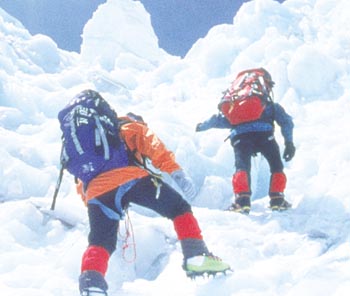
Peak Performance: Watching 'Everest' in The Tech's Hackworth IMAX Dome Theater, audiences should feel as though they're making the climb themselves.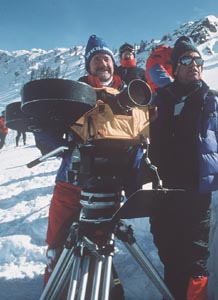 Freeze Frame: Greg MacGillivray sets up a shot for 'Everest.'
Special addition to the October 29-November 4, 1998 issue of Metro.