|
 |
|
[ East Bay | Metroactive ]
Image-Conscious
Keba Konte talks about microphones, Africa, and self-promoting
By Gabriel Serpa
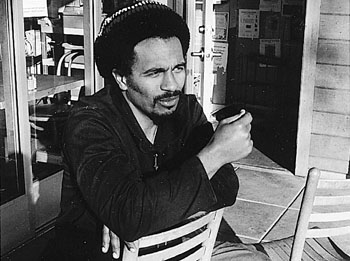
On a sunny winter afternoon, Keba Konte strolls up to the Temescal Café, where we sit and talk about life and art. Konte is a mixed-media artist who uses photographs in a variety of conditions to tell stories. He defines his work as "photomontage" -- his photos transfered onto unconventional materials. Photomontage on Wood, his first book, is a collection of work from 1998-2001. As a trained photojournalist and world traveler, Konte immersed himself in taking pictures and recording sounds on his trips. Our interview begins with technical difficulty as I bang the recorder on the table. This doesn't rattle Konte, instead he easily begins to relate one of his own recording experiences.
UV: Testing, testing. Maybe you can school me on how this thing works.
KK: Actually, I'm the OG. In 1994 I was in South Africa at the elections of Nelson Mandela and I was walking around with a microphone, interviewing people in the street, getting ambient noises, and recording Nelson Mandela's inauguration speech.
UV: Was your trip a pivotal moment in your life? A lot of your artwork comes from your trips.
KK: Well there were several trips; the first was the most pivotal, when I went to West Africa in 1992. Before I had gone I was studying about Africa, revolution and culture. To be in Senegal was just such a beautiful place and culture. The work that I produced on that two-month trip was an intense period, I can see now that I was inspired and the location was rich to photograph that I am still drawing upon those images.
UV: Would you expand on the transition from a photojournalist to an artist?
KK: While I was studying photojournalism at San Francisco State, I was also studying art photography, welding, print-making, and experimenting a lot on my own. Even as a kid I was building robots or drawing, so it wasn't so much of a transition. Also, when I was doing the photojournalism, at the parallel time I was working at commercial photography, doing album covers for Suga-T and her whole family, Master P, and the whole Bay Area hip-hop underground gangsta scene.
UV: Would you elaborate on some of the themes of your artwork?
KK: The overall tone of the work is sort of melancholy and political. I would like to think of Jumping Over Places I Would Rather Not Be, as a statement I try to drive home in a lot of my work, which is the resilience of African people around the world. For example, in this particular image a child is making an impossible leap over a cemetery and behind the cemetery echoes the same shapes and materials of the city, Johannesburg, South Africa. And you can see in his jump with his arms outstretched, he is going to make that jump, and I believe he will. That is symbolic for myself and my people as a whole, of overcoming some incredible obstacles.
UV: What type of themes do you expect in the future?
KK: In the near future I would like to do more public arts, and when doing public artwork I think history is a strong element and the continuity of history. Africa is my thing. That's my culture and what I'm fascinated with. And I think so often the African experience has been so misrepresented. And now I have positioned myself to where I can create works that will be seen and thought about by a lot of people. The whole idea of doing the public art is driving that point home, of African history and the African diaspora.
UV: Looking at your work I felt the African and the African American were juxtaposed. Do you believe that to be true?
KK: I don't always purposely juxtapose them, a lot of times they are interchangeable. I have been influenced by the African culture; so you will see when the nails are sticking out (of the piece Resurrection) there is a very African esthetic that is seen in a lot of African fetish sculptures.
UV: How do you feel Paul Andrews and Robert Rauschenberg have influenced your own work?
KK: Well I started doing photo transfers and someone told me to check out Rauschenberg. I looked at his work and I think he influenced people who influ-enced me. So, I saw the indirect work in my work, which is using photography in a very nontra-ditional way, using photography to paint, to tell a kaleidoscope of images and not being bound to the print, the frame, the mate. He has inspired me to really open up the doors to mediums.
UV: Are there any local or national artists you would like to collaborate with?
KK: I would like to work with non-visual artists, like Will Power.
UV: How might that work?
KK: Well this is another thing that Rauschenberg and Romare Bearden would do: set designs, or maybe projections. I have done multimedia displays where I was building audio tracks and mixing in slides and videos of my own work. I have done pieces on the Million Man March and Bay Area Hip Hop. So, I could see collaboration coming out that way.
UV: How does the time and energy you put into your work boil down?
KK: About 90% business and 10% art. Starting off as freelance journalist and a commercial photographer, I was in business for myself. And I think a lot of artists are a little queasy around doing business or there is a taboo around handling money. I spent a lot of time self-promoting, like self-publishing a book through a black artist collective, Black Star Express. Or promoting my website (www.kebakonte.com).
UV: Your name is very poetic, so it must have a meaning?
KK: It's a Griot name; Griot is a traditional African storyteller. Their responsibility in the village and tribe is to tell stories and pass them on through the other Griot. That is where I see myself, telling stories and history.
Gabriel Serpa ([email protected]) is a freelance writer but in his spare time he hangs out with Geoffrey Chaucer and Tupac Shakur.
[ East Bay | Metroactive | Archives ]
Copyright 1994-2025 Weeklys. This page is part of Metro Silicon Valley's historical archive and is no longer updated. It may contain outdated information or links. For currently information, please go to MetroSiliconValley.com home page, e-edition or events calendar.
|
![[whitespace]](/gifs/whiteline2.gif) |