|
 |
|
[ East Bay | Metroactive ]
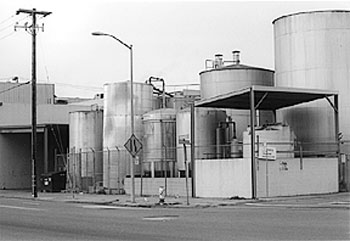
First stop: Red Star Yeast factory.
Taking the Toxic Tour
West Oakland is steering itself into a different future
By Erica Pedersen
It's a bright, crisp high noon on the corner of Mandela Parkway and 7th Street in West Oakland. The Old Highway used to run through here, and 7th Street was once the sweating center of blues and jazz. In West Oakland's world war prime, industry boomed, jobs surged, the Port was alive with railways and ships, and neighborhoods grew. Now weeds clamor out of dead space, old Victorians tip and peel, and commuters race through without looking back.
The neighborhoods here are flanked by freeways and stuffed to their stinking brims with factories. West Oakland's industry and semitruck traffic make big cash for some, but they also churn out five times more toxins than all of Oakland combined. Poisons and poverty are systematically left behind for the African American, Asian, and Latino communities to live with. Most live within an eighth of a mile of an industrial area, and 76 percent live below poverty. Low real-estate rates invite gentrification and threaten to displace long time residents. But despite the obvious decay, statistics to measure it did not exist until recently.
Here at the 7th Street/ McClymonds Corridor Neighbor-hood Improvement Initiative headquarters, a resident-led organization to improve West Oakland, the struggle for self-determination is rounding a major inflection point. In 2000 the Initiative partnered with an influential ally, the Pacific Institute, an independent, non-profit think tank on sustainable solutions to community develop-ment problems. Together they collaborated on the Environmental Indicators Project. It names and explores the red flags, or indicators, by which a commun-ity's health can be monitored, such as lead abatement and voting power. Today the report goes public. Key leaders on both fronts unveil the Project results, launch a website, and host a four-part Toxic Tour of West Oakland to add a living dimension to the numbers.
The publication of the report is significant. Allen Edson, Executive Director of the Initiative, explains that, "[after] many, many, many years of complain-ing, we now have a weapon to fight back." Sound methodology and accurate data capture West Oakland's needs and provide the expert muscle to revitalize the community. Over the long run, the community can now track the indicators. Council-woman Nancy Nadel adds that the report allows West Oakland to "take its own pulse" to gauge its own revitalization.
One way to kick start improvement is to bank on the commuter hustle by building the Transit Village around the West Oakland BART station, a key transfer point for Bay Area travellers. Vice Chair of the Initiative and resident of West Oakland for forty years, Monsa Nitoto, wants to bring West Oakland back to "the old days of the Boardwalk," when West Oakland's waterfront was recreational. But industry dulls revitalization plans. While the proposed Transit Village involves building housing, office, and retail space, the potential sites are just a few blocks away from the pungent and carcinogenic Red Star Yeast factory. A shining example of West Oakland's notorious land conflict, it is the first stop on the tour.
Outside, a washed and waxed tour bus rolls up. Since West Oakland has seen a fifteen percent drop in bus mobility over the last four years, its immaculate presence is more than out of place. The near full busload of reporters, residents, and directors board and then file out a few blocks later to look up the brick and silver factory that steams out 33,000 pounds of acetaldehyde a year. It smells like sour wine; a big drag of it is spicy on the lung. "Yeast manufacturing is not a benign activity," Project Director Meena Palaniappan understates its effects.
Just around the corner is the next stop: the local Super Fund site. Under a massive freeway overpass there are piles of trash left to rot a few yards away from a plastic playground. Repeatedly used as a dumping ground, it took six months for the City to remove 263 tons of illegally dumped garbage from West Oakland's streets. There is more waiting. This grim underpass is also the former site of DC Metals, whose residual toxins are still buried a paltry two to five feet underground. The whole scene gets a little eerie.
The third stop showcases a major culprit in West Oakland's air problem -- truck traffic. Every day, 10,000 trucks huff and brake through neighborhoods and school areas. It's not en-tirely legal, but it's not entirely enforced, either. Only an "iron lung," as Nitoto says, can protect residents from over-exposure and its consequences.
Poor air quality especially effects the elderly and child-ren. West Oakland's youth are seven times more likely to be hospitalized for asthma than the average child. But high risk doesn't translate into education and preventive care. The last leg of the tour is the West Oakland Asthma Coalition's home base. The Coalition will only have to work harder over the next ten years as truck trips are expected to double by 2020.
For such a clear day, the outlook is pretty bleak. But these are pregnant times for West Oakland; a sun rise follows every midnight. Before today, statistics with real weight did not exist. Data was unreliable, inconsistent, and infrequently updated. Now West Oakland doesn't have to rely on half-hearted collection agencies to provide the statistical information it needs to effect protectionist policy. A more democratic dialogue is securely in place. The Pacific Institute does not want to control the discussion or the direction West Oakland takes. From the partnership's beginning, there has been an equal exchange, and the final indicators come from the resi-dents' most prescient concerns.
The Clean Area Coalition, which includes the Initiative, the Institute, and other key lobbyists for change, is already organizing around the next steps. They plan to charge each truck going to the Port a dollar a day, and dump Red Yeast in favor of Transit Village.
Riding on the heels of so much success, maybe it's easier to accept that the City's support has been largely nominal. Nevermind that Mayor Brown shows up late to the meeting, conspicuously timed for airs and graces with cameramen. Misused but not broken, West Oakland is using its own will to define its future self.
Erica Pedersen is a Berkeley graduate living and writing in San Francisco.
[ East Bay | Metroactive | Archives ]
Copyright 1994-2025 Weeklys. This page is part of Metro Silicon Valley's historical archive and is no longer updated. It may contain outdated information or links. For currently information, please go to MetroSiliconValley.com home page, e-edition or events calendar.
|
![[whitespace]](/gifs/whiteline2.gif) |