|
 |
|
[ East Bay | Metroactive ]
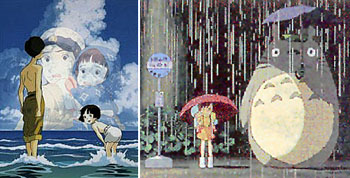
Berkeley's Stone Bridge Press publishes the last word in anime classics, The Grave of the Fireflies (left) and My Neighbor Tortoro (right).
Tits and Tentacles
The Anime Encyclopedia gives a genre its due in depth
By Richard von Busack
Flying squids, talking robots, and Japanese girls in sailor suits are the featured players in Helen McCarthy and Jonathan Clements's The Anime Encyclopedia: A Guide to Japanese Animation Since 1917 (Stone Bridge Press, $24.95). This new book from the small Berkeley publisher is the one the world of anime's been waiting for. Obviously no study of anime in the English language has been this thorough yet -- and if such a book had existed, it would have been done by co-author McCarthy, who wrote an indispensable study on Hayao Miyazaki, director of the dazzling Princess Mononoke and My Neighbor Totoro.
Some of the better work by directors not named Miyazaki, as outlined here: Perfect Blue -- a nice-try of a thriller, with a series of untrustworthy points of view and a narrative so tangled that the only one who was sure of where he stood was the guy selling popcorn in the lobby. Among 2,000 listings for earlier classics such as Barefoot Gen and The Grave of the Fireflies. Speed Racer (whose real name is "Go Mifune") is here, of course. And there's various items about the work of the Japanese Disney, Osama Tetzuko, whose intrepid and charming work was adapted into the recently theatrically released anime Metropolis. Tetzuko's little robot hero Tetsuan Atom is on the cover of McCarthy and Clements book. "Astro Boy" as we know him, is the Mickey Mouse of anime, a figure rich with childhood associations, ready to lead in the non-fan viewer to anime.
The authors approach their subject with amusement as much as authority. Without this ency-clopedia you'd probably never know that a character named "Gust Turbulence" was the anti-hero of the anime Agent Aiku. Having finished the blow-by-blow of the bodice-slasher Lunatic Night they conclude "the authors would like to apologize for making this sound a lot more interesting than it is." And in noting an aggravating device as often used in feature films as in anime, they write in the item for Lensman: "Overlong gee-whiz beauty passes of the spaceships to allow us to gawk at the incredibly expensive computer graphics." Among the collections here of course a few listing are de-scribed as "tits and tentacles:" stories of man versus creatures possessed of acid saliva strong enough to melt through spaceship hulls and dissolve uniforms, but mild enough not to inflame the skins of the biggest-breasted crew-women.
Interviewing the authors by e-mail, my first question was: "How in the world did you ever manage to see so many of these animes?"
"I think I did something really awful in a past life," Clements responded.
"We worked at it," noted McCarthy. "And we didn't watch all of them ourselves -- as we say in the introduction, others saw a lot of the films in the book, people whose word we trust. Where we state a strong opinion, we have seen the film."
And the worst of them all?
"For me, it's The Gigolo," McCarthy responded. "I would rather watch paint dry."
"So many to choose from ...," Clements writes. "The Lolita Anime series was the most unpleasant. Bondage Queen Kate was pretty bad. Officially, the worst anime ever made is something called Butchigiri, which was so bad that even the animators who worked on it disowned it."
The authors hope that some more attention drawn to their favorite animes will result in a theatrical rerelease. "There are many that would repay viewing on a huge screen with a good sound system," McCarthy said, "Miyazaki's My Neighbor Totoro made me fall in love with Japanese animation. It only had a relatively low-key theatrical release from 51st Street Films a few years back."
Clements was first hooked by one paricular anime: "For me it was Gunbuster, a simple tale of kamikaze schoolgirl rocket-pilots, fighting to defend the Earth from alien invaders, who discover that the aliens have the moral high ground, and that it is better for the universe if humanity loses. It's a heart-rending allegory of the Pacific War. And Momotaro's Divine Sea Warriors is the first ever feature-length anime, a propaganda film made in 1945. It shows a Japanese animal army attacking cowardly British ogres, and it's a fascinating document. It's also a real survivor -- anime-cels were in such short supply that the animators had to wash each one with acid and re-use it, so the original artwork that made the film was destroyed even as it was made. After the war, the Occupation forces thought they had shredded all copies of it, but a print was found hidden in a warehouse in 1983, and re-released in Japan. If I had my own DVD company, that would be the first title I bought ... though I doubt I'd sell more than a dozen copies."
"If there is one thing that attracts me to anime," McCarthy notes, "apart from the visual dynamic, it's the willingness to consider wide-ranging story and character possibilities, covering a wide spectrum, from mass TV fodder to wildly experimental work."
This "mass TV fodder" floods the markets; and sometimes intelligent anime is vandalized by bored voice-over actors. "It's annoying when actors and direct-ors turn in a bad job because they just can't be bothered. But that kind of lack of professionalism just reflects badly on those con-cerned. And there are some really good, talented US and Canadian voice actors working in this field."
Clements adds, "The computer-game tie-ins are perfectly honest about what they are, so it's not really possible to get annoyed about them. Anyone who is pre-pared to pay money to watch the anime of Tekken or Toshinden probably isn't going to appreciate anime as fine art anyway. Such releases pay for the more obscure releases too, so I prefer to see them as unwitting patrons of the arts! And thanks to DVD, we do at least stand a better chance of seeing the originals. You can walk into a video store and buy the uncut original anywhere in America. You have a much better chance of seeing good anime today than you ever did in the past."
[ East Bay | Metroactive | Archives ]
Copyright 1994-2025 Weeklys. This page is part of Metro Silicon Valley's historical archive and is no longer updated. It may contain outdated information or links. For currently information, please go to MetroSiliconValley.com home page, e-edition or events calendar.
|
![[whitespace]](/gifs/whiteline2.gif) |