|
 |
|
[ East Bay | Metroactive ]
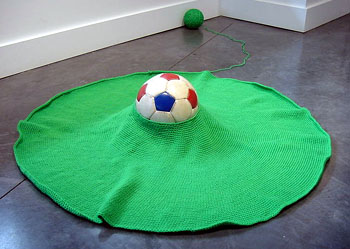
Birgit Gehrt's "Soccer for Gabriel" weaves Visual Alchemy 1 & 2 together nicely.
Eye Spy
The Oakland Art Gallery presents Visual Alchemy 2 through March 9
By KO
If the newly opened Oakland Art Gallery has a specific mission to initiate dialogue into the arts, than Visual Alchemy 1&2 certainly continues the notion. In the Gallery's previous show, Reconstructing Reality, which honored the memory of Sept. 11th, artists' work responded to current events in our lives. In Visual Alchemy 1 & 2, the works speak to each other as well as between artists.
Visual Alchemy may be a lighter approach than Recon-structing Reality was, but in its two-part form -- where the four artists of Visual Alchemy 1 recommended the artists repre-sented in Visual Alchemy 2 -- the gallery's apparent commit-ment to developing community dialogue is taken to a different level. Alchemy occurs in the transformation of common-place material, in this case into works of art and then from an exhibit into a challenge for the viewer.
Exhibit designers Beth Gates and Carol Ladewig's faith in the dialogue commitment virtually left them out of the curatorial process in Visual Alchemy 2, where artists chose the next bunch of artists to exhibit. With the installation of Visual Alchemy 2, the central concept of Visual Alchemy 1 appears transformed as inter-preted by the new set of four artists. With this generation, a new communication be-tween artists is born and the opportunity is extended to the community at large.
To best play the game, it is important that Gallery goers observed Visual Alchemy 1 very carefully. For those who didn't, a recapitulation of Visual Alchemy 1 here will help solve the puzzle of Visual Alchemy 2. Consider how the artwork of individual Visual Alchemy 1 artists Mari Andrews, Alan Rath, Laurie Reid, and Lucy Puls related to each other. Imagine Andrews' "Propensitus Gravisu III," a piece consist- ing of water-formed stones suspended on brass rods drilled into the wall above the heads of viewers. Andrews' other works were leaf-dotted webs of monofilament or tar-coat- ed twine. When viewed in conjunction with Reid's watercolor paintings, the transformative power of water (and pigment) linestrokes on paper matched the rhythms of Andrews' webs. A wide strip of paper with marks dusted in iridescent powder echoed Andrews' waterfall of stones.
Visual Alchemy 1 included three examples of Rath's work, which sat almost equidistant from Andrews' and Reid's. His "Electric Asparagus," a wooden crate-like box of mailing tubes held with paper speaker cones, vibrated at subsonic levels. All of Raths' work emits some type of energy, whether light or vibration. The articulation and materials of Raths' electronic assemblages, with their secret inner workings, were near to the secret stuffing of Puls' concrete blocks encasing anonymous plush toys whose pastel fuzziness bulged out of the cold hardness of grey concrete. Puls' other works sat across from the entrance: As the refuse of material culture, cast-off objects such as LP records albums, toasters, and toys, were "frozen" in time and visible through the translucent resin they were encased in. Andrews' wayward, ocean-bound riverstones at the end of steel rods were suspend-ed in time, creating another dialogue between the two works of art -- a silent conversation of materiality and modernity.
Now take these clues as a challenge to visit Visual Alchemy 2 and match up the current offerings of Bruce Cannon, Karen Kersten, Rob Keller, and Birgit Gehrt with the artists of Visual Alchemy 1 who chose them.
One set will be immediately obvious: Rob Keller's electronic pieces are definitely related to Rath's works. As antenna-mounted spheres shrink from shadows cast by the viewer, a Morse-code message emanates from antennae mounted in the depths of a container, and Keller's work literally communicates with the world. These two pieces sit across from Cannon's "Project Document-ation" of other pieces with delicate web-like flow chart illustrations in almost identical arrangement to Andrews' webs and Reid's subtle tracery. And now the wall where Andrews' waterfall once hung displays Cannon's carefully mounted samples of forest botanicals, another set of natural elements out of place by placement.
Gehrt's work, tightly crocheted circular collars around fairly common objects: sponges, a basketball, polyure-thane foam, seem materially similar to Puls' resin and con-crete encapsulations on first glance, but the delicate line unraveling from the pieces and set aside in balls of thread is again web-like.
So who chose who? When you think you know, ask at the desk for the answers and see how well you untangled the nature of the artists, the work, and the materials from which the work was created.
[ East Bay | Metroactive | Archives ]
Copyright 1994-2025 Weeklys. This page is part of Metro Silicon Valley's historical archive and is no longer updated. It may contain outdated information or links. For currently information, please go to MetroSiliconValley.com home page, e-edition or events calendar.
|
![[whitespace]](/gifs/whiteline2.gif) |