|
 |
|
[ East Bay | Metroactive ]
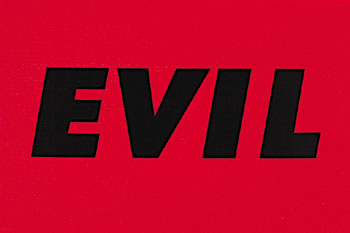
Edward Ruscha's 1973 screenprint "Evil."
The Devil's Work
UC Berkeley's Graduate Theological Union exhibits 'The Image of Evil in Art' through May
By Aimee Le Duc
Tucked away in the Berkeley hills is the mysterious Graduate Theological Union -- the GTU. It's one of UC Berkeley's many appendages, and it is striving to expose evil. The exhibition, The Image in Evil in Art, is a combination of local private collections showing some of the strongest examples of 16th through 20th century Western European art dealing with good and evil. Even beyond its contextual consequences, the exhibit is worth making the trek to see -- the art is technically sophisticated and tragically beautiful.
However, putting work on the walls under the title The Image of Evil in Art requires a look beyond the visual. By labeling something "evil," the exhibit's curators stake a claim that there is a universal understanding of evil. Although that's a far larger endeavor than this exhibition allows, it does for the most part do a thorough job depicting a traditional Christian view of evil.
The work is spread throughout GTU's Flora Lamson Hewlett Library. The first images you see when walking into the lobby are hung along a wall in front of a row of chairs. The art stares, with a historically and theologically complete set of answers, at its passively sitting viewer, but it's unclear whether the viewer can stare back with the same confidence. It's difficult to wholly accept these binary notions of Satan and death.
No piece in the show confronts the issues of Christian notions of evil more directly than Edward Ruscha's 1973 screenprint on wood-grain veneer paper. The piece is titled "Evil" and is simply the word itself printed in black capital letters on a deep red background. It looks like a billboard or advertisement, both common inspirations for Ruscha who is the only American included in this show. There is no haunting specter of death snatching children away in their sleep as in Kathe Kollwitz's exquisite lithograph, "Death Grabs the Children," there is no marching display of holy men defending against all that is bad. Ruscha's work gives nothing more than a word. He takes away the viewer's ability to limit evil to something visible or tangible -- he asserts there is not only one image of evil in art. It is all around and can be as simple as a word. It is the most disturbing work in the exhibition.
Using Ruscha's work as a point of entry into the show allows the viewer to see the exceptional body of work as a process in comprehending the many faces of evil in our society. This exhibition is a strong start, but ultimately, it is begging for a sequel.
[ East Bay | Metroactive | Archives ]
Copyright 1994-2025 Weeklys. This page is part of Metro Silicon Valley's historical archive and is no longer updated. It may contain outdated information or links. For currently information, please go to MetroSiliconValley.com home page, e-edition or events calendar.
|
![[whitespace]](/gifs/whiteline2.gif) |