
|
 |
|
[ East Bay | Metroactive ]
Underestimated Prophet
San Francisco singer-songwriter cum guitarist shines brightly in relative obscurity
By Jeff Palfini
Attempting to describe Chuck Prophet's sound is much like trying to update Evander Holyfield's family tree -- a long, involved, and ultimately pointless undertaking. The singer-songwriter's music is a genre-bending amalgam of widely varied influences, from Brill Building hit-writers like Carole King to folks like J.J. Cale, Alex Chilton, Bob Dylan, and Tom Waits. Prophet himself describes his music as "traditional song-writing turned sideways," which is probably the worst and best description of it out there.
"There's something mysterious about hearing 'Good Vibrations'," he says by way of explanation. "You don't know what it is about the record that makes you want to keep coming back to it ... you want things to make sense but you don't want them to make too much sense, and that's what I consider bending things a little bit."
And bend he does, blending genres, experimenting with different microphones, anything to keep his music sounding fresh. By his own admission, each of his six solo albums is very different from the last and, in some way, a reaction to it.
Prophet originally earned a reputation as a freewheeling roots-rocker during his time in the mid-to-late '80s with L.A.'s Green on Red, a predecessor of today's alt.country acts like Wilco and Son Volt.
His first solo album, Brother Aldo (Fire Records, 1990), was a demo of songs he and his now-wife Stephanie Finch had been trying out in San Francisco's underground scene at bars like The Albion in the Mission. The demo ended up being made for the paltry sum of $800 and released "as is," according to Prophet. It was straight-ahead singer-songwriter material with just a hint of the swagger and inventiveness found on his later albums.
His second and third releases, Balinese Dancer (1993) and Feast of Hearts (1995), reflected a wider range of influences, including Southern blues and zydeco sounds, but failed to strike a chord with critics and fans. Feast of Hearts marked a rather unhappy pairing of Prophet and producer Steve Berlin of Los Lobos fame. Berlin's hands-on approach did not sit well with Prophet, who was used to more freedom in the studio, something to which he would return on his next album, 1997's Homemade Blood.
"We spent a lot of time in the control room on [Feast of Hearts]," says Prophet. "When I got done with that record, I just wanted to make a quick rock 'n' roll record where everybody would stand on their feet, five people looking at each other -- so we made Homemade Blood."
The album's live-in-studio feel brought Prophet his greatest critical and commercial success up to that point, even spending months on top of Rolling Stone Germany's critics poll. Homemade Blood was a rock 'n' roll record, pure and simple, so some fans were confused and even a bit disquieted when Prophet released his last album, The Hurting Business, in January of 2000. The 12-song outing, put out on Oakland's HighTone Records, was co-produced by Jacquire King, who had recently finished working with Tom Waits on Mule Variations. The album is one part Chuck Prophet, one part Tom Waits, and one part hip hop, weaving samples and turntable needle drops amidst candid yet artful lyrics punctu-ated with Prophet's expressive guitar work. Some fans felt betrayed by the departure; one European fan even went as far as to send Prophet an email telling him to "leave his turn-tables at home" when he came to Europe. But Prophet shrugs off concerns about alienating his fan base with experimentation.
"Sometimes you've got to be willing to fall on your face," he says. "I've just got to get off on what I'm doing, that's really the bottom line. If I can't get off on it, I can't expect other people to."
These days, Chuck Prophet is rolling. The singer-songwriter turned heads at this year's South by Southwest Music Festival with inspired performances both with his band and as a guitarist for Austin alt.country songstress Kelly Willis. His sixth album, No Other Love, is coming out in June, as is the new Willis album on which he appears. On top of that, his wife Finch's band, Go Go Market, for which he also plays guitar, is releasing their debut album on London's Evangeline Records on April 26th.
But Prophet has been around long enough to know that he shouldn't get too caught up in the hoopla. Instead, he is keeping himself busy with live appearances and studio work with frequent collaborator Kim Richey. He seems unmoved when asked whether he ever thinks about this album "going big."
"I don't know much about that kind of stuff, except for that it would be great to go from living like a college student to living like a grad student," Prophet says. "But it's just hard for me to voodoo anything like that."
Prophet is definitely more college student than flashy rock star. In fact, he still plays the same $150 Telecaster that he bought when he started with Green on Red in 1984. Onstage he is a presence, with a look and a voice that recalls a '90s slacker version of Tom Petty -- a comparison he hears a lot and with which is finally making some peace. He is sur-rounded by a talented band including the ubiquitous Max Butler on guitar, mandolin, and steel; Finch on vocals and keyboards; Teenage Rob Douglas on bass, and Paul Revelli on drums. But it is Prophet, grimacing as he seemingly forces sounds out of his 18-year-old guitar, that commands your attention.
In the end, Chuck Prophet may, heck, probably will, go the way of many of his musical heroes like Dan Penn and Alex Chilton. His music will be revered by a cult following, as well as by the society of rock critics and rock snobs, but will go widely unnoticed by the general public. That wouldn't be a terrible fate for Prophet, or those who love his music, but it would be unfortunate for the numerous uninitiates. No matter what the fan response, Prophet sees no end in sight.
"I ain't gonna be done for a long time," says Prophet. "I ain't gonna be done until I'm making little cassette tapes to send to my friends, you know. Maybe then."
Until that day, you can catch Chuck Prophet and his band, the Mission Express, at their April 26th appearance at the Starry Plough in Berkeley.
[ East Bay | Metroactive | Archives ]
Copyright 1994-2025 Weeklys. This page is part of Metro Silicon Valley's historical archive and is no longer updated. It may contain outdated information or links. For currently information, please go to MetroSiliconValley.com home page, e-edition or events calendar.
|
![[whitespace]](/gifs/whiteline2.gif) |
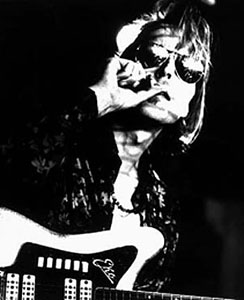 Prophet appears to be more than making peace with Petty.