|
 |
|
[ East Bay | Metroactive ]
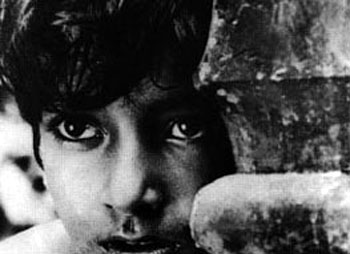
Satyajit Ray's boy-hero, Apu, in Panther Panchali.
Ray of Light
Master filmmaker Satyajit Ray is honored this week at the PFA
By Richard von Busack
He was last seen dying on camera at the 1992 Oscars. Satyajit Ray was too weak from heart disease to sit up for a last interview, so he was filmed in his hospital bed ready to leave this life talking about how much Deanna Durbin meant to him. Durbin was Universal Studios answer to Judy Garland back in the 1940s, but who was Satyajit Ray? India's greatest filmmaker is the deceptively simple answer -- a giant figure in world cinema who yet never made a fortune in it; a man too western, maybe, for eastern tastes, and too eastern for western tastes.
Ray's Apu Trilogy regularly turns up on the list of the best films ever made, but at the time of his death, it had been 10 years or more since he'd had a U.S. distributor, and the original prints of his films were in bad shape. A 13-film retrospective at the Pacific Film Archive is a chance to have a fresh look at his greater and lesser known work. Here's new Motion Picture Academy print of 1971's Company Limited (May 3), and 1962's The Expedition (May 4). Here also is Monihara, the missing third episode from his classic Two Daughters, united on a double bill with Ray's documentary on the man he revered the most -- the author, politician, and edu-cator Rabindranath Tagore. Inci-dentally, a Tagore anthology is a bedside prop in Monsoon Wedding.
Ray's best known films are the Apu Trilogy -- and yes, Apu on "The Simpsons" is named after Ray's hero -- 1955's Pather Panchali (Song of the Little Road) playing May 9, 1956's Aparajito (The Unvanquished) and 1960's Apu Sansar (The World of Apu), both playing May 11.
The films chart the childhood and manhood of Apu, a boy with a loving and improvident father and a mother whose losses in life steer her toward depression. The family moves from a rural village to Benares, the holy city on the Ganges, where Apu's father lands a job selling the kind of religious trinkets that turn up at the Ashby BART swap meet. Later, Apu goes to college in Calcutta, where he stays to face the reversals any young writer can expect. After a death in his family, Apu takes on a period of wandering, mourning, and renunciation, after which he picks up the thread of his life.
Ray's work conveys much in silence, so much about the ten-sions of family life, the relin-quishings, and smotherings. Even religious crises are handled with a lack of grand sentiment, estranged from both the American and Indian cinematic traditions Ray grew up with. As befitting the son of India's best-known writer of nonsense verse, Ray was also comical and fanciful. He made several movies for children -- probably the lingering influence of Deanna Durbin.
Ray studied physics and grad-uated from the University of Calcutta at age 19. Like Alfred Hitchcock, he became a commer-cial artist. Such work can be dull, but it does teach you about the life of inanimate objects, and how, through lighting and jux-taposition, they speak about the people that own them. In 1950, Ray was sent to London by his advertising firm. There he was first struck by movies. He claimed he saw 99 of them in six months. The most important of these was The Bicycle Thief, Italian neo-realist director Vittorio De Sica's film, shot with nonprofessional actors on sidewalks. The Bicycle Thief convinced Ray that such films could be done in India, as the antithesis of the escapist musicals popular in the subcon-tient then as now.
On the way back from England, Ray decided to make a film from a book he'd done illustrations for, Pather Panchali. It took five years to realize the project, for Ray was a novice director using amateur actors and a cam-eraman who had previously done only still photography. The Apu Trilogy was made in Bengali, a language that less than a sixth of India could understand. In a country that was then 20 percent literate, subtitles would make no difference.
One moment of encouragement to this seemingly doomed project came from meeting the French filmmaker Jean Renoir while Renoir was working on his 1951 movie about India, The River. From Renoir, Ray learned a guiding principle, a line from The Rules of the Game: "The tragedy of this world is that everyone has their reasons."
Another famous director, John Huston, saw an incomplete version of Pather Panchali and recommended it to the Museum of Modern Art in New York. Ray's work thus debuted in America rather than India. From that time on, Ray was a fixture in the more adventurous movie theaters of the West.
Exoticism alone might have made Ray a one-time sensation for art-film audiences, but he has endured because of his quality. Observe his attitude toward wo-men, for example. It was Pauline Kael who once wrote that while watching Ray's films, she found it hard to believe Ray was male.
In Apu Sansar, a wife (the lovely Sharmila Tagore, Rabindranath's granddaughter) dutifully fans her husband as he eats. From Ray's sly handling and Tagore's minxish face, you can tell that such a scene is a fixture of Indian movies -- an instruction in wifely duty. Ray dissolves the shot into a world-turned-upside-down image of the loving husband fanning his bride as she eats.
Tagore is unforgettable as the ultimate victim of the pedestal in Ray's 1960 film Devi (The Goddess), showing May 10. The young girl incites her father-in-law's smothered desire, which leads the old man to dream, and the dream itself leads him to claim that she's the living goddess Kali. Thus superstition destroys his household. On a less epic scale, in 1963's Mahanagar (The Big City), showing May 12, a husband nearly ruins a good marriage by his anger at his wife, a saleswoman, who is not only working but making more money than he does.
To miss Satyajit Ray's film, Akira Kurosawa said, was like missing the sun and the moon. For those of us who do most of our traveling in a movie theater, mis-sing Ray is more like not knowing about the roundness of the world -- not knowing how much we have in common with people on the other side of the earth.
[ East Bay | Metroactive | Archives ]
Copyright 1994-2025 Weeklys. This page is part of Metro Silicon Valley's historical archive and is no longer updated. It may contain outdated information or links. For currently information, please go to MetroSiliconValley.com home page, e-edition or events calendar.
|
![[whitespace]](/gifs/whiteline2.gif) |