
|
 |
|
[ East Bay | Metroactive ]
Photograph by Elizabeth Gorelik
Understand Me
Welcome to the world of Bay Area choreographer Mary Armentrout
By Andrea Siegel
On a summer night in 1986, a man's screams woke me in my new apartment. Under my bed covers, I cringed. Was he inside? I looked across the moonlit studio. No, but he was close. A woman shrieked. I thought, "Any more and I'm calling the cops."
Silence. I hoped no one was hurt. I relaxed back into sleep and forgot.
Again the next night, screams woke me. While his deep voice bellowed, I grabbed the phone. I ran to the window. In the dim light, I could see silhouettes of their weird Berkeley outfits on the factory roof a few feet from my second-floor window. He shouted and raised his arm. I dialed 9-1-1.
I paused long enough to rec-ognize Shakespearean English, then their period costumes. I hung up the phone. I watched them close the skylight and walk downstairs to finish the performance.
This introduced me to the Blake Street Hawkeye Studio that choreographer Mary Armentrout shares with several others. (The screaming thespians were part of the now-defunct Blake Street Hawkeyes.) During the years I lived on Dwight Way in Berkeley, I got used to sleeping through cymbal smashing, drum beating, and carousing -- theater noises which formed a vivid background to my dreams.
In 1992, six years after my awakening, when Armentrout painfully lumbered into an Oakland Hills Feldenkrais class I took, she mentioned an upcoming performance at Blake Street. I thought, I doubt it.
Her rapid recovery from her injury included regaining an astounding fluidity of movement. She invited the class to her per-formance. I didn't have the nerve to say, "It's past my bedtime." The theater was in my back yard. I had never been inside.
Thus began my fandom of Armentrout's work specifically, and my appreciative study of dance in general. What exactly are her performances? Not quite modern dance, though the bodies in motion and stillness move heart and mind. The sounds -- from fragments of speech to clanks of spoons dropping -- aren't quite music. But something in the cumulative effect allows me to take a breath and say, "Yes, that's what life feels like. How did she do that?" Perhaps this is not dance, but whole-body theater, or embodied theater, where the body is more at the service of movement, and narrative action is secondary?
Please bear with me as I attempt to describe how her work works.
"You don't understand me." Isn't that the human cry of the ages? "I hurt my toe." That's another one. Welcome to the world of Mary Armentrout, a place related to the one we're used to, but containing instead a nuanced collection of archetypal images, body movements, and spoken phrases. Symbols reso-nate and bounce across the stage, making a mysterious, poignant commentary on the world we know.
The piece, "Each Night," where three performers cry out, "You don't understand me!" and "I stubbed my toe," echoes with the weird curiosity of a remembered dream. As the piece starts, you see Armentrout sitting on a chair in a simple childish pink dress. Two other dancers (Jennifer Taylor and Esther Honda) are lying in different dreaming positions in the midst of a strange jumble of furniture, manikin torsos, and random domestic objects.
It isn't clear which of the two performers lying on the floor says, "I remember," or "I didn't say that." The voices do not connect as the dancers do not touch. The spoken phrases about not-knowing, about being misinterpreted, fragments of talk, feel like part of the dance of human isolation -- even alienation.
Honda, wearing a slip over men's pants, keeps repeating, "I didn't say that," while Armentrout creates dissonant clatter by dropping spoons on the ground. I grow fond of these spoons. Something about the slow calculated way Armentrout prepares to drop each one, and then her shock as another spoon hits on the ground, reminds me of my doing the same absurd thing over and over in my life, and my surprise at getting the same result. In the "real world," babies drop spoons, toys, anything they can, as often as possible. It's one of the earliest human take-charge gestures. It's collaborative and creative: Work has been made for another person, the adult who must pick up the spoon. The dropping also causes another's emotional response -- often annoyance. In this way, babies learn. Are adults, using different tools, any different?
Meanwhile, in "Each Night," Armentrout is pulling from her pockets a whole silverware drawer full of spoons. The noisy clanking as spoons land on the door (lying flat on the floor) startles. Like those actors entering my dreams, the sound becomes accompaniment. In an "ideal" domestic setting, cutlery doesn't break out of character. It never makes that noise. In Armentrout's universe, no glasses break, no angry words are exchanged, and no plates are chipped, but we can drop the silver.
"It was so peaceful," says performer Jennifer Taylor hypnotically. She's dressed in a Victorian nightgown. My expectations are flummoxed. I have no idea what these three dancers are doing up there on stage, but I want to keep watching because they have gravity. Nothing interests me more than that. Perhaps "Each Night" is a dream the choreographer has each night. A dream is an in-voluntarily private nightly entertainment. The dance makes public the privacy of her nights?
On stage, the two apparently sleeping figures dream in har-mony, but how can two share a dream? Maybe "each night" Armentrout and the two other women on stage hang out in their studio and do this dance.
"It was so peaceful, so calm. Tranquil," says the woman in the Victorian nightgown, as she walks across the stage.
"I didn't say that," repeats the other sleeping figure.
Perhaps this dance nudges at showing aspects of a person-ality -- the peaceful one, the experimenting child, the one who stands up for herself and will not be misinterpreted. "I didn't say that." The dance integrates these qualities into a whole.
The dancers provide signals of conventional narrative. Dancers "stay in character," making self-consistent gestures. They say certain lines that are only theirs to say. I find it won-derful that one can interpret these moments in many ways. I can not say for certain, as I can with Hamlet for example, that if Hamlet had just returned to school, the tragedy wouldn't have happened.
"Something is happening," says Armentrout, and the performance shifts. An unseen force seems to be pulling Armentrout back by the hips. The wall stops her. Then she takes giant wobbling cathartic steps away from the wall. She escapes carefully, using her balance, treasuring each step. That felt very "real" to me, though what do I mean by "real"? Is it as real as dreaming?
When Armentrout rises, before walking across the stage with the woman in the Victorian nightgown, her hands arc with sunrise-like grandeur. The two dancers' comments blend while they walk together as one. "You don't understand me." "I stubbed my toe today, it must be my toe." They don't listen to each other. This reminds me of competing needs in one body, or in mother and child.
Hard androgyny encircles this dance -- the paradox of being public with something as intimate and feminine as dream. It seems brave and balancing. Here is nothing of the Hollywood crap served to us as "feminine," but the work seems Feminine in an essential way, like Diana the goddess of the hunt, or Woman as penetrator of the mysteries.
Even though I moved back to New York City in 1997, I try to see Mary Armentrout's work each time I return to the Bay Area. I recommend you join me. She'll be performing "Blue Sofa" at the Lab, 2948 16th St., SF, on May 10, 11, 17, 18 at 8pm. $10-$15. 415.864.8855; www.thelab.org.
[ East Bay | Metroactive | Archives ]
Copyright 1994-2025 Weeklys. This page is part of Metro Silicon Valley's historical archive and is no longer updated. It may contain outdated information or links. For currently information, please go to MetroSiliconValley.com home page, e-edition or events calendar.
|
![[whitespace]](/gifs/whiteline2.gif) |
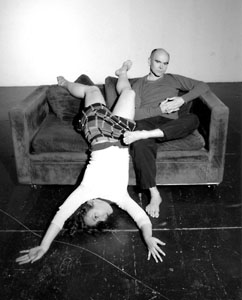 Mary Armentrout and Alan Grant in the world of the "Blue Sofa"