
|
 |
|
[ East Bay | Metroactive ]
Made in the Shade
The shy DJ who six years ago swore off the jiggy-ness of commercial hip-hop on his debut album Endtroducing... now says, "It's all good."
By Todd Inoue
Campbell-born Josh Davis, aka DJ Shadow, is an unlikely hip-hop hero. He dodges the spotlight, preferring to let his hip-hop symphonies speak for him.
Shadow burst onto the scene in 1996 with his Mo' Wax album Entroducing.... Composed entir-ely of sample-based forms, this sonic confessional was unlike anything out there -- a breath-taking instrumental hip-hop record stitched together by beats, loops, found sounds, and movie dialogue. Entroducing was an acquired taste; it commanded a gestation period before listeners grasped the hidden colors, themes, and dramatic devices.
Instead of proclaiming the platitudes of the time -- e.g. "My Bentley is phat" -- Shadow asked questions through abstract sound: What does your soul look like? What does midnight in a perfect world sound like? His album culminated what Shadow refers to as a "lifetime of vinyl culture" and commented on what hip-hop had become and where it could be. On the inter-lude "Why Hip-Hop Sucks in 1996," Shadow's answer, spoken by Lyrics Born, was simple: "It's the money."
Entroducing was unlike any other hip-hop album of that year. By 1997, the album topped critics and artists' "best of" lists. Pretty soon, everybody wanted to know about the camera-shy vinyl archeologist whose only goal was to record with Kool G. Rap.
Over the next six years, DJ Shadow toured the world, both with and without his Solesides (now renamed Quannum) crew. He also worked with James Lavelle on UNKLE -- a collabora-tive project with Thom Yorke, Mike D., Badly Drawn Boy and surprise, Kool G. Rap. He re-leased Preemptive Strike, an album of Entroducing-era remixes and early tracks. He scored the music for the Marc Singer's documentary about the homeless who live underneath New York's subways, Dark Days. He also co-produced Zach de la Rocha's upcoming solo project.
The consummate record dig-ger, Shadow's love of obscure funk from the late '60s and early '70s was archived in two compilations. In 1999, he col-laborated on the now legendary all-45's Brainfreeze mix session with DJ Cut Chemist, recorded live at a Future Primitive show in San Francisco, that was re-leased to the acclaim of DJs and funk fiends everywhere. On a follow-up project with Cut Chemist, Product Placement, the pair outdid the first, with an hour-long set doubling the amount of 45s. The limited ed-ition CD was followed up by a live re-creation that sold out the Fillmore last year.
It's been a long, strange trip for a young kid who was discov-ered making mixtapes while a student at UC Davis in the early '90s, one of which caught the ear of Dave "Funken" Klein, a journalist and A&R for Hollywood/ Basic. With Klein's encourage-ment, Shadow remixed a Lifer's Group track "The Real Deal," that impressed James Lavelle of Mo' Wax label, and launched Shadow into his first four recor-ded singles between 1993-95: "In/Flux," "Entropy," "Lost and Found" and the symphonic "What Does Your Soul Look Like?" These early recordings showed off Shadow's depth and patience as a producer -- a skill that would launch his career as one of hip- hop's preeminent sound sculptors.
While at Davis, Shadow and his homies -- Lateef the Truth Speaker, Lyrics Born, X and Gab from Blackalicious, and spiritual leader DJ Zen -- formed a label, Solesides, and began a success-ful run as one of the most re-spected Bay Area hip-hop crews in the mid '90s.
Now in 2002, DJ Shadow is readying his second album of all-new original material: The Private Press. The title refers to companies who put out records for anyone with a tape and some cash. The new album finds Shadow artfully conveying movement, narrative, and emotion through intricate and painstaking methods of produc-tion. Like Entroducing did, The Private Press blasts hip-hop off into a different trajectory. And it's worth the wait.
Urbanview caught up with Shadow in Southern California during a busy week of promo-tional duties.
UV: After Entroducing came out in 1996, what were the reactions and how did you feel about them?
DJ Shadow: It was all across the spectrum. The very first review that came out of England was really, really bad. That was the first one I read and I felt like it was kind of good, because anything after that would be great. After the record starting catching on in America, there were a lot of people within hip-hop who were unaware of who I was. People were just basically not knowing and trying to test me. Which is cool. I made a hip-hop record that was challenging, hopefully. I anticipate a little more (criticism) this time. I think that's good. It'd be bad if you put out a record that everyone instantly liked.
UV: After all the media attention, did you ever feel you had to dis-tance yourself from Entroducing?
DJ Shadow: I don't think so. When I make a record, after three-four months I forget all the things I really wanted to accomplish that I wasn't able to. By six months I'm pretty harmonious with it, no matter what its shortcomings. Every record I've made, I've done the best I can and if that ever stops happening then I'll know it'll be a turning point in my career. From Entroducing to UNKLE to this record, I've defin-itely tried my hardest. I know when my attention span or concentration level slips, I take a half hour break and try to come back really strong.
UV: Just a half-hour? Not a day, two days, two weeks?
DJ Shadow: Yeah, usually. Only if I've been really, really successful. I think its nice to reward yourself if you've put in a real solid week where you've made a lot of things happen and feel real good about it. Just slow down and take stock and reevaluate how far you've come, then I can legitimize a longer break.
UV: Hip-hop and pop have evolved so much since 1996. How has your musical taste changed in the past six years?
DJ Shadow: My habits have gone much closer to what they were in the mid-late '80s. Back then I re-member buying two 12" singles in one week in 1986. One was "South Bronx" by BDP and the other was "Throw the D" by 2 Live Crew -- both are classics. I was listening to L.A. stuff, Oakland stuff, Texas stuff, Miami stuff, overseas stuff, back in the '80s. I think in the mid-90s and up until a few years ago, if you were making hip-hop, you had to delineate yourself between underground and commercial. For initially good reasons, underground was a secret society and had a strict code of conduct to preserve the culture. Then it became more incestuous and close-minded and I've ex-cused myself in the years since Entroducing and basically just gone back to listening to every-thing from Def Jux to the Three 6 Mafia or Hot Boys or Mystikal or whatever. I'm much more free. As far as all genres, I always listened to psychedelic music as a tool. The songs were long -- they had a lot of time to have long solos and odd combinations of sound. In the last four years, I feel like I finally understand it as a genre.
UV: Psychedelic music and hip-hop seem like odd bedfellows. How did you research the psychedelic groups?
DJ Shadow: Digging, basically. I've been buying records since 1987. By this point, if I've seen something I've never seen before, I'll know it's probably obscure or hard to find. At my same little store in Sacramento (Records, on K Street, featured in Scratch) where I've always been digging, over the past four to five years I've been paying a little more for certain things they knew were rare. They knew psyche-delic stuff better than I did. It's the same with garage rock. I hear a few records that pique my in-terest then I start digging with that in mind. Before I know it I've got 20 things I really like and put them on a tape and then I start trying to do some research and read a few books and talk to dealers that specialize in them.
UV: How did these new interests in psychedelic music and garage rock manifest themselves on your new album?
DJ Shadow: I think the new album reflects the psychedelic influence a lot stronger. Maybe not in overt texture, but arrangement-wise I understand (psychedelic music) more. Arrangement is what I concentrated on for this record. When you've only done ten songs, it's like throwing darts at a dartboard. It's easy to hit a new place every time. When you've got 50 darts on the board, or 50 songs under your belt, it gets hard to hit a new part, to hit something you've never hit before. That becomes a challenge and I found through arrange-ment, I was able to back myself out of corners. When you work with samples, you have to have a lot of stuff to choose from. It's not like you can write your way out of corners, you have to construct your way out.
UV: The album title refers to privately recorded records that anyone could put out. What did you find so fascinating about these "private press" records?
DJ Shadow: In the process of gathering material for the record, I was stumbling across these private press records that had hand-drawn covers. There were a lot of companies in America, if you sent them a tape, no matter how poor the quality they'd put it out anyway as long as you paid them. A lot of them had non-copyrighted covers, generic artwork, and would spray paint your name on top. I found these records really charming and empow-ering in a weird kind of way. I think in making them, they had nothing to lose. When I started making this record, I had really achieved a lot of what I set out to do in between the making of Entroducing and the beginning of making this record. I felt like I pressed reset on my career and that I had nothing to lose. I found myself in a very free space.
UV: What was the first song you committed to Private Press?
DJ Shadow: The first song I started working on was the drums and throbbing bass sound of "Fixed Income" and the beginning stages of "Monosylabik." With "Monosylabik" I went down in the studio the first day. I wanted to kick start the process in a unique fashion. Because I was anxious not to repeat myself, I decided to work on that song first because it had more to do with technical concept than me trying to say something emotion-ally. Nine times out of ten for me it's the other way around. With "Monosylabik," I thought since I always work the other way, let me try and work cold and calculated to start with an entirely technical concept in mind. Every single sound is ripped from the first two bars. It deconstructs and deconstructs and gets more manipulated and twisted as it goes along. It's the most labor-intensive song I've ever done.
UV: How did the rest of the album evolve after that marathon session?
DJ Shadow: By the time I was halfway through "Monosylabik," and felt that "Fixed Income" was coming along nicely, I felt really good and back in the swing. I was on the road for most of 1999 and took a few months off in 2000 before I started working on this record. It had been a long time since I spent 50-60 hour weeks sitting at the MPC (sampler). It's like a muscle; it takes a while to get back in the swing. When I got back, the next songs to bubble up were "Giving Up the Ghost," "Mashing on the Motorway" and "Blood on the Motorway."
UV: Are you satisfied as a hip-hop listener today? Like if you had to re-record "Why Hip-Hop Sucks in '96" in 2002, what would you say?
DJ Shadow: I'd probably have Lyrics Born say, "It's all good." I don't know if I've matured or hip-hop ma-tured but I feel very satisfied as a hip-hop listener these days because there's so much to choose from. I think the main thing was me deciding well, it's silly to limit myself to under-ground "real" hip-hop. I started realizing when Entroducing came out, or around 1997, that most of the interesting things I was hearing was coming out of the South. Tom (Lyrics Born) was a huge dancehall fan. X and Gab would always be bumping Outkast. It was only a matter of time before it worked its way into my brain. It was like "It's OK! You can listen to all kinds of hip-hop!"
UV: That's like some hip-hop 12-step program: "Acceptance is the first step to recovery."
DJ Shadow: When you're making hip-hop and trying to make a name for yourself, especially at that time, you had to demonstrate you were down. You had to be up on the latest underground stuff. It took a lot of energy but it's because I'm a little older and more established I feel very free to pursue my listening tastes in a real organic way. In the same way I can know every single scratch in a DJ Faust or DJ Mars or Space Travelers, I find myself listening to obscure dirty south stuff or a Cannibal Ox record or a garage rock 45. That's how my listening diet is.
UV: What do you want people to get from The Private Press?
DJ Shadow: I would like them to get a sense that the spectrum of music is wider than they previously thought. Hip-hop can be so broad. I want people to be challenged and feel like they had this revolutionary new exposure to music they didn't think was possible.
Todd Inoue is the music editor of the San Jose Metro.
[ East Bay | Metroactive | Archives ]
Copyright 1994-2025 Weeklys. This page is part of Metro Silicon Valley's historical archive and is no longer updated. It may contain outdated information or links. For currently information, please go to MetroSiliconValley.com home page, e-edition or events calendar.
|
![[whitespace]](/gifs/whiteline2.gif) |
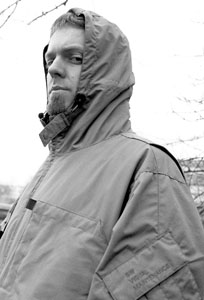 DJ Shadow comes out of the darkness and back into the spotlight.