
|
 |
|
[ East Bay | Metroactive ]
Book Learning
Ismail Ivory misreads V.S. Naipaul's 'The Mystic Masseur' in new film
By Richard von Busack
"He spent the rest of the afternoon in a cinema, but this was torture. He especially resented the credit titles. He thought, 'All these people with their name in big print on the screen have their bread and butter, you hear. Even those in little little print. They not like me.'"
--The Mystic Masseur by V.S. Naipaul
Any large second-hand book-store in England is full of a defunct kind of book -- 60- or 70- year-old English lit in com-pact editions meant to be exported overseas to the British Empire. These books by once-popular writers -- Galsworthy, George Moore, G. K. Chesterton -- were published by Everyman Editions.
I have a copy of The Pickwick Papers in "little little print" for the India trade, a book reduced to the size of half an ordinary sandwich. The type is scarcely larger than the printed warning to "Close cover before striking" on a matchbook. Reading it would be as hard as writing it was.
The new Merchant-Ivory film, "The Mystic Masseur", is about a Trinidadian man who collects such editions as relics of far-away Mother England. But this screen ver-sion of V.S. Naipaul's amusing first novel is like those books condensed for export -- a chore to decipher.
The 1957 novel seems Irish almost -- in dialect, in wit, in air of disappointed resignation. "So Trinidad does behave," laments the hero, who through hustle, works his way up from dirt-poor Caribbean island boy to medal-wearing member of the British Empire.
As a second-generation Hindu, Ganesh is the descendent of laborers brought to the nigh-equatorial island to work on the railroad. By the late 1940s, there's not much to do except cut grass, slash sugar cane, or toil as an oil-patch roughneck. Ganesh (played by the unremark-able Aasif Mandi, lately seen in American Chai) is the inheritor of not one but two different foreign traditions: his estranged father's own Hinduism as well as the British custom of self-improvement through reading.
Newly unemployed, Ganesh togs himself up in full swami dhoti-and-turban outfit to be-come a country healer, a layer on of massage. But country healers are "ten a penny" ("Pretty soon the masseurs be massaging each other," carps Ganesh's wife, Leela). Ganesh breaks out of the pack by virtue of the fact he's a voracious reader. He has such a mass of imported British books around the house that the stacks become the equivalent of the Scarecrow's diploma: proof that Ganesh has brains.
Naipaul satirizes the reverence common people have for a book, despite how dull or amateur it might be. While any viewer hears plenty of warnings not to confuse source novels with films, director Ismail Merchant often shows Ganesh's own kind of reverence for the text without real comprehension of the crosscurrents in the prose.
This strange film gives the feeling that something got lost in the translation. Certainly, some revision was due. The stalest part of Naipaul's book is its attitude toward women. There are some jolly jokes about wife beating, for instance, and women don't really enter Naipaul's story except as background characters.
Merchant has increased and sweetened the part of Ganesh's aunt, hiring the superb Zohra Sehgal to play her. Unfortunately, the expansion of Sehgal's role includes a badly directed death-bed scene. Similar stretching can be seen in one of the minor characters: Mr. Stewart, appar-ently a renegade Englishman with a Hindu fetish. James Fox plays him -- has the wily Fox ever been worse?
Besides Sehgal, the other standout performance comes form Om Puri as Ganesh's father- in-law, Ramlogan, a Dickensian small-town shop-keeper, a con-niver who meets his match. Puri offers a pleasant reminder of Redd Foxx's sharp, shifty Fred Sanford. His Ramlogan is a small businessman who complains to the ceiling -- a man who always takes his petty disputes to the gods.
The first shot in The Mystic Masseur warns of the pace to come: a steam engine slowly wending its way toward the viewer on a British train platform. No Merchant-Ivory film is without its puffer-belly crawling up to the camera. The appearance of the train precedes the film's reverent scene of Ganesh entering a real British library. We see stacks of leather volumes flaking away in the damp, unread and unreadable -- and it's a perfect image of director Ismail Merchant's killing reverence for text.
Merchant has taken a lively satirical novel and dried it out, adapting all the details but discarding the real raucous spirit. Making Ganesh's trip to England the highlight of his life contradicts the book's point. Ganesh's ambition breaks out of the constraints of colonialism in Naipaul's novel; the film endorses that colonialism. It's nostalgic for stodginess.
[ East Bay | Metroactive | Archives ]
Copyright 1994-2025 Weeklys. This page is part of Metro Silicon Valley's historical archive and is no longer updated. It may contain outdated information or links. For currently information, please go to MetroSiliconValley.com home page, e-edition or events calendar.
|
![[whitespace]](/gifs/whiteline2.gif) |
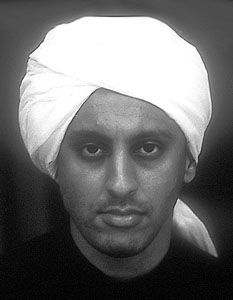 Aasif Mandi plays Ganesh the brainiac (um, masseur).