
|
 |
|
[ East Bay | Metroactive ]
A Movie of No Importance
Oscar Wilde's famous comedy becomes 'There's Something About Ernie!'
By Richard von Busack
In the press notes for the new film of The Importance of Being Earnest, director Oliver Parker notes, "I was intrigued by [the play's] specific relationship to A Midsummer Night's Dream." Though that sentence may not seem revealing, it gives the wary viewer an idea of how ruthlessly Parker has lowered the boom on Oscar Wilde.
Parker's method is the same one film directors have used lately to renovate Shakespeare. It's like a waiter sousing a platter of duck al'orange with ketchup on the hope a kid will eat it. Wilde, however, isn't as universal or as resilient as Shakespeare. He's rooted to a time and place: the 1890s and Victorian London. The 1956 film version has remained definitive because of its refusal to be updated or opened up for the screen; the proscenium arch is practically visible above its peerless cast. For a play in which social artifice is the theme and text, it's no disgrace to heighten the artificiality of a film of the play. Making this play "relevant" is an inane plan.
The Importance of Being Earnest is a trifle among trifles: a story of two dear chums, Algernon (Rupert Everett) and Jack (Colin Firth), who engage in harmless deceptions to free themselves from such duty as might afflict a pair of lounging gentlemen. To get out of disagreeable societal duty, Algernon tells a lie about a dying friend named Bunbury who lives in the country. Jack uses the pseudonym Ernest to give himself a different identity in the town than he has in the country. However, both deceptions prove dicey when the men fall in love: Jack loves Gwendolen (Francis O'Connor), a girl enamored with the name Ernest; Algernon is captivated by Jack's ward, Cecily (Reese Witherspoon), a girl with romantic illusions of her own.
The cast is a mixed lot. Though Witherspoon looks very pretty with bangs, she seems self-conscious with her accent. By contrast, O'Connor, who was born with her accent, plays Gwendolen as an ardent, heavy-breathing girl -- she seems to be fighting her corset. Jack's country manor is West Wycombe, the estate owned by Sir Francis Dashwood, proprietor of the Hellfire Club. It's a lovely background, rich with blasphemous history, but you rarely get a chance to enjoy it.
The early scenes of London bordellos, gambling hells and the 1890s version of Cabaret's "Kit Kat Club" are all meant to remind us that Jack and Algernon's seemingly harmless monkeyshines conceal a world of hypocrisy and male privilege -- and really, how pedantic. Worse is Parker's attempt liven up the play with spit takes, Homer-and-Bart-style comic stranglings, jazz bands and a butt shot (Cecily getting the name Ernest tattooed on her ass). Amid these indescribably forced shenanigans, Judi Dench offers a reprieve. Although Parker's tasteless editing destroys the momentum of her performance, Dench rejoices in the seriocomic authority of Lady Bracknell (who Parker idiotically suggests was a dance-hall girl in her youth). Dench's performance stands out in this pandering film like a diamond in a hooker's earlobe.
[ East Bay | Metroactive | Archives ]
Copyright 1994-2025 Weeklys. This page is part of Metro Silicon Valley's historical archive and is no longer updated. It may contain outdated information or links. For currently information, please go to MetroSiliconValley.com home page, e-edition or events calendar.
|
![[whitespace]](/gifs/whiteline2.gif) |
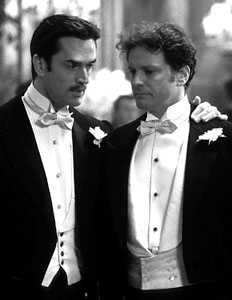 Who's being Ernest now?: Everett and Firth as partners-in-crime.