
|
 |
|
[ East Bay | Metroactive ]
Global Corners
Filipino artists confront racism in Brown Man's Burden
By Aimee Le Duc
As I walked up the stairs of Babilonia 1808, to view the current exhibition, Brown Man's Burden: Selected Works of Filipino Artists from the Babilonia Wilner Collection, I asked myself the obvious questions: What is the Brown Man's Burden? Is it the weight of confronting racism and stereotypes? Could it be the exhausting struggle of fighting to regain what has been taken away from you after years of colonization and imperialism? How is it that these five contemporary Filipino artists featured in the exhibit are using their art making practices to answer these questions, and how are they finding meaning as international Filipino artists today?
The show's title is actually a parody of a Pear's Soap advertisement from a hundred years back that bragged the White Man's Burden could be lifted with both personal cleanliness and by the use of Pear's Soap to brighten up the "dark" corners of the world. Just as this ill-conceived ad revealed the deep sedimentary effects of imperialism at the time, the participating artists in this exhibit are exposing the devastation of globalization and consumption to identity, family, and faith in the Filipino Diaspora today.
Santiago Bose's painting, "Sitting in Darkness (Apologies to Mark Twain)," is a hypnotic narrative piece that personifies the affects of colonial education and the establishment of cultural hierarchies. The background of the painting shows an elementary school classroom flanked with modern art classics from "American Gothic" to a Jackson Pollock painting; and in the middle of "Sitting in Darkness" there is an outline of a brown child standing in the middle of white students and a white teacher who is asking his students questions about the boy at his side. The disturbingly inane answers drawn in bubbles above some of the students' mouths point out the delicate but pervasive surfaces of institutional racism that can create and destroy us in ways we cannot realize.
The work in the show is creative and chancy. The paintings, drawings, sculpture, and mixed-media pieces require that the viewer understand a great deal about Filipino history and current situations, however, the work can grab you with its visceral textures as well. Gabriel Barredo's sculpture, "Mindscape," is a stunning example of the exhibit's thickness and depth. It is a mechanized contraption created from sculpted crucifixes, hands, and eyes connected with vines, mirrors and magnifying glasses. "Mindscape's " haunting movements and fantastic construction pull viewers toward it in almost a voyeuristic way - but it keeps them there by pulling away the syncretic layers of imperialist symbols and gestures to allow a multi-faceted, fluid existence to be seen. Alfredo Esquillo's "Sagrado-Ordinario" operates in much the same way by weaving together various images as illustrations for calendars. The woven pieces are colorful and fun, but disturbing and difficult to decipher at the same time.
Just as the Filipino consciousness is far more than one thing or another, the artwork in Brown Man's Burden thrives on multiple levels. The work assaults the foundations of global hegemony but still preserves the tender and comedic nature of a thriving people. It is an exhibit that is worth the attention and effort.
[ East Bay | Metroactive | Archives ]
Copyright 1994-2025 Weeklys. This page is part of Metro Silicon Valley's historical archive and is no longer updated. It may contain outdated information or links. For currently information, please go to MetroSiliconValley.com home page, e-edition or events calendar.
|
![[whitespace]](/gifs/whiteline2.gif) |
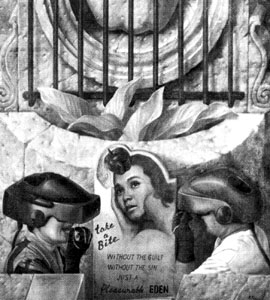 "Virtual Eden" by Alfredo Esquillo at Babilonia 1808. Through Sept. 7.