|
 |
|
[ East Bay | Metroactive ]
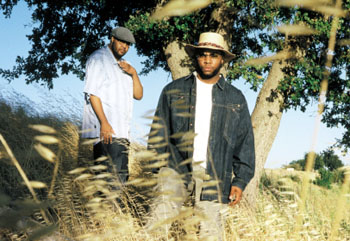
It Takes Two: Xcel and Gab are flowing with 15 years of old-school chemistry.
Revolutionary Architects
Blackalicious keeps building on Blazing Arrow
By Sylvia W. Chan
I am in LOVE with Blackalicious's latest album, Blazing Arrow. I loved Nia, their last album too, but this one, this one is the bomb in all the ways I need right now. A sign o' the times everyone should hear, a soul tonic we all should swallow, a sweet salve for the chafing and pain brought on from too much flossin', ballin', blingin', and war ringing in our ears all the damn time. To quote Lateef the Truth Seeker on the album's "4000 Miles" -- a track that also features Jurassic 5's Chali 2Na sitting in with Blacka's emcee extraordinaire Gift of Gab andbeat/breakmaster Chief X-cel -- Blazing Arrow is "acontribution against the wackness," a "journey through music" (to quote the tune again) that transports and transforms euphonic space with every hook and rhyme.
The amazing thing is, Arrow's magic goes beyond its meticulous production, its starry slew of cameos (including Gil Scott-Heron, Ben Harper, Dilated Peoples, ?uestlove, and Cut Chemist, to name a few), and its seriously booty-bumping beats. No, the album's alchemy arrives in its fluidity -- for example, the way in which an epic, spirit-wail of a track like "Release" (featuring Zach De La Rocha and the magnificent Saul Williams) transitions into delicately tapering cello strings, before blossoming into the sunlit old-school soul chorus of "Day One," a chorus that sings-pleads-implores us over and over again: "Get your soul back." It's this sentiment that rumbles and nudges through each of the album's 17 tracks, and the mantra that metabolizes them all into one stunning whole.
The Blackalicious story began back in 1987, when Gab (Tim Parker), sat behind X (Xavier Mosley) in Mr. Hightower's home economics class at Kennedy High School in Sacramento, CA. The two hit it off immediately. Kind of. "We would come to class every day and argue about who was doper," laughs X-cel, "Ice-T or Too Short. And obviously Too Short was doper..." Gab cuts in immediately. "Watch out, man," he says, smiling, but serious. "Remember words..."
Though they eventually resolved that both artists were legends, the debate sparked a conversation about hip hop between the two that continues to this day. Speaking with Urbanview before their gig at Bimbo's a few weeks back, the two gave the quick rundown of the band's history. How Gab started off as a battle lyricist. How X's dad was a record collector. How Gab called up X and said he needed a DJ; X asked, "For how long?" and Gab said, "Forever." How they started Solesides Records along with folks like DJ Shadow, Lyrics Born, Lateef, Jeff Chang, and Joseph Patel back when X was a communications major at UC Davis. How Solesides morphed in Quannum Records. How they've got mad love for the Bay Area (Gab currently lives in Oakland, and X is originally from Union City). And finally, how the transition from indy to major label has been for them this past year.
Now signed to MCA (though Quannum is still up and running and being distributed through MCA), the two are clearheaded about being part of an industry where mediocrity's the norm, originality the exception, and compromise a given. They know it's all about soundscans and units sold; know that, as X explains, there's three major independent distributors (Red, ADA, and Caroline), all owned by major media conglomerates (Sony, Warner, and EMI, respectively), and that finding outlets for independent sounds is getting harder everyday. They chose MCA because they wanted those outlets, and at the end of 2000, Nia's critical and commercial success had a bunch of labels knocking on their door. The deciding factor behind which one they chose was seeing, as X says, "who would let us be us and not try to tamper with our mix."
"Because you know, we have a 15-year-old chemistry," he continues. "So our perspective is a lot different than groups that just make demos and get signed."
"It's a long-term vision," adds Gab. "It doesn't stop here. It's about looking to the future, about laying the groundwork for the project we've put down. I mean, just because we're on a major label ..." -- his voice trails off for a moment -- "it's just not a finish line type of thing, you know?" When asked if they feel like they've ever compromised for the sake of this vision, the answer is emphatic and immediate. "Nah, nah. Not at all," says Gab. "We went into this deal with MCA with our own fanbase and we got that fanbase from being ourselves. Because that's what we've always been and that's how we've gotten to the point where we're at now."
It's obvious the Blackalicious boys are well aware of music's capacity to crystallize soul, as well as its ability to affect what's ahead. When I ask why music should matter at all these days, when the world seems so incredibly fucked up, when souls seem like the last priority on most folk's agendas, Gab and X both pause, and Gab tells me no one's ever asked them that question before. "I think music is a gift from God, first of all," says X, voice hovering a touch above a whisper. "It is one vehicle and medium. I mean, I look at music like, you know those little time capsules? That people put their things in to preserve? Music is like that time capsule. You put that message in there and there it will be."
Gab builds on X's idea, referencing Khalil Gibran, breaking it down: "I once read that musicians and artists are like the architects of the future (The Prophet). Music has the power to shape. I think music can be a revolutionary thing. I think music can help bring about change."
[ East Bay | Metroactive | Archives ]
Copyright 1994-2025 Weeklys. This page is part of Metro Silicon Valley's historical archive and is no longer updated. It may contain outdated information or links. For currently information, please go to MetroSiliconValley.com home page, e-edition or events calendar.
|
![[whitespace]](/gifs/whiteline2.gif) |