|
 |
|
[ East Bay | Metroactive ]
Local filmmaker, Paul Ginocchio, crafts a community in his new documentary film A Place Named Destiny
By Jodi Levin
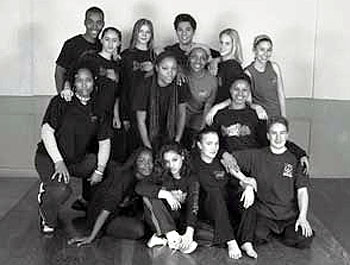
Causin' a Commotion: Teens from the Destiny Arts Youth Performance Company take it to the stage.
Paul Ginocchio, a 33-year-old video producer, got clued in to the intricacies of cross-cultural communication when he tagged along with an inspirational sociology professor to India. The result of that trip, Explorer's Journal, became a classroom tool to broaden cultural understanding. "Some loved it, a few people of Indian descent complained that it focused on the poverty," says Ginocchio. "It was supposed to be a personal journey, but it taught me to be aware of other people's cultures and not put myself in the documentary." His next trip was to Australia to make a film about the Mardu Aborigines. In a "coinky-dink," his work-in-progress about the Mardu, Keep Your Culture, led him to Destiny Arts Youth Performance Company, the group that lights a fire each spring at McClymonds High School, where the group's members -- most of whom are at-risk teenagers -- create and perform a full-length show. "In low-income areas, 85 percent of public schools don't have art programs," says Ginocchio. "Schools are more and more geared towards test scores, but how do you test art?" His new documentary, A Place Named Destiny, premieres Saturday, June 8.
Urbanview: You traveled to Australia for Explorer's Journal. What made you choose the Mardu to film?
Paul Ginnochio: My mom was going to teach in Australia on a teacher's exchange, so I knew I would have a place to stay over there. I started researching aboriginal culture and I was blown away. I researched to death. I put together some information about Explorer's Journal and sent it to 30 aboriginal communities and heard from no one. When I got there, the first weekend of my trip, I got a letter [from Michael Rae, a representative of the Mardu tribe], "we got your packet in the mail, and we'd be interested in talking to you about our community, Punmu." I started doing research on the Mardu and found out that they were forcibly removed from the desert in the '50s and '60s, and that they were one of the last cultures to have contact with white people. The Mardu left the settlements to return to the desert to preserve their culture; it's the most remote community in Australia. I met Michael in Port Hedland and pitched to him the idea of doing a film about how the youth keep their culture alive.
So I'm at Port Hedland, and he goes and pitches it to the community. After two weeks of waiting in Port Hedland for the tribal elders to decide -- mind you, it was 115 degrees every day -- they said no. I'm on a three-month trip, it's been a month and half already, I'm out of money. I contact Michael again and say, "Is there any way we can do this?" He tells me the teacher, Janet, and her husband Peter are coming through Port Hedland, and I can meet with them. I give them a copy of Explorer's Journal, and they go and tell them that this guy wants to come out and he's really gonna do good, that it would help the young people retain their culture. They said yes. It's an eight-hour drive from Port Headland into the desert. I take a four-wheel drive, lots of water, and lots of food. I got out there and spent two weeks in Punmu. They had never met an American before.
UV: What was that like?
PG: Actually, there was kind of a conflict in that they moved back to desert to keep their culture, but they were teaching them English and Christian songs. I was kind of mortified. But the people and I really bonded.
UV: What led you to Destiny Arts?
PG: I took a ton of photographs and a ton of video of the Mardu. A year went by and I had to do something. I started to edit it and futz around but I didn't have any money, didn't have my own equipment, so I got a job at Bay TV. I made a "Keep Your Culture" calendar with the photos and some information about Punmu and the children of Punmu. I made 2,000 copies and sold 500. I thought I was gonna use the proceeds from the calendar to do the documentary, but I broke even. The Punmu got 100 of them. Peter told me that they were all so proud and they had them on their walls. So I had a ton of extra copies. I decided to donate the calendars to youth groups so they could learn about culture and that's how I found out about Destiny. They have tons of classes at Destiny, youth leadership classes, martial arts classes, scholarship programs, and they do outreach to schools -- especially under-served schools. The Destiny Arts Youth Performance Company is kind of an offshoot of all these things.
Community Efforts: The kids face life head on.
UV: What was it about Destiny that made you want to film it?
PG: After that, I saw them perform at this Martin Luther King Jr. celebration. I was inspired by the dance they were doing. I went to the producers at Bay TV to see if I could do a piece on them. The show's producers said yes. I contacted Sarah Crowell, artistic director of Destiny, and said I wanted to do a piece about Destiny for the news. "Fairy tale on the Flip Side" was the show the company was performing that year. I went and started filming the rehearsals they were doing for the show. One of the first things I saw down there was Sam [a company member] performing a monologue. He was 17 at this point. It was a kind of political theater, and he ended by saying "Revolution, revolution, revolution." I thought, "This is deep." This isn't just dancing. And there were blacks, whites, Asians, Latinos, a mix of different cultures. It felt really vibrant to me.
I edited everything together into a four-minute piece. It's exactly what you don't see on the news, what's going right in our society. They showed the piece, and interviewed me, Sam, and Chloe about Destiny, and doing the video. I didn't believe it would happen because there wasn't, like, a murder in front of Destiny; Destiny hadn't burned down. That was when I realized I wasn't a newsperson. After that, I took a big risk, called Sarah, and asked, "How would you feel about doing a documentary?" She said, "Let's do it." I quit the news, used all my investment money, cashed in my stocks, and bought an Avid. My first day I started shooting recruitment at McClymonds.
UV: What was the process like?
PG: I followed them [through] every rehearsal. Two times a week, sometimes three. They did exercises to get to know each other. At the end of May, I had 100 hours of footage, and then interviews, and also some stuff [about] their lives outside of Destiny. I started logging all the footage and looking at everything I had.
And then I kind of like, from there, figured it out -- which I'm still figuring out by the way -- and put all this material together. I had three strong characters: Chanel comes from a tough background, hasn't met her father and does a performance piece about that, and comes out as a lesbian in the documentary. When I first started shooting I knew she was a lesbian but she didn't want that to come out on tape ... she went from not wanting to share to spouting everything about being a closeted lesbian. I thought it was really brave of her; it's going to help other kids.
Alice was a no-brainer. She was a new character, had never been in Destiny before, and also didn't know her father. She had an unstable mother, was raised by her grandparents, and found this outlet that helps her [to] not be violent, which is dance. She's an amazing dancer.
And then I have Sam, the veteran. Been at Destiny since [he was] ten years old, gone through the whole program, it's his last year and then he's going to college. He really shows what Destiny can do; he's the product of Destiny.
I just tried to work the story around them. They have the rehearsals, they basically write the script themselves, and then they put on this big show called "Soul Dust." In the show, they go full circle: the kids trying to escape from their lives, sharing their issues and what they're facing, through realizing how much they have in common. At the end, they have all these different people dance together in a big piece about people realizing they have a community, coming together.
Jodi Levin is a freelance writer and former Urbanview staffer. She now stays home, writes grants, and plays with her three-year-old son.
[ East Bay | Metroactive | Archives ]
Copyright 1994-2025 Weeklys. This page is part of Metro Silicon Valley's historical archive and is no longer updated. It may contain outdated information or links. For currently information, please go to MetroSiliconValley.com home page, e-edition or events calendar.
|
![[whitespace]](/gifs/whiteline2.gif) |
 Destiny Awaits You