|
 |
|
[ East Bay | Metroactive ]
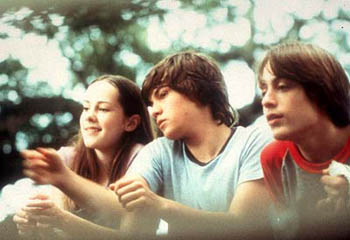
Dream On: Francis (Emile Hirsch) schemes with fellow derelicts Tim (Kieran Culkin) and Margie (Jena Malone).
Southern Culture on the Skids
'The Dangerous Lives of Altar Boys' does bad things to a good book
By Richard von Busack
Current events have made The Dangerous Lives of Altar Boys one unfortunate title for a film. Why is everyone outraged, though? The culprits are part of a class of people who often threatened eternal punishment for the souls in their charge. What's a little physical trespassing compared to hellfire?
Unfortunately, the mildly anti-clerical film rendered from Chris Fuhrman's spare and touching novel (newly reprinted by the University of Georgia Press), isn't anything special or scandalous. The Dangerous Lives of Altar Boys is less like James Joyce's memoir of infernal threats in Catholic school and a lot more like that Hayley Mills parochial school high-jinks movie, The Trouble With Angels.
Here's the introductory sentence of the novel: "Jesus Christ had been bone meal and rumors for 1,974 years, but we were only 13." Untroubled by religion, but much oppressed by its officers, a quartet of Catholic junior high school students hangs out in a delinquent gang, shoplifting, boozing, and scheming pranks.
The main part of the story focuses on the friendship between the narrator, Francis Doyle (played by the undistinguished Emile Hirsch), and his buddy Tim Sullivan (Kieran Culkin) -- a friendship slightly interrupted by Francis's crush on a young girl, Margie Flynn (Jena Malone).
The boys, in trouble because of an obscene comic they created one drunken weekend, are being threatened with suspension by their teacher: crotchety one-legged nun Sister Assumpta. The mean nun is played by Jodie Foster, the film's executive producer.
While a book and the movie it inspires can be expected to differ, The Dangerous Lives of Altar Boys has been softened to the point of bonelessness for general consumption. The action, which takes place in the grotty parts of Savannah, Ga., during the worst of the 1970s, is milked for suburban nostalgia.
Director Peter Care, a veteran of music videos, tries to heat up this lukewarm film with cartoon sequences. Walter Mitty versions of the lives of the boys are illustrated by noted cartoonist Todd McFarlane. The quartet of animated superheroes includes Captain Asskicker and Major Screw, who has a revolving drill bit for hands.
These badly written interludes don't just blow the mood, they also stand out as violent anachronisms in the world of '70s comics. McFarlane has made a huge fortune by steroiding up cartoon characters to compete with Schwarzenegger and WWF big-muscle action heroes. While McFarlane certainly draws a good monster, his gimmicks grate. Take his Spawn, for example: What if Batman were actually dead and could kill people with big chains that sprouted out of his body? McFarlane works louder, he doesn't work smarter.
Malone's Margie is the most true-to-the-times part of the picture, from the precocious way she drapes herself on the bleachers to her sense of personal uncertainty -- is she naturally crazy or have her personal experiences made her that way? Her story is capped with a clever bit in which it turns out that she's not as crazy as she thinks she is.
In the novel, Francis matches Margie for nerves. Because his father whipped him bloody, he has grounds for a war against the adult world. Unfortunately, the inert Hirsch keeps you wondering what Margie sees in Francis. There is only slightly more chemistry here than there was between Hayden Christensen and Natalie Portman in Star Wars: Episode II--Attack of the Clones, but only slightly. Some of the soundtrack music saves the love scene; Crosby, Stills and Nash's "Do for the Others" recalls the how it is when you're young, and you hear confessions of bad behavior from a first lover, confessions that you can't handle.
Also note Vincent D'Onofrio as a chain-smoking priest named Father Casey who does a beautiful double take when he sees an obscene comic book. Though Foster has directed one very funny movie, Home for the Holidays, there's something in this patrician performer that hampers her in comedy: she's seems afraid of being laughed at. Despite trying on a limp and an Irish accent, which should have loosened her up, Foster attempts to show us the nun's humanity, but that tactic only impedes the satire.
The film, which could have been a Southern version of François Truffaut's The 400 Blows, cites William Blake's noble motto: "The road of excess leads to the palace of wisdom." Unfortunately, The Dangerous Life of Altar Boys detours from the road of excess and ends up on the road of mild rebellion.
[ East Bay | Metroactive | Archives ]
Copyright 1994-2025 Weeklys. This page is part of Metro Silicon Valley's historical archive and is no longer updated. It may contain outdated information or links. For currently information, please go to MetroSiliconValley.com home page, e-edition or events calendar.
|
![[whitespace]](/gifs/whiteline2.gif) |