|
 |
|
[ East Bay | Metroactive ]
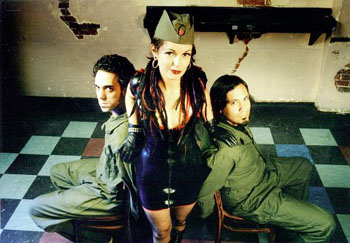
Totimoshi is (left to right) Don Voss, drums; Meg Castellanos, bass ; Tony Aguilar, guitar, vocals.
Method to Madness
Oakland's Latino-rooted rock heavy band Totimoshi kills us prettily.
By Erica Pedersen
Last week I got a chance to meet the minds behind Oakland's metal-and-more trio, Totimoshi, over a cocktail and a dictaphone at Jack London's Last Chance Saloon. I've listened to their latest album, Mystertioso? (Berserker Records, 2001), a good three times through, in murky to mellow moods, and I still can't make it fit into a bite I can chew. But the trying is sweet.
Singer, lyricist, and guitarist Tony Aguilar is a Sagittarian rocker from outside of Bakersfield with roots in mariachi, old country, and blues. And with wife Meg Castellanos, a half-Cubana Flamenco dancer and low-end bass player, they alchemize punk, metal, and rock with a Hispanic heat. Their grunge, spatial sludge, muddle in the mid-low metal is an intense desert drone. It's an expulsive anger that relentlessly repels and attracts with a vision all its own. Unexpected, it works. And with charmed drummer number five, Don Voss, on tour and in the studio, they've finally found the musician, sound engineer, and confidante they've been looking for since the band's first gel in November 1997. Just back from a four week, 32-show US run, working on a seven inch set for November, (this time with Voss on drums), and making headway on a Latino rockumentary, Dirt Farmer, and Cuban benefit, Totimoshi has a lot of rock to talk.
Urbanview: What does Totimoshi mean?
Tony: My mom has an amazing ability to improv stories. One day she told me that my grandmother [from Mexico] had used a word to describe her attempt at speaking English, of which she didn't know a scratch. That word was Totimoshi. We liked it and it stuck. It's the idea of this double meaning of somebody speaking, or of trying to use whatever tools you have to try to communicate with somebody. You know, it's the same thing people do with music; instruments are the tools you have.
UV: Tell me about your last tour.
Tony: We actually started with a car fire, the van caught on fire the first day of the tour, we weren't even out of Oakland yet. We put it out with an Evian bottle [laughs].
Meg: We left April 26th, but after [the fire] it was pretty smooth sailing. We had a lot of really cool shows, and some of the better shows were actually parties, like this one party in the middle of the night in Laurence, Kansas.
UV: What made it better?
M: Um, people were really drunk. It was like three o' clock in the morning at this rehearsal space, our friends put it on and, yeah, people were letting loose, lots of chicks up in the front rockin' out.
Don: It was one of those situations where we were playing a club that was okay, but it's sort of like any other club. They changed the bill around, and suddenly we were still on the bill, but our friends who kind of hooked us up with the show to begin with, weren't. The way I looked at it, the way we all looked at it, was like fuck it, I'd much rather play a party and be with our friends, rather than play some shitty show. And they hooked it up. We went to a show at the Replay Lounge in Laurence [Kansas], and just told people about it. They made an announcement that, you know, when the show's done, go and see two bands play, one from Oakland, at 2:30. There were seventy people all crowded into this tiny space.
UV: How was the reception? Did people know of you?
M: Yeah. This time was our third time out across country, and people came to our shows already having our past CD [Totimoshi, 1999] some had our T-shirts, and someone actually drove all the way from New York to Philly to see us, and we were pretty impressed by that. We ended up headlining this festival called the Emissions Festival in Youngstown, Ohio, cause this band Spirit Caravan broke up and we got to fill in their place, which was great. We got an encore.
UV: How is your dynamic together playing live on stage?
D: I think the live thing is where we sort of become what we do. One thing I noticed is the way we set up is so much different than other bands. The drums are right up front. But instead of everybody having their own big space, we set up close together. I'm sitting and Tony's amps are right here, and Meg's amps are right there, and everyone's playing close together.
UV: How would you describe Totimoshi's style?
M: Pretty distorted, pretty crunchy, pretty sludgy. I don't think we're a slow, doom, sludge band per se. If anything we're a cross of many genres. Punk, metal, goth even.
T: I would describe it as a little bit country, and a little bit rock and roll actually mostly rock and roll. We're a heavy band with a sensitivity towards new wave, punk, and metal. We punish you but in a pretty way.
D: I've always tried to describe it as if Black Flag and The Melvins got really drunk and had hot sex. 'Cause it's
reckless, to a certain degree.
UV: Critics compare you to The Melvins, to early Nirvana, among many others. Are they influences?
T: Their music is an influence, they're great bands. But I wouldn't say that they're the fundamental backbone of what we're doing. I think we get compared to The Melvins just 'cause we are heavy like them, but I don't think we sound like them at all. I think we're very different.
D: It's more melodic than the Melvins. That's where I hear it.
UV: Tony's voice has David Bowie's clean vibratro, and ability to morph and assume different characters.
T: I actually love David Bowie. He's one of my favorite singers. His voice is just so effortless, too, when he sings. When he sings it's just gorgeous.
M: That's quite a compliment.
UV: So you [Meg] don't do any vocals?
M: No.
UV: Do you imagine it staying that way?
M: We want to bring in background vocals. I think eventually Don and I will sing.
UV: The vocals aren't really in the forefront; they blend into the whole distorted, reverb symphony. The bottom takes the lead.
T: That was just a production choice that we decided to make. I was listening to a lot of Jesus Lizard, Albini, and a lot of those groups where vocals aren't out in the forefront, they're more just a part of the overall sound. And we've actually talked about that, about moving in that direction, having the vocals more out in the front on the next recording.
UV: Is there a reason to obscure the lyrical message?
M: [Laughs] It's rock n roll, baby!
T: I think the lyrics are cool, but I think the overall main purpose is just the melody; so long as the melody's there, it doesn't make a difference to me whether people can decipher them or not.
M: That's why we put the lyrics in with the CD, so people could know what he's singin' about.
UV: The lyrics are really meditative. Where are they coming from?
T: Our lyrics tend to be introspective, a sort of wandering within mind frame, a train of thought. I like listening to the phonetics. I'll come up with all the melodies, and then I'll hum them to myself and write down what I think I'm saying. And then I look at it to see if it makes sense, and some of it actually ends up making sense. It doesn't necessarily have to make sense logically. I think there's a difference between making sense if you read something, if it makes you feel a certain way, if it affects you in some way or another. To me it's better than necessarily stating something that's just a statement, or a fact about something.
UV: What do you think are the roots behind this kind of music?
T: I honestly think it's blues. It's acoustic blues; I do everything in a chord. And it's back from when I was a kid. I was really into blues music, acoustic blues. I was listening over and over to it, and I was trying to emulate those guys, playing open chords all the time, doing open chords, doing slide. Then I started getting really into Hendrix and when I started trying to write my own music, everything sounded like Hendrix, so I ended up tuning to an open chord, like I had for the blues stuff, and then I ended up just doing patterns that I had learned with regular tuning for open tunings. It made it a completely different pattern. It was like something that I had found. It was just mine. So I just started doing that, just kind of experimenting with that, and writing songs around that.
UV: How long have you [Tony] been playing? What did you grow up on?
T: Since I was 13. I always was fascinated by it. As a kid, my first love was actually Gene Autrey. I was like super into him. I think it was Led Zeppelin I, the whole reason was Jimmy Page, that I wanted to play guitar. It just moved me so much that I could think of nothing else. So I just asked my dad for a guitar and he bought me one. My town was all Mexicans and Oakies. I would come out of my house, and there would be Mariachi music, and my mom would be dancing. And I'd go out on the porch and there'd be Oakies across the street singing country western music. It's pretty cool, pretty rich.
UV: Meg, when did you start playing bass?
M: I started when the band started, basically. I'd always kind of fiddled around with my roommates' instruments, but Tony couldn't find a bass player when he started the band, and so I started picking it up in 1997.
UV: And you put out your first album in 1999?
M: Yeah.
UV: You picked that up pretty damn quick.
M: I have a lot of dance background, so rhythmically I could understand it pretty well. So it came easy; it was just getting my hands to do the proper thing. I'm still learning how to play. I'm a good player, let me put it that way, but I don't feel like I'm a really great musician, yet. I still have a lot to learn. I studied Flamenco dance for about three or four years on and off, but it was pretty complex. The accents are all over the place. There's a lot of sixes and twelves, so you really have pay attention to what your doing, and have an understanding of the music which is foreign to most people unless you grow up with those rhythmic sounds happening all the time.
UV: What female bass players are you into? What about Sonic Youth's Kim Gordon?
M: I like Sonic Youth a lot, I like Kim Gordon. I like the Breeders, Kim Deal. There's a lot of amazing female players out there, but not a lot that are really popular. Rock is still male dominated. It seems like most female guitarists are bass players, you know. I've seen a lot of local, more underground bands, with female players usually playing bass.
UV: Don, how long have you been playing drums?
D: Off and on for like seven years. Actually, I met my biological parents when I was eighteen, so my biological dad is an amazing musician, he's a guitar player, and he had a band going, like total old man rock. It was genius, and they needed a drummer. I could kind of play, and I said I'd love to do it. We played live like maybe twice, but I did it over a period, I think between the time I was nineteen and twenty-two, so it was really good experience because they played all kinds of styles, like there was some jazz, there was some Beatles kind of stuff, there was straight up rock stuff. That's when I really started to figure out how to play drums.
T: Don's cool 'cause he's a guitarist first, and then he learned how to play the drums. He's fitting in perfectly.
UV: What are some likeminded local bands?
T: Theory of Ruin, for sure. I think we also fit in with High on Fire. The thing is, we can fit in with punk bands, and metal bands.
UV: Tell me about the documentary and the benefit concert in Cuba you're working on.
M: We're doing a documentary that focuses on Totimoshi and our Latino roots, and we'll organize a huge concert in San Francisco as a benefit to bring a bunch of bands over to Havana, Cuba. It'll be directed by a friend of mine Laura Plotkin (Red Rain, 21). It's called Dirt Farmer, after one of our songs. We're going to talk to a lot of metalers over there, a lot of roqueros, and interview them, feature them in the movie, and state something that crosses over all of our cultural backgrounds and brings people together. Cuba's never had a concert that focuses on heavy music such as ours, so it's going to be the first of it's kind, and we're really excited about it. My grandmother lives in Havana. My Dad's from Cuba, and that's one of the main reasons I wanted to do it. I wanted to give the Cuban kids a gift of a concert. I just feel so lucky to have been able to grow up in this country with the freedoms to do whatever it is I want to do, live how I want to live. Unfortunately they don't have that luxury over there.
UV: Any musical muses?
T: Beer and weed. That was just a joke. I drink beer, she smokes all the weed [laughs].
M: Don't lie.
UV: What limits your music? Any demons?
T: Nothing limits us. We're a bottomless pit of musical inspiration. Our worst demon is named El Rectus; he's with us everywhere we go.
UV: Can he be vanquished?
T: No. He's an ever-present, ever-haunting evil genius.
[ East Bay | Metroactive | Archives ]
Copyright 1994-2025 Weeklys. This page is part of Metro Silicon Valley's historical archive and is no longer updated. It may contain outdated information or links. For currently information, please go to MetroSiliconValley.com home page, e-edition or events calendar.
|
![[whitespace]](/gifs/whiteline2.gif) |