|
 |
|
[ East Bay | Metroactive ]
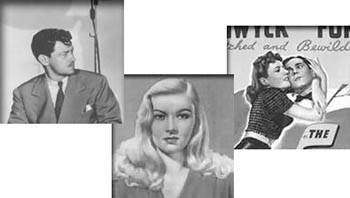
Vision Quest: Preston Sturges keeps an eye on his work, Sullivan's Travels (left) and The Lady Eve (right).
Christmas in July
The Pacific Film Archives honor Hollywood legend Preston Sturges with an 11-film retrospective.
By Richard von Busack
In the late 1930s, Preston Sturges was one of the highest salaried writers in Hollywood, where, as the saying went, you never saw so many unhappy people earning $100,000 a year. He'd worked for Goldwyn and Universal and MGM, had written dialogue for kings and drum majorettes and Tolstoy heroines. Now he was burning to direct. A script of his titled Down Goes McGinty was being readied for filming at Paramount. Sturges offered his services as director for the sum of $1. The studio couldn't refuse, but predicting disaster, the producer William LeBaron quoted to Sturges the maxim, "Shoemaker, stick to your last."
"You show me a man who sticks to his last, and I'll show you a shoemaker," Sturges wished he'd replied, but didn't think of it until later. In a startlingly short rush of creative fervor, from 1940 to 1948, Sturges made a name for himself. He became to adult comedy what Hitchcock was to thrillers and what Orson Welles was to, well, Orson Welles. Sturges pushed for complete artistic control in an era when American films were assembled piecemeal, like the factory goods they were; the scads of writer/directors since have owed a portion of their success to Preston Sturges. "Christmas in July" is an 11-film retrospective of Sturges's work at the Pacific Film Archives in Berkeley. Included in this set of films are two screenplays he wrote in the 1930s (Easy Living, showing on July 7; The Good Fairy, July 5 and 7); the series also includes Mitchell Leisen's film from Sturges's script Remember the Night (July 5) -- the best Christmas movie you've never seen.
But the best of this mini-fest is Sturges's work as a director. Each is a kind of essay on problem subjects: electoral chicanery (The Great McGinty, July 6); advertising (Christmas in July, 1940, July 6); divorce (The Palm Beach Story), sex (The Lady Eve with The Palm Beach Story, on an essential double bill July 13). Later Sturges considered unwed motherhood and war (respectively, The Miracle of Morgan's Creek and Hail the Conquering Hero, double billed on July 20th) and homicidal jealousy (Unfaithfully Yours, July 27). A slightly autobiographical film sums up Sturges's career. It's his piece about a deluded Hollywood director who -- anticipating Woody Allen -- considers comedy too meager a medium to express the Soul of Man. In Sullivan's Travels (July 27) a film director, Sullivan (Joel McCrea), contrives a "deep dish" movie with allegorical figures representing Labor and Capital fighting it out with their fists. Incidentally, Sullivan's title for his film, Oh, Brother, Where Art Thou? was borrowed by the Coen Brothers, who would like to consider themselves in the tradition of Sturges, and probably come closer to it than anyone else these days.
There is such a wealth of material here that it's easier just to highlight elements of it. In The Lady Eve, Jean a female card sharp (Barbara Stanwyck, responsible here for some of the most humid moments in 1940s American cinema) goes after a wealthy, prissy herpetologist Charlie Pike (Henry Fonda). When Pike rejects her on moral grounds, this tempting Eve turns Lilith. She disguises herself as a refined British lady to punish him and teach him a lesson. All this occurs in a time when on screen the line between good girls and bad girls was as plain as a barbed wire fence. The film's motto is "You see, you don't know about girls ... the best ones aren't as good as you probably think they are, and the bad ones aren't as bad."
The Miracle of Morgan's Creek has the irresistible Betty Hutton as a mostly good girl, Trudy Kockenlocker, whose youthful randiness is cloaked in patriotism. Before she can "send off" the soldiers, she's leashed by her hostile father, the town's constable -- William Demarest, the Sultan of Snarl. She escapes with the unwitting aid of the swain who has had a crush on her since she was six (Eddie Bracken, a twerp's twerp). Her escapade results in pregnancy. This comedic masterpiece was made in a time when it was forbidden to show a woman in a pregnant condition on screen in America, so some damned fancy writing is involved, to be sure. The wild story's wrapped up not so much in reconciliation, but in a burst of ingenious irreverence about the way the USA picks its heroes.
The Palm Beach Story is the best farce ever made in Hollywood. It involves a straying wife named Geraldine (Claudette Colbert), a handsome, improvident husband (McCrae) and a cluster of strange wealthy people: the drunk and disorderly Ale and Quail Club, and the billionaire nerd John D. Hackensacker, played by popular 1920s crooner Rudy Vallee, in a role that pioneered the stunt casting of other aged dreamboats: Tom Jones, George Hamilton IV, and so forth.
In his time, Sturges was the third highest-paid executive in the country, and a business partner to Howard Hughes. He was 42 when he directed his first film, and was pushing 50 when the streak was over. Toward the end, in 1955, Sturges was directing a film in France; there may not be any second acts in American life, but sometimes you can get another shot in Paris. Sturges died waiting for his last hit. Still, he possessed the faith of a lifelong gambler, whose losing streaks had been interminable, but who had tasted more than a few enormous wins after he made that wager with Paramount.
One of many great moments in The Palm Beach Story. Geraldine encounters a millionaire (Robert Dudley) known as "The Texas Weenie King." The old man still has a wandering eye, which Geraldine appreciates - she's about to run away from her under-earning husband and go look for a millionaire to keep her in the manner to which she'd like to become accustomed. Unfortunately, the Weenie King is just plain too old. Though he's ancient and deaf, he understands the situation, and recites a melancholy little poem, out of nowhere: "Cold are the hands of time that creep along relentlessly, destroying slowly, but without pity, that which yesterday was young. Alone our memories resist this disintegration and grow more lovely with the passing years." Without a beat, he adds, "That's tough to say with false teeth."
Cold are the hands of time, but even time can do nothing to stale the work of Preston Sturges.
[ East Bay | Metroactive | Archives ]
Copyright 1994-2025 Weeklys. This page is part of Metro Silicon Valley's historical archive and is no longer updated. It may contain outdated information or links. For currently information, please go to MetroSiliconValley.com home page, e-edition or events calendar.
|
![[whitespace]](/gifs/whiteline2.gif) |