
|
 |
|
[ East Bay | Metroactive ]
Tiny Universe
The Phoebe Hearst collection unveils the lasting endearment of the mini portrait.
By J.D. Buhl
Thanks to a new product named "PalmSunday" you can now access the readings for each Mass of the year "quickly and easily" from your Palm OS. This because, as the catalog reads, "You can't walk around with a bound volume of the Sunday lectionary."
And those who pilot their lives from their palms know you can't walk around with a full-scale portrait of a loved one or favorite pet or some prominent personage, but you can take comfort in a palm-sized version of the same. From such a realization grew the art of miniature portraiture--intricate and often very small (one-and a-half by one-and a-quarter inches) renderings of subjects from "a Man" to Napoleon Bonaparte--that contented Europe and thrilled American collectors until snapshots came along. The Berkeley Art Museum at the University of California currently has, for the first time on public display, nearly fifty miniature portraits from the collection of Phoebe Apperson Hearst; these objects, all late examples of the phenomenon from England, France, Germany, and Poland, date from the seventeenth to the nineteenth century.
And while many are reproductions of famous sittings, reduced to snuff box, bracelet, or breast pocket size, these personal portraits--or "limnings" as they were called (classified as both paintings and decorative objects)--are not just for beholding visually: they are meant to be held. Miniature is one art form that screams attachment, its intimacy more than implied. As nicely framed portables, they could make any place feel like home; as private icons they served the heart. Like the canceled stamps, spent matchbooks, or any variety of relic we carry for always, miniatures were, in the words of one artist, "striking resemblances, that will never fail to perpetuate the tenderness of friendship, to divert cares of absence, and to aid affection."
The relatively big "Portrait of Six Children" (Polish, 1805) illustrates the miniature's co-emergence with the "companionate marriage," and more loving, lasting families; and one aid to the affection is particularly fetching, a 1790 "Portrait of a Woman," her large eyes calling. But beyond the remaining how-did-they-do-that question, this collection of precious images offers little more toward a compelling show.
So, how did they do that? Watercolor was applied to bleached, smoothed ivory with a small sharp-pointed brush called a pencil. Paper, foil, cobalt-glass, gold-plated copper, and other materials produced a secure case for travel, or wearing as jewelry; some even featured an arrangement of the subject's hair on the reverse side, often intermingled with that of the person who commissioned the portrait. Holders, it seems, were also reused as circumstance or fickleness required--look for the brutish French revolutionary in the frame with the girlish bow.
And look also through your own pockets and effects. How many "miniatures" do you carry around? A thoughtful accounting of one's own attachments--and their physical manifestations--will lend great understanding to a viewing of this practical, and most personal art form.
J.D. Buhl carries around plenty.
[ East Bay | Metroactive | Archives ]
Copyright 1994-2025 Weeklys. This page is part of Metro Silicon Valley's historical archive and is no longer updated. It may contain outdated information or links. For currently information, please go to MetroSiliconValley.com home page, e-edition or events calendar.
|
![[whitespace]](/gifs/whiteline2.gif) |
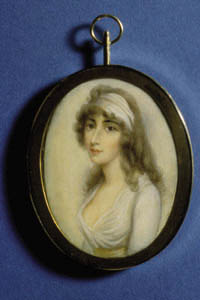 Portrait of a Woman, c. 1790, Watercolor on ivory, 3-3/4 x 2-1/2 in., Phoebe Hearst Museum of Anthropology, University of California, Berkeley.