|
 |
|
[ East Bay | Metroactive ]
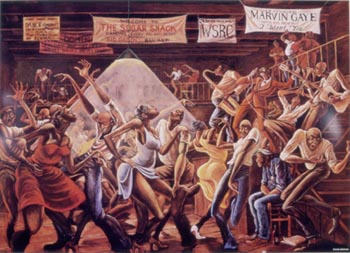
New York art critic, Frank Getlein, called Barnes's Sugar Shack (which appeared on Good Times and a Marvin Gaye album cover) "a stunning demonstration of the fusion of New-Mannerism and Genre painting that Barnes alone has perfected."
Master at Work
Renowned figurative painter Ernie Barnes shares beauty with Oakland.
By Cicely J. Sweed
Internationally-acclaimed artist, Ernie Barnes, is probably best known for his painting Sugar Shack, which appeared in the opening credits of the 1970s hit television series Good Times. But before climbing that long ladder to artistic success, Barnes spent five seasons as a professional football player for the American Football League. In 1965, he was met with a splendid twist of fate when New York Jets owner David "Sonny" Werblin acknowledged Barnes's artistic potential, and offered to pay him a full salary for one season while he painted fulltime.
By the end of the season, he made his professional debut in a solo exhibition at the prestigious Grand Central Art Galleries in New York City. Due to his unique use of exquisitely elongated limbs, exaggerated postures, and perfect lighting, he was credited as the founder of Neo-Mannerism, a style based on Mannerism, the post-Renaissance art movement in which artists used elongated figures and dark and light contrasts. The show was a sell-out.
Now, more than 40 years later, this 63-year-old painter, whose works have been collected by the likes of Sammy Davis Jr., Miles Davis, Whoopi Goldberg, Sidney Poitier, Alex Haley, Will Smith, and Harry Belafonte, is still in his prime and has received inter-national acclaim for his work, becoming widely recognized as one of the most prominent African-American artists living today.
In a recent phone conversa-tion, the jovial Cancer talked about creative inspiration, the state of black art, and offered words of wisdom to aspiring young artists.
Urbanview: Art critic Frank Getlein credited you as the founder of Neo-Mannerism. Can you explain how your style developed?
Ernie Barnes: [Neo-Mannerism] is the proper academic category for my work. Frank Getlein was the first person to discover it [in my work]. He wrote an essay on my work and that's where he placed it. Finding your own style is very important because we as black painters exist under the banner of "black art," and there really is no such thing. And it's very limiting and doesn't allow individual excellence to surface. My style came as a re-sult of my art instructor asking me to pay attention to what my body felt like in movement, and not from necessarily trying to display any judgement regarding any ethnic idea. And that effort of trying to pay attention to what my body felt like in movement lead to the style of elongated and distorting because it was the way to capture the body language that best expressed the feeling I was after.
UV: What do you feel is the central underlying theme that you're trying to get across in your work?
EB: All of my work relates to people, and various forms of activity. I don't think I have one particular message because each and every person will take a difference message from what-ever work I create. Creatively, I don't have a goal because bas-ically I paint for me. My fortune is that other people tend to like what I do. But I feel that an art-ist plays a major role in shaping public sensibility, so many of the works I created were for the purpose of evoking memories, stimulating associations, and fellow feelings among people, as well as, to elevate, to fortify, and to give rise to and try to sat-isfy that part of ourselves that holds to dreams. There has to be a refusal to recognize limits and limitations. And that's one of the things that encumbers us when we use the idea of "black art." I don't paint exclusively African American themes. I've had a life experience that ex-posed me to other people. And other points of view, so my work reflects that.
UV: You talked about painting for yourself. How is it different for you to work on a piece that's been commissioned?
EB: I always paint for me. I have to paint what I enjoy, and what moves me. Even if it's a com-mission, somebody else's idea, I have to take that idea and make it mine. Otherwise I can't get into it. I have to live with it and support it to the point where, when I go to canvas, my judge-ment is mutual between me and the person wanting the painting.
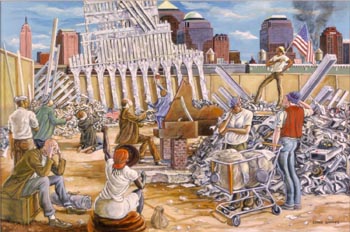
UV: Your latest work, In Remembrance, commemorates the tragic events of September 11th, and is currently on view at the Museum of African American Art in Philadelphia. Was it commissioned?
EB: No, it is a visual response to 9-11. It was a painting acquired by Mr. Bob Green as a gift to the city of Philadelphia because the city has the Hero Scholarship Fund, which con-tributes to the education of children of deceased fireman and policeman. So when we made prints of the painting we sold them at $1000 each in order to raise $100,000 for the scholarship fund. And they're pretty much all gone.
UV: In 1995 your autobiography Pads to Palette was published. Tell me more about your main motivation for writing an autobiography?
EB: I was always asked about how does a professional football player become an artist. So this book really is an answer to that question. It's a story of sensitivity surviving the hazards of being born a male. As a male there are certain codes. Un-written rules that exist that you're sup-posed to live up to. And these rules don't apply to a child that grows up with sensitive feelings, especially one who likes to draw. The term "the hazards of being born a male" means that we're required to do masculine things. That means a boy's not supposed to cry. He's supposed to be tough. He's supposed to be insensitive. So against that back-drop you have me who grew up as a sensitive individual who had to eventually prove himself as a professional football player, or as a football player. So that's why I call it the story of sensitivity surviving the hazards of being a male.
UV: The same year that your autobiography came out, you were in a traveling exhibition, "20th Century Masterworks of African-American Artists." How did it feel to be the only living artist in the show?
EB: I was just very very pleased to be included with such dis-tinguished company as Romare Bearden, Jacob Lawrence, and Charles White.
UV: Although you were introduced to art at a very young age, because of segregation you weren't able to actually attend an art museum until 1956. Only to find that there weren't any African American artists repres-ented in the museum. When you asked the docent why, she said, "Your people don't express themselves this way." Almost 50 years later, it is still hard to find African American work in major museums or in surveys on modern art in general. Do you feel that your contribution as an artist in America right now can further the education on African American art?
EB: All the work I do contributes to that purpose. I do what I can as far as exhibiting and placing my work in collections that have value. And for fees that can be re-spected. I don't work at trying to twist the arms of those that are in positions as the gatekeepers of culture to place my work there. I've had exhibitions in the past, and I'm certain I will in the future.
UV: What words of wisdom would you give an aspiring young artist?
EB: Well if they want to become artists, they have to learn to listen to themselves and to work freely and try to stimulate per-sonal worth by drawing from their own experiences. The most important thing to do is to work, and to look at the work of other artists. Not to copy the work, but to study the work to see what the artist was trying to state. And what method he chose to make his statement.
In Rememberance, which is a visual response to 9-11, originally began as a piece depicting the plight of the homeless.
UV: Some of your older work such as the infamous Good Times painting, Sugar Shack, and The Graduate will be on view at Samuel's Gallery, along with new work. Tell me a bit more about the newer work you'll be showing.
EB: I'll be signing prints of Sugar Shack. There will be some original works on paper as well. Some of these works are studies of paintings I've created that are now in collections. Oakland is really getting a gift at being able to acquire the studies. They're very precious to an artist because that's the roadmap that usually leads to the creation of the painting.
UV: You haven't made public appearance in the Bay Area since 1981. Why did you decided to do a show in Oakland now?
EB: Because Samuel Fredericks [of Samuel's Gallery] asked me to. I like Samuel's Gallery very very much. And I like the effort [that Samuel] has done to bring art to the Bay Area. When I first came to the Bay Area [in 1981], it was at gallery that was run by a friend of his. I just like to get my work before people because I believe an artist plays a major role in shaping public sensibility. And that's part of my purpose.
[ East Bay | Metroactive | Archives ]
Copyright 1994-2025 Weeklys. This page is part of Metro Silicon Valley's historical archive and is no longer updated. It may contain outdated information or links. For currently information, please go to MetroSiliconValley.com home page, e-edition or events calendar.
|
![[whitespace]](/gifs/whiteline2.gif) |