
|
 |
|
[ East Bay | Metroactive ]
Listings to plan your week by
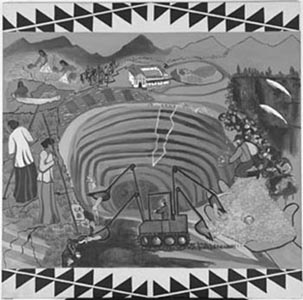
Pratap Chatterjee, author of Gold, Greed, and Genocide, reads at this week's "Sedition: Poetry and Politics."
Poetry and Politics with Pratap
Pratap Chatterjee wears many hats. He hosts the weekly environmental radio show, "Terra Verde," on KPFA, is the Environmental Commissioner for the City of Berkeley, has won multiple awards for his investigative journalism, works as the research and media coordinator for Project Underground (a local environmental and human rights watchdog), created Gold, Greed, and Genocide -- the book and the documentary -- about the dire impact of the 1849 Gold Rush on California Native Americans, writes plays, and is a prolific spoken word artist to boot. All things considered, I think it's safe to say that Chatterjee is somewhat of a local hero. In recognition of this impressive list of accom-plishments, "Sedition: Poetry and Politics" -- a biweekly spoken word staple of the East Bay -- has booked Chatterjee for its next event. Come bask in the brilliance of Pratap's personal sedition at the TUVA Space in Berkeley this coming Monday. Feel free to bring along some of your own favorite food and drink (within reason) as well as your notebook -- freshly inscribed with your latest poem, song, rant, skit, or speech -- for the open mic.
Mon/19, 7:30pm. TUVA Space, 3192 Adeline, Berk. $3-$5 sliding scale (no one turned away). [email protected]. (EL)
Tape is to music as cinema is to theatre.
Transparent Tape Music Festival 2
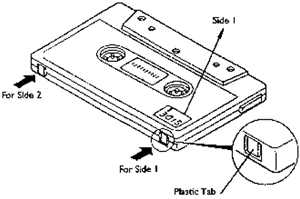
Remember your first double decker tape deck? The possibilities! Splice from the radio, from other tapes, stopping and starting, slowing and speeding, a maestro, if you please. You can even beat tapes up (they're of sturdy stock), throw them in an open shoebox unsheathed (don't forget to label), and even re-spool tape intestines if they happen to spill out everywhere (with a pointer finger). The "New" San Francisco Tape Center never gave up on the tape, selling their whole collection for two bucks at a garage sale at the first whiff of CD. Matt Ingalls and Joe Anderson, lead curators of this revitalized camp of composing for a fixed medium--in this case, tape--see the record/playback dynamic as a "vital and unique territory for exploitation." Tape music's not music in the same way that cinema is not theatre, the argument goes. Out with live performance and instrumentation, and in with cutting and pasting taped nuggets ad infinitum. Presented together with sfSOund, ACME Observatory Contempory Music Series, and Transparent Theatre (a renovated church complete with pews), the festival is part historical survey of the genre, and part showcase for new composers. Highlights include a reworking of the first computer music ever recorded, pieces by global leaders in the niche field, and six premieres of new works by local composers. Old mono feedback works are reincarnated as a wall of sound on a 20 plus loudspeaker surround system, the arrangement of which is all part of the symphony. The whole festival is a tribute to that box o' mixed tapes everywhere, just on a larger scale.
Fri/16-Sun/18, 8:30pm. Transparent Theatre. 1901 Ashby, Berk. $7-$15. Reservations recommended, 415.614.2434. Complete schedule, http://sfsound.org/tape.html. (EP)
Alexander Rodchenko: Modern Photography, Photomontage, and Film
Alexander Rodchenko (1891-1956) was one of the most talented and prolific of the Russian Avante-Garde. Unlimited in versatility, he plumbed the depths of painting, design, illustration, photography, and film. An impressive array considering he was engaged at various times in teaching, directing a museum, and serving in countless government art agencies. Like many of his contemporaries, Rodchenko fervently believed in the Communist ideal and art's role in furthering it. Thus, he committed his considerable formalist talents to render dynamic, energetic imagery that belied a reality that was sinking ever deeper into deprivation and terror. The starkest example of this was his documentation of the White Sea Canal project--a futile endeavor that resulted in an unnavigable waterway and the deaths of over 200,000 forced laborers. Ultimately, Rodchenko's considerable flair for embellishment proved insufficiently distant from reality for the Soviet apparatus. Stalin's Socialist Realism, a movement that fabricated reality outright, pushed Rodchenko and his modernist aesthetic into oblivion. The last twenty years of his life were spent in poverty and obscurity in the utopia he had conjured through his camera lens. An exhibition featuring Rodchenko's photomontages, original publications, cinematic montages, and photographic portraits will run from August 14th to October 13th at the UC Berkeley Art Museum in Gallery 3. A panel discussion regarding his relationship with the Soviet State will be held on September 29.
Wed/14-October 13, Wednesday through Sunday, 11 am - 7 pm. Berkeley Art Museum and Pacific Film Archive, Gallery 3, 2626 Bancroft Way, Berk. $4-$6. 642.0808; http://www.bampfa.berkeley.edu/main.html. (JN)
[ East Bay | Metroactive | Archives ]
Copyright 1994-2025 Weeklys. This page is part of Metro Silicon Valley's historical archive and is no longer updated. It may contain outdated information or links. For currently information, please go to MetroSiliconValley.com home page, e-edition or events calendar.
|
![[whitespace]](/gifs/whiteline2.gif) |
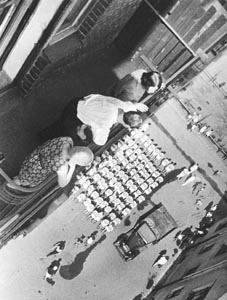 Gathering for a Demonstration, 1928; gelatin silver print; now showing in "Alexander Rodchenko: Modern Photography, Photomontage, and Film," at the Berkeley Art Museum.