
|
 |
|
[ East Bay | Metroactive ]
Blaktronik Science
Oakland-based electronic music duo create themselves into the future
By Sylvia W. Chan
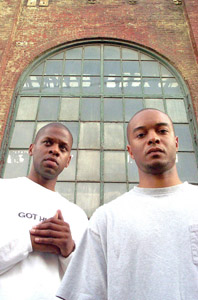
"Ass Bomb"--a new monthly party at San Francisco's Club Six--is bumping and Blaktroniks is breaking it down, talking satellites and slavery, music and freedom, souls and technology. "Think about it," says Edd Dee Pee (aka Eddie Smith), "everybody got these cell phones now. And cell phones are hooked up to satellites. If you got a satellite, you could manipulate millions of people's minds at once. There are no people of color that own a satellite. See?"
Later, X-Ray (aka Badi Malik) offers up this take on the cur-rent state of affairs. "People are in prison," he says as I stare at his t-shirt, which reads "FUCK THIS" in white capital letters on a black background. "But music can change that. Look at it like this. I look at slavery as an experiment in seeing if you can corral a human being much like you would a horse, to see if you can break it, like when you put a saddle on that horse. And the one thing humanity has proven is you cannot break a human being like you break a horse or an ox. We put that in our music, that raw human spirit you cannot break. You hear it, and hopefully, you vibe to it."
Blaktroniks makes music with machines, music I-- an R&B writer from Oakland who doesn't know shit about electronic music--probably wouldn't know what to do with if it wasn't for that vibe, a soulfulness and strength that pervades the layers of sounds tumbling from their laptops and sequencers, a sensuousness that runs through their latest album, Seduction at 33 1/3, released last month on the German label, Moving Records. Former San Francisco Bay Guardian club columnist, Amanda Nowinski, hipped me to the band a while ago, but I was reluctant to check them out; thought I'd be alienated by their stuff the way I was when I tried to get down with folks like Kid 606, Aphex Twin, and Autechre. No disrespect to any of those artists, but I like music to grab my body and mind, the kind of stuff that goes beyond my cerebrum and gets sexy on my ass, the way Seduction does with tracks like "Fais Mois Fremir" (which features vocalist Shi-Shi Monique and saxophonist Klaudia Promessi) with its torch-song shimmer and shades of Sade, or "Do U Want 2," a haunting stunner with a muted, stuttering heartbeat, gorgeously minor-key chords, and plaintive vocals by singer Naziere that come in at song's end and make you ache like hell. And while Blaktroniks pushes musical boundaries the same ways those aforementioned artists do on cuts such as "Teknik Cleansing" and "Talking Drummachine," blending postmodern aesthetics, caustic commentary, and a sly wit wrapped in an experimental spirit and meticulous production values, they also write songs that surpass clever collage, tunes that prove that the soul is not in the machine, but in the people tweaking them.
Roots Innovation
Here at Six tonight, I'm a bit overwhelmed by the guys' acerbic views on the scene and the world, suddenly regretting the three shots of Beam I poun-ded to calm my nerves, and wondering how the fuck I'm going to contextualize their comments in terms of the environment around us--a club in the heart of San Francisco's increasingly gentrified Tenderloin that's full of the band's friends and peers (like Jonah and Billee Sharp of Reflective Records and the Bored Collective--the main organizers behind the event), as well as a whole lot of drunk, mostly White folks (who seem to make up the majority of any SF club's demographic these days) dancing their asses off to the evening's headliner, Black Detroit techno legend Carl Craig. Both Nowinski and writer Philip Sherburne have written articles on Blaktroniks (in the Guardian and the SF Weekly, respectively) that highlight the facts that although much of electronic dance music originated in African American communities with folks like Craig and Larry Heard (who Blaktroniks will open for at next month's "Ass Bomb"), the genre's audiences are mostly white, and that the Oakland-based band gets far more love overseas in Europe that they do on their very own side of the Bay.
The first point's something the guys are well aware of, and though Malik and Smith, both 33, insist the disparity doesn't change how they go about their business, they're resolute on the fact that they make Black music, that the sound of "blackness"--no matter what mainstream conceptions of it may be--is, as Malik says, "rooted in innovation and necessity, the need to create and create new things." Smith builds on this sentiment when we speak a week later, stating matter-of-factly, "We're Black, so everything we do is Black. You can't say we make White people's music because we're Black. You can't separate the color from the art." As to the second point, both say they have immense faith in this city of ours, with Smith citing local legends like 2 Short, Digital Underground, and Tony Toni Toné as folks he's proud to share a homebase with, and Malik, who arrived here seven years ago via Milwaukee and Minneapolis, saying emphat-ically, "I love the people of Oakland--it's a community here, a real city." So, I ask them, why should Oakland give a fuck about two fellas messing with a bunch of machines? Smith doesn't mince words in his response--"Oakland should care because we're offering another option. And we're not trying to cut in on anybody's else's money, so you can't hate. We're not trying to cut in on the Coup's money, on the Tonies' money. We're just trying to chill right here next to everyone."
Electronic Ebonics
Smith and Malik hooked up back in 1996, after Smith (who was born in Detroit and lived in Los Angeles before finally settling in the Bay 15 years ago) saw "a need for Blaktroniks," saw that "there was an empty space" in the local scene. He says he chose the name Blaktroniks because he was trying to come up with something both "electronic and ebonic," and though the title may seem to connote an emphasis on race, Smith says this was not his intent at all. "The plan was to come up with a group that made some really good electronic music where you wouldn't be able to tell whether the people making it were Black or White," he explains, "but surprised people by having a name that made them question what is Black or White, you know?" Malik--a software engineer who'd been involved in "alternative rock kind of stuff" and "a lot of avant-garde jazz scenes" back in Minneapolis--had started a record company, Dykon Integrated Media (www.dykon. com) at about the same time, and joined Smith in a mostly "administrative capacity" at first, but soon became part of the music-making process himself. The years that followed have been productive ones; they've put out four full-length albums--Return of the Afronaut, Process of Illumination (both released in 1997), National Tantrum (2000), and Seduction. Together, the two make interesting colleagues, and while both are sharp, witty, and outspoken as hell, Smith's the group's obvious front man, the guy who works a crowd with a metaphor for everything and quip for everything else, while Malik's the quiet guy behind the scenes, the calm one with a slow smile and occasionally, a wickedly subtle sarcastic streak.
Both stress that innovation is something Black music needs more than ever these days, and that the only resentment they have about the lack of accep-tance of their music in their own communities is due to the fact that, as Smith says, "motherfuckers are still scared and they don't even know it. The future is now, you know? There's nothing retro about it."
"And," adds Malik, "I've listened to all the classics, the Marvin Gayes, the Stevie Wonders, the Sam Cookes, just to name a few--and the thing that bugs me about what goes on in this country is you got any number of people trying to repeat what people like that have done. I think it's really important for African Americans to move forward and the only way we as a people can move forward is if we advance mentally ... we can't keep trying to duplicate some romantic period in our minds of what the good old days were like. There were never any good old days. People were struggling in the 'good old days' just like they are right now. And that's the only resent-ment I have."
Blak to the Future
Listening to Smith and Malik speak, I'm reminded of a moment from Richard Pryor's comedy album, Bicentennial Nigger, in which he drops these classic lines: "I don't like movies when they don't have no niggers in 'em. I went to see Logan's Run, right? They had a movie of the future called Logan's Run. Ain't no niggers in it. I said, well, White folks ain't planning for us to be here. That's why we gotta make movies. Then we'll be in the pictures." And suddenly, I think that that just may be the way one contextualizes Blaktroniks in the world at hand, two guys dead-set on the fact that Black folks have to see themselves as part of the future, have to create themselves into the future, and that if they don't, nobody, especially the powers that be, are going to go out of their way to make that happen. Malik says he believes electronic music's the only medium in which he truly feels people can create something that's never been heard before, that within it, "you can take something that isn't even music and make it music.
"And that's thrilling," he says quietly as Craig's set winds down, my buzz fades, and "Ass Bomb's" clientele slowly drifts back towards the world outside the club's doors. "That's a thrill."
[ East Bay | Metroactive | Archives ]
Copyright 1994-2025 Weeklys. This page is part of Metro Silicon Valley's historical archive and is no longer updated. It may contain outdated information or links. For currently information, please go to MetroSiliconValley.com home page, e-edition or events calendar.
|
![[whitespace]](/gifs/whiteline2.gif) |
 Eddie Smith and Badi Malik of Blaktroniks are all about making music that moves the spirit (and your ass).