|
 |
|
[ East Bay | Metroactive ]
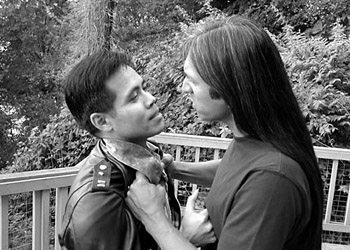
Low Rez-olution: Seymour (Evan Adams) gets an earful from Ari (Gene Tagaband) when he returns to the reservation in 'The Business of Fancydancing.'
Moanologue
'The Business of Fancydancing' follows a poet who has torment by the ton
By Richard von Busack
Let's make a giant leap of logic and presume that the fictional Seymour Polatkin (Evan Adams), the successful gay Spokane Indian poet, has something in common with the writer/director of The Business of Fancydancing, the successful gay Coeur d'Alene Indian author and poet Sherman Alexie. No broke writer ever labored on a screenplay about the emotional pain of a rich writer. In The Business of Fancydancing, Polatkin re-examines his roots when an old friend, Mouse (Swil Kanim), dies. For the first time in 10 years, the poet returns to the reservation where he and Mouse grew up. There, his former friend and now enemy Ari (Gene Tagaband) confronts Seymour. The poet is still remem-bered and disliked as the sissy who got too big for his britches and became a literary star in Seattle while his two best friends from childhood stayed behind, wasting away in violence, cynicism, and substance abuse.
Seymour loathes the reserva-tion as a prison where Native American populations are stuck, drunk, and suicidal. In that, he has something serious to talk about. But despite Polatkin's un-derstandable bitterness, he isn't as alone as he thinks. Let's see: he's self-loathing, he's gay, he's in AA, he's depressed about his cultural heritage, his parents are dead alcoholics, his childhood friends are anti-intellectuals who don't understand him, and he loved someone who couldn't love him back. Welcome to the club, Poindexter! You could meet 19 people with those troubles at any poetry reading in America, and chances are they're not getting published, either.
Seymour may have bad mem-ories, but he's treated like a prince. The poet has an ob-gyn boyfriend, Steven (Kevin Phillip), who worships him, but Seymour only has contempt for him. You have to be paying attention to note that Seymour's old girl-friend Agnes (Michelle St. John, charming in a badly written part) supported Seymour through college. He influenced Agnes to go to the reservation, although she hadn't grown up there. She's culturally at home but doomed to unhappiness. Supposedly, she thinks twice a day of how great it could have been with Seymour, if only he were straight.
Adams plays Polatkin with levels of coyness unseen since Truman Capote died. In the most aggravating scenes, Polatkin argues with an angry interviewer (Rebecca Carroll) who believes that the poet has sold out Native Americans. This straw-woman reporter is like the fake news-casters Martin Lawrence hired for the opening of his new in-concert film. In the old days, artists castigated themselves; it was a more hands-on era.
We can forgive an artist his incredible narcissism--and maybe even his repellent ethno-centric streak--if he's honest with us. There's one poem here that transcends self-pity, a piece about children waiting in a car outside a tavern for their parents to finish drinking. But just as Alexie's last film was called Smoke Signals, this one ought to be called Smoke Screen. The film fogs our understanding of this writer.
The Business of Fandydancing--one of the year's most agonizing shot-on-digital films--offers more evidence that the digital-camera revolution may be as big a bust as the dotcoms. It's as if someone had designed a revolu-tionary new hammer, and people thought the new tool would turn them into a carpenter overnight.
[ East Bay | Metroactive | Archives ]
Copyright 1994-2025 Weeklys. This page is part of Metro Silicon Valley's historical archive and is no longer updated. It may contain outdated information or links. For currently information, please go to MetroSiliconValley.com home page, e-edition or events calendar.
|
![[whitespace]](/gifs/whiteline2.gif) |