|
 |
|
[ Features Index | East Bay | Metroactive ]
In History, Outside
The Geography of Hip Hop
By Brian Goedde
Represent, Represent
In rap music, geography is compulsively referenced. Jay Z is from Brooklyn; LL Cool J, Nas, and A Tribe Called Quest are from Queens; Snoop Dogg, Freestyle Fellowship, and Dilated Peoples are from Los Angeles. Too Short is from Oakland. Nelly is from St. Louis; the Roots are from Philly; Big L is from Harlem; Goodie Mob is from Atlanta; 2 Live Crew is from Miami; Geto Boys are from Houston. This is not information to be discovered; it's communicated in their lyrics. To know their music is to know their city of origin.
Oftentimes a geographical origin is established even before a rapper states his or her name. The Detroit crew Slum Village, for instance, carries geography in their name itself, connoting both urban and rural; their album Fantastic Vol 2 begins with the song "Conant Garden," in which the MCs Baatin and T3 declare that, "Where we come from is a place we call Conant Gardens." "'Motown!'" says a sample, and they answer: "Get the shit started." Only now that group name and place of origin have been established can the album begin.
A person's place is his or her surname; we should just as soon say "KRS-One of South Bronx" -- except we'd actually say "KRS-One of the Boogie Down Bronx," a place-name he coined in the creation of his group Boogie Down Productions (likewise, the Roots re-cast the city they live in as Illadelph). Or we might say "Ice Cube of Compton," of the man who announces himself and his group in one of the most famous hip-hop introductions ever, as "comin' straight outta Compton / Crazy muthafucka named Ice Cube / From a gang called Niggaz With Attitude / When I'm called off / I got a sawed-off / Squeeze the trigger / And bodies are hauled off."
Ice Cube frames his thrilling entrance by identifying his city even before invoking his "called name," as if the name is secondary to the place, or created by the place. This song and album announce the presence not just of NWA, but of Compton itself as a hip hop presence. Ice Cube, who will kill us if he's "called off," is terrifying, but what made him such a crazy muthafucka? The song itself answers, with a repeated chorus sample: He's from "city of Compton." Ice Cube's insane brutality is an extension of his place of origin. In fact, he is an extension of his city: he is barreling out of Compton, into... where? If he's "straight outta Compton," what is he headed straight into? Any-where his music is played -- including your own bedroom.
In the 1970s, the poet Richard Hugo issued his commandment: "You found the town/ Now write the poem." As blunt as his version is, hip hop surpassed his words with the most sublime edict of all: Nas' "Represent, represent!" In lyrics, photos, postures, and attitude rappers are obligated to represent the place where they come from. They represent the place in the sense of lyrically depicting it, presumably because they have a love for it, but they also represent the place in the sense of being a literal representative of that place. The place is responsible for creating the rapper (as in the case of Ice Cube and Compton), and they, in turn, are responsible for the place. As MC Phife of A Tribe Called Quest says, "If my partners don't look good, Malik don't look good/ If Malik don't look good, Quest don't look good/ If Quest don't look good, Queens don't look good/ But since the sounds are universal, New York don't look good."
Rap's study of its own ecology is that intense. Since the place -- as much as the rapper -- is the author of the art, it obligates the rapper to feel responsible not only for his or her partners in the rap group, but for the day-to-day reality of the neighborhood. This is "repre-senting" with the most serious weight of the word, as a lawyer represents the accused in a court of law. Even more serious: the lawyer is not synonymous with his client, but Phife is attempting to be-come synonymous with Queens and New York. "Representing" a place means full commitment to pleading its case.
The rapper is responsible to his or her place of origin -- but that place is open to definition. For a place to be represented, the rapper must feel appropriately represented by it. Some rappers claim that they're from another planet and the transmission of their artistry is their message to Earth. This is what Kool Keith did on Dr. Octagon, stepping entirely outside the physical boundaries of his home to declare, "Earth people, New York and California/Earth people, I was born on Jupiter." On ATLiens, Outkast claims both a place on earth and some other world; the album title compounds "Atlanta" and "aliens," and in the liner notes, Outkast claims to come from "Atlantis." The dual existence of being "from Atlanta" and being an alien -- or as their name describes, outcasts -- suggests an element of real existential struggle. It's obvious why a racial population descended from slaves would feel alien to where they now live; as Charles Mudede once wrote, the history of the Atlantic slave trade is the closest thing humans have to understanding what alien abduction might be like. Rap is certainly a descendant of this profound alienation, and this may be what compels rap music to insist on establishing an origin, Earthly or otherwise.
Inslumnational Underground
Nelson George writes in his book Hip Hop America that, "Because hip hop has so many elements -- music, clothing, dance, attitude -- its essential mutability makes it adaptable worldwide." More succinct as usual, hip hop itself identifies its worldwide constituency, in Outkast's song "Bombs over Baghdad," as the "inslum-national underground." Outkast has that Joycean knack for compressing entire essays into the space of a single word: Just as in the word "ATLiens," the phrase "inslumnational underground" simultaneously identifies and creates a new geographical structure.
Imagine the flight patterns of the 747 over the skies, connecting cities by their wealth; Outkast constructs the inverted reflection of those paths, an international, subterranean network con-necting the world's slums. Every American city may have a slum, but when its inhabitants are "inslumnational," they are not in exclusion; they are not "ghettoized" to a certain number of blocks: they belong to an international population. It suggests a powerful world-wide network of like minds, linked over nations' bound-aries -- but by way of the slums, that city zone from which, it is often said, there is no escape.
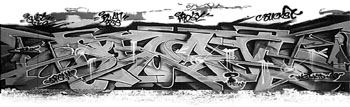
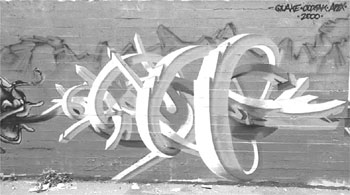
And the art of hip hop has passed beyond American borders: Japan and France have produced visionaries like DJ Krush and MC Solaar, respectively; There are now rappers in German, Spanish, Italian, and Japanese who are every bit as inventive as their American counterparts. Other cultures have pored over the elements of hip hop and selected those which make sense to them, and have formed their own voices. This is a fundamental, built into the hip-hop process -- the same as taking Adidas sneakers and pulling out the tongues; taking a concrete wall and making it a canvas for graffiti; taking a James Brown break and turning it into an entire song.
American rappers have been busy exploring the rest of the world as well. First, of course, is the attention given to Africa. Among dozens of other examples is the X Clan album To the East, Blackwards, and the Stesasonic rap, "A-F-R-I-C-A, Angola, Soweto, Zimbabwe / Tanzania, Zambia, Mozambique / And Botswana, so let us speak / About the motherland." The Dead Prez later elaborate on this chorus, bringing it back to the Western Hemisphere -- "A-F-R-I-C-A, Puerto Rico, Haiti, and J.A. / New York and Cali, F-L-A" -- arguing that, because of the elaborate, generations-long Atlantic slave trade, "Africa" consists of these places as well as the countries on the actual continent. "No it ain't 'bout where you stay," they conclude, "it's 'bout the motherland."
Beyond expressing a definite inslumnational solidarity, rap has become a way to "think globally and act locally." The most stunning example of international travel in a rap is a song called "World Trade," by the Ukenjam crew. The chorus is about them "going all around the world / on a musical search / from city to state / diggin' in the crates, giving birth." ("Diggin' in the crates" is the act of searching for records, kept in milk crates.) The MCs bring different levels of internationalism to the track: Chicara raps in Japanese, NewMan raps an autobiography of his life-long travels that coincide with his hip-hop experiences, but the verse that steals the track is Maanumental's:
"I hopped the train, went to the Ukraine / Where crews hang, and sing tunes of true pain / Felt them for a bit then skipped to see the Swiss / That help be on time with rhymes that I rip / I dipped to the Deutschland to learn with the Germans / Bumpin' Kraftwerk on the Autobahn, swervin' / Flew to Ireland, soon as the tires land / See T. Soul grinnin' with a Guinness in his hand / Scram to Amsterdam, threw a few jams / Hit the smoke shop, ran through a few grams / Exhaled and set sail to chill in Brazil / Capoiera skills helped build my windmills / Jetted to Japan and cooled with tight crews / Next thing I knew I was rhymin' haikus / Cruise to the Caribbean and walk the plank / Spark the dank, changed my last name to Ranks / Rolled the wave breaks to the shores of Australia / Vibed with the Aboriginal wise story-tellers / And last but not least, the motherland to feast / Those mother yam treats, rockin' summer jam beats."
Maanumental travels the world in his mind; his vehicle is not trains or planes but hip hop. Just as he represents his crew to the rest of the world, he can indulge in the pleasures of hip hop found in all its international forms: Kraftwerk, Capoiera, and Car-ibbean weed. He takes Nas' phrase "The World Is Yours" literally.
Street Ministry
Even so, there is a fund-amental anxiety in hip hop, that it represents a society but has no place. As fully loaded as hip hop is with ethics, codes of conduct, specific language, "throw[ing] your hands in the air," and other ritualized elements, hip hop is a fully realized civilization -- but an unlocated one. The "inslum-national underground" is underground precisely because it has no true place to call its own: no city, no temple, no institutions. Rap has, nevertheless, developed a location for itself that is as metaphysical as it is physical: rap is from "the streets."
"The streets" is probably the most intrinsic of all rap precepts. All rappers, all songs, all careers, and all aspects of hip hop culture are measured by their distance from the street; and the closer to the street, the more "real" the rap is. Rap uses "the streets" with the full weight of metonymy -- like saying "Washington" to mean "the government." But where the metonymy of "Washington" is grounded in the Capitol Building, White House, and so forth, "the streets," as they exist in rap, run through places, or by places. "The streets" aren't a place in themselves; they are a non-place, a shared idea of place. Dr. Dre claims he is "still taking my time to perfect the beat / And I still got love for the streets." He of course means the politics and cul-tures found there, but where there?
"The streets" is a meta-physical city, composed of all the places ever mentioned in rap. The street supercedes the literal city from which a rapper hails. Whether s/he is from Chicago, Oakland, Seattle, New York or Berlin, the rapper represents the streets of that city -- not the entire city.
As much as "the streets" aren't a place, their presence dominates the consciousness of hip hop. Even when rappers don't mention them explicitly, they're talking about the streets. In Group Home's "Supa Star," for example, MCs Lil' Dap and Melachi rap about the terrors of ghetto life and the tortured psychology it creates. It begins with them in conversation:
Melachi: What the fuck is wrong with you man? Shit
Lil' Dap: Yo I be seeing out my
Melachi: Man yo I be seeing
Lil' Dap: The world's about
Although they are speaking from within Lil' Dap's apartment, the building they're in doesn't contain the ghetto life that they rap about: It's what's outside that compels the rap, because it's what's outside on the street that constitutes their condition.
The view of the streets isn't always a scene of terror: In "World Party," Goodie Mobb wants to "wash away the pain so we all can party in the streets." Snoop Dogg is happy to be "rollin' down the street / smokin' indo / sippin' on gin and juice / laid back / with my mind on my money and my money on my mind." In Snoop's case, the street is a site of total pleasure, replete with alcohol, weed, and thoughts of money (and what more could you want?).
As an environment expressed in rap music, the street has no structures on it, no buildings, landmarks, etc; there is only the same shared surface of the street itself. Yet the street is in a state of constant negotiation between private and public space. The traditional privacy of one's car, for instance, is converted by Snoop into the most public displays of indulgence. A public sidewalk becomes a private space if business is being transacted there. Even that most private act, the act of murder, is made a public act ("Yo I be seeing out my window gunshots every day") when it occurs on the street.
At the opening of "All the Places" by Pete Rock and C.L. Smooth, the track opens with a soul vamp of "the spaces and places I've been / Aaaaaaaaall the spaces and places I've been," repeated four times. C.L. follows it not with an actual list, as Maanumental might have, but with a melange of unnamed spaces with meta-phorical features. "Welcome to the zone where the strong only survive / Places I drive all the gangsters can't stay alive / Take my universal journey through the jungles of the hardest town / Where my brothers lay their lives down." He welcomes you to "the zone" that he is in; not a specific place or defined space, but an unidentified "zone," inside which lies a "town" and "jungles"; this is the zone of the streets, the conflation of spaces and places, of personal and universal. "The streets" is as specific as your block, and as common as a shared myth: to listen to hip hop is to enter this zone, this city in common.
Or: "Knowledge is the key and if you ask 'what is it, G?'" Guru raps, "It's just the form of my style of street ministry."
[ East Bay | Metroactive | Archives ]
Copyright 1994-2025 Weeklys. This page is part of Metro Silicon Valley's historical archive and is no longer updated. It may contain outdated information or links. For currently information, please go to MetroSiliconValley.com home page, e-edition or events calendar.
|
![[whitespace]](/gifs/whiteline2.gif) |