|
 |
|
[ East Bay | Metroactive ]
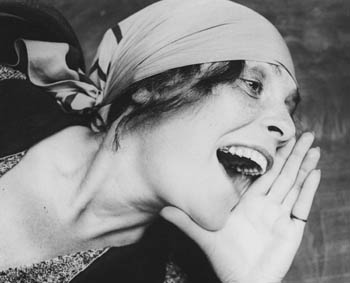
"Lily Brik, 1924," by Alexander Rodchenko on view at the Berkeley Art Museum.
About This
Rodchenko's photomontages offer a romantic glimpse at the modern world.
By J.D. Buhl
All Berkeley's in love with Lily. Her dazzling lines call for Beauty and Truth and citizens respond. She demands "Look at me henceforth!" and all the vigorous hope of 1924 Russia showers from her laughing face. But upon first encountering the ubiquitous Mrs. Brik -- Mayakovsky's lover and herald for a new show of Alexander Rodchenko's photography -- I thought it was Steven Tyler from a '70s Norman Seeff session: the openness, the joy, the warm grays marbling black-and-white in action. And Seeff's subjects seemed always to have their mouths open, playing. It's a marvelous picture, from the scarf to the freckles to the pinkie ring, and deserves more eye time than one can give it on passing busses.
But there's nothing else like it in the Berkeley Art Museum exhibit. The closest thing to joy is beaming athletes, or the hint of humor in Rodchenko's photomontages as they make the covers of journals or illustrate Mayakovsky's writings. There are some great angle explorations, but most pieces display that particular love for the modern world that can romanticize radio towers; a love of speed and machinery that makes progress the real subject.
My momentarily mistaking him for Seeff is testament to Rodchenko's dynamic innovations having permeated contemporary art; the perspectives and dramatic layouts of the Russian avant garde forged the modern aesthetic and never left -- they dominate our advertising and propaganda. Rodchenko -- first painter, then collagist, then photographer -- was employed by Soviet enterprises to "celebrate the totalitarian ideal." He believed the bourgeois decadence associated with artists could be transcended for the artist-as-graphic-designer, a worker among workers. Seeff, by chronicling the coke-fed growth of the counter culture's aristocracy, lent his own chocolaty tones to the promotion of a different "revolutionary optimism."
Perdition awaits. By the time his enthusiasm fell from favor, Rodchenko was reduced to documenting the vicious White Sea Canal project where 200,000 "criminals" (class enemies) died in forced labor.
Mayakovsky's last poem for Lily was "About This." "It's terrible -- not to love," he wrote, "horrible -- not to dare." But the Soviet dare was made to the masses, not the individual. It's the lovely Lili who beckons, not Mayakovsky's shriveled "widow," written out of history. The poet himself hangs around the corner, as stuck to the end of a cigarette as Robert Johnson. His suicide looms, bourgeois decadence lives on. Progress too is ravaged by time. Here enters despair, the emptiness of passion when directed to the state. This is only secondarily the theme of "About This." Mayakovsky thinks it's about his anguished love and the monstrous life it creates. But "this theme a knife to my throat plied," and hissed how despair lies behind these photographs like the paper they're printed on. Considering our current state of manipulation, you may look on this aspect of the exhibition "and looking at it, a banner-bearer you'll burn, a flame of red-silk on a banner-filled earth. ... Your spirit will burst from your very own skin."
[ East Bay | Metroactive | Archives ]
Copyright 1994-2025 Weeklys. This page is part of Metro Silicon Valley's historical archive and is no longer updated. It may contain outdated information or links. For currently information, please go to MetroSiliconValley.com home page, e-edition or events calendar.
|
![[whitespace]](/gifs/whiteline2.gif) |