
|
 |
|
[ East Bay | Metroactive ]
Benshi On Board
The lost art of the benshi gets revived in PFA's Japanese Silents series
By Peter Crimmins
Next to Dolby DHX Surround and pop music cross-promo-tions, silent film has it rough. It's hard to get anyone besides hardcore cinephiles and Buster Keaton fans to sit through silent moving picture-postcards of a time and a place long gone with-out some kind of added bonus. This is not a new problem. Japanese exhibitors at the turn of the century had to figure out how to show American silent pictures to their feudal-trapped and Kabuki-trained audiences. The stories from the West were baff-ling, and their customs shocking: why do Americans allow them-selves to be kissed in public?
In these early years of Japanese cinema, exhibitors developed a live-narration style called katsuben, performed by someone called a benshi. It was the benshi's job to explain why the man with the handlebar moustache was grabbing the woman in the corset, or - when Japan began its own film industry - why the man with the long sword was ignoring the woman in the kimono. Kabuki theater audiences knew all about nar-rators, so a person standing in the theater bellowing the story on the screen in a flamboyant cadence was perfectly welcome. More than welcome, they were the draw. You couldn't sell a ticket without a benshi on board.
The audience more easily identified with the person stan-ding in the theater than the shadows flickering on the screen, so a benshi had the position and power to change the story on the screen if he or she saw fit. It was his show and he worked it. Either to please the censors or to play to the yokels in the rural audience at a tent-screening, a benshi could turn the besieged king into an evil overlord and the bandit marauders into samurai revolutionaries. Benshi created their own in-dividual styles, and audiences lined up to see them rather than the films they were narrating.
Japan held onto silent film for a few years after America had switched to sound, but the writing was on the wall. Dialogue on a sound strip eliminated the need for benshi; their heyday came to an end in 1937. Besides a brief appearance on American television in an episode of South Park (Robert Smith vs. Mecha Streisand), the art of the benshi is an evaporating craft.
Japanese silent film is itself a rarity. Very few titles survived the 1923 Tokyo earthquake, WWII American firebombing, and the nitrate film stock they were committed to. The perpet-uity of Japanese silent film and the art of the benshi can be largely attributed to one man: Matsuda Sunshui, whose Matsuda Productions archives films and ketsuben recordings, and trains new benshi. He passed away in 1987, and now one of his prize pupils will be appearing at the Pacific Film Archive this week-end to perform as part of the PFA's Japanese Silents series. An international ambassador of Japanese silent film, Midori Sawato will be performing four shows during her 3-day stay in Berkeley, including The Water Magician, an early film by cinema master Mizoguchi Kenji (Fri, 7:30) about a woman water magician who falls for a young man's boyish charm. It needs some cultural translation at the outset - a water magician uses a long paddle to create patterns on the surface of a lake or river; they were once popular at summer fairs in backcountry Japan. That might be the only Cliff Note you're going to get from this Japanese time capsule offering a glimpse of what film-as-theater once was. U
[ East Bay | Metroactive | Archives ]
Copyright 1994-2025 Weeklys. This page is part of Metro Silicon Valley's historical archive and is no longer updated. It may contain outdated information or links. For currently information, please go to MetroSiliconValley.com home page, e-edition or events calendar.
|
![[whitespace]](/gifs/whiteline2.gif) |
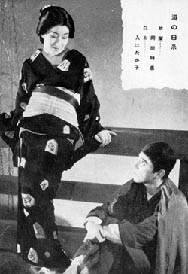 Japanese silent cinema master Mizoguchi Kenji's The Water Magician.