|
 |
|
[ East Bay | Metroactive ]
Final cut: Improvisation and scripted elegance marry each other in Shadows.
Take Two
Indie filmmaker, Rob Nilsson, presents his own film series alongside his hero John Cassavettes's famous works.
By Peter Crimmins
Genius? Misogynist? The answer to Le Tigre's lyric about the revered father of American independent cinema might be both, and a whole lot more. John Cassavettes's legacy as a fearless actor's director (an operandi kinder to actors than audiences) is still recognized in all those Dogma films and by local filmmaker Rob Nilsson, who calls JC a mentor. His still-challenging ideas about acting realism has earned him the title Artist. His oeuvre paints him as a Gambler. We might call him a Huckster.
"People have all sorts of wild ideas about Cassavettes, that he was way-out and faddish. But he was interested in one thing--what's in here," said Nilsson (thumping his chest) in an interview before the release of his film Chalk. Nilsson will be presenting a series of his own films alongside selected Cassavettes works at the Pacific Film Archive every week in October. His last handful of films (Chalk, Slope, Scheme 6), made with a collective he created in SF's Tenderloin, takes cues from and furthers ideas of improvisational film-making begotten of Cassavettes, Mike Leigh, and Tomas Vinterburg (The Celebration). In this league of collaborative filmmaking unafraid to get messy with the epic dramas of common people, the diktat director is dead.
Cassavettes entered film-making with a chip on his shoulder. As a marginally successful New York actor in the 1950s with something to prove to demeaning cattle-call TV roles and Lee Strasburg's Actor's Studio, he struck out with his own acting workshop on West 46th Street in NYC. Where Method disciples were encouraged to dig into their essential emotions and body memories, Cassavettes (twice rejected from the Actor's Studio auditions) practiced the notion that character, really, should react from their own insecurities and lies--their masks--rather than directly from their deepest emotions. People routinely deflect themselves from how they truly feel, and hot lava eventually bubbles up through their cracked crust.
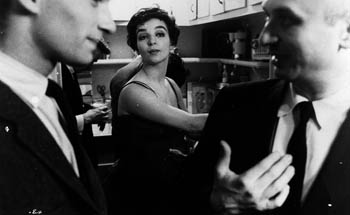
Cassavettes's first film, the famously improvised Shadows, is about three siblings--a struggling night club singer, his young sister who passes for white, and a mumbling, slouch-ing brother who grumbles about "all that Beat jazz." Made with a borrowed 16mm camera and donations from the listeners of a late-night New York City radio show, it ends with a title hovering over a New York street: "The film you have just seen was an improvisation."
Improvisation was now. It was jazz, daddy-o, and the hand-held camerawork around awkward blocking makes the poorly lit B&W film feel immediate. Its murky storyline sparkles with pinpoint flickers of countless emotions flitting across faces, but that improvisation claim is a bit of film-flam on Cassavettes' part. A few years before passing, Casavettes cryptically told film professor Ray Carney no one knew the real story behind the film. That was Carney's "rosebud." He spent a decade investigating the making of Shadows and learned that half of it was scripted by Hollywood screen-writer Robert Alan Arthur.
In 1958, the first cut of the film was seen and unanimously hated by a small circle of friends and critics (the lone applauder was the staunchly avant-garde filmmaker Jonas Mekas). So Cassavettes rolled up his sleeves and wrote and filmed new mat-erial. In Carney's shot list com-paring the original improvised scenes with the newer scripted ones he shows that Cassavettes had fundamentally reconsidered and deepened his characters. Not only do they work through a clearer emotional narrative arc, the scripted scenes are respite from the muddled and frenetic improvised scenes. They have a beginning, a middle, and an end. Avant-garders be damned: Shadows became more user-friendly, retaining that final title card for Beat-cred.
Carney's published list of 1957 scenes versus 1959 scenes prompts moviegoers into a game of Where's Waldo inside the theater, but spotting the scripted bits among the improvised is beside the point. The last title card is not the reason Shadows is still being screened 40 years later. It chal-lenges filmmakers then and now to "fulfill the promise of cinema," as Nilsson put it. "John showed us the way to go."
The Rob Nilsson films being presented are: Chalk (Thu/3), Northern Lights (Thu/10), Words For The Dying (Thu/10), Signal 7 (Thu/17), Heat And Sunlight (Thu/17), Stroke (Thu/24), and Scheme 6 (Thu/24).
[ East Bay | Metroactive | Archives ]
Copyright 1994-2025 Weeklys. This page is part of Metro Silicon Valley's historical archive and is no longer updated. It may contain outdated information or links. For currently information, please go to MetroSiliconValley.com home page, e-edition or events calendar.
|
![[whitespace]](/gifs/whiteline2.gif) |