|
 |
|
[ East Bay | Metroactive ]
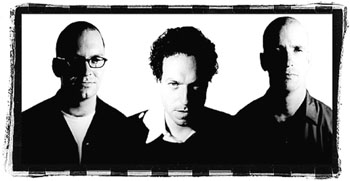
Serious players (l-r): Mark Yahnke, Anthony Bonet, and Bennett Green.
Jazz, The Beatles, and Gongs
Q&A with A Night of Serious Drinking's Anthony Bonet
By Kathleen Richards
While many music fans complain about the lack of quality in music these days, A Night of Serious Drinking aspires to bring new life to a seemingly dying art and is seeing it to fruition with the release of their third album, Never Odd or Even. Formed in 1997 from the ashes of the local rock bands Portashrine (who were signed with Warner Bros.) and Her Majesty The Baby, singer/guitarist Anthony Bonet, drummer Bennett Green, and bassist Mark Yahnke began playing according to principles that characterize jazz and classical rather than rock.
I spoke with the charismatic, Spanish-born Bonet, who's also a longtime DJ at KALX and the booker at Bottom of the Hill, about ANOSD's inspirations, influences, and aesthetic goals.
UV: When did you decide that jazz was such a big influence in your music?
AB: Well it was happening for me already. If you listen to the Portashrine record, you can hear some of that. I was playing with a little bit of dissonance, trying to get more subtle rhythms out of it. There's a song on the Portashrine record called "Again and Again" that I thought we butchered. So we did that song on the first A Night Of Serious Drinking album as a kind of statement saying, this is what's different between this band and the last band. And mostly it comes down to whispering, to the ability to not play, less is more, and trying to be subtle. And to find a space in the songs for layers and layers of nuance as opposed to the song being a bat and you're hitting something.
UV: Was that a personal goal or was that a response to the music you weren't hearing?
AB: A big part of it is DJing at KALX and booking the Bottom of the Hill and seeing the same sort of cookie-cutter thing. And also it came from going to jazz shows, going to classical shows, and see-ing performers really, really give and perform. And none of this bullshit, juvenile, sophomore-in-high-school, petulant attitude that's supposed to pass for rock star stuff. You see jazz players like Billy Higgins or Elvin Jones or Jackie McLean, these guys give
UV: If that aesthetic appeals to you so much, someone might say, so why not just play jazz or classical music?
AB: Well we do, the new record has allusions to Bach and does have jazz pieces. But beyond that, I do still like pop music a lot. My heroes are George Gershwin and Harold Arlen and Irving Berlin and Cole Porter, Chuck Berry and John Lennon and Elvis Costello. I like people who can write, sit down and work at it, craft it. I love the Beatles. The Beatles achieved an excellence. Paul McCartney is a motherfucker! Or Hendrix. Wow, what a monster! So yeah, it's very achievable. It's only in the '90s that we've seen this incredible degradation of the live art.
UV: How is your new album different from your past ones?
AB: Each of our albums is an exploration of something. It's what we're grooving on at the moment. The last record was an uninterrupted suite, it was nine songs that all went seamlessly into one another. But for this record I was exploring a lot of Eastern philosophy and religious thought as well as music theory. And the idea of intervals, of love being defined as an interval. So the record explores inter-vals -- the very consonant pop intervals, the more diminished intervals of jazz, repeated inter-vals like minimalist music like heartbeats and gongs and chimes as a metaphor. In Tibet, a gong is a metaphor for the visible world coming out of nothing. And it is defined in a lot of reli-gious philosophy as male/female, right/wrong; something beyond the palpable realm. Love can be seen as a search for that other half, the complimentary. The Zen people say, "not two not one." And it is, love is a pain in the ass, it isn't just great. So there's a lot to be said and writ-ten about. There's a song on the record, a jazz standard called "But Beautiful," which pretty much sets it up. "Love is funny or it's sad or it's quiet or it's mad. It's a good thing, or it's bad, but beautiful." And really, that's it. That's the record.
UV: That's pretty deep. Do you expect people to get that?
AB: [Laugh] Well, you don't have to. I think the music's enjoyable. I put a lot of thought into the record obviously. There are liner notes that suggest some of the threads running through the record, but fundamentally, you turn it on its head, and it's just a listening thing and the songs either appeal to you or they don't. And then as you listen more, the unity starts revealing itself.
[ East Bay | Metroactive | Archives ]
Copyright 1994-2025 Weeklys. This page is part of Metro Silicon Valley's historical archive and is no longer updated. It may contain outdated information or links. For currently information, please go to MetroSiliconValley.com home page, e-edition or events calendar.
|
![[whitespace]](/gifs/whiteline2.gif) |