|
 |
|
[ East Bay | Metroactive ]
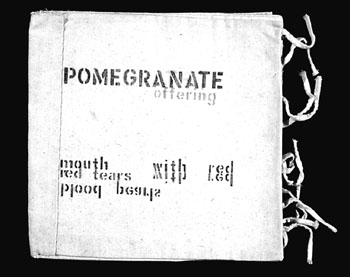
Pomegranate Offering, 1975.
Altered Tongue
Theresa Hak Kyung Cha at the Berkeley Art Museum through December 16.
By Aimee Le Duc
September 11th is no longer a date; it's a state of mind. It drives through our realities like a knife struggling to cut through raw meat. It's painful and seemingly all over us. We've seen the scenes of destruction, we've witnessed the aftermath. Each of us, in our own way, spend our days trying to take it all in, striving to find the language to explain where we are now and how we arrived here. Where are the words that tell us what's happening or how we feel? Words, sentences, histories, languages, ourselves -- how do they all come together?
The Berkeley Art Museum is currently exhibiting a comprehensive body of work by Theresa Hak Kyung Cha. Her films, performances, text-based etchings, and drawings offer us something we desperately need, the space to feel confused.
Theresa Cha was born in Korea in 1951. The country was under Japanese occupation and all Koreans were being forced to speak Japanese. Her family eventually made their way to San Francisco, where Cha had to learn English. She was a woman without a homeland and without a language to express how that affected her. Cha struggles with the emotional and visual characteristics of language and how intimately tied she is to those characteristics. She searches for the roots of words; she deconstructs the meanings of words and sentences by rearranging letters and typography. By manipulating the English language, Cha transforms the relationships we have with our assumed meanings. Take time to watch some of her short video pieces. They brilliantly question notions of what a natural language is and reveal that disjointed relationship between speech and identity.
Cha's family lent many of the pieces to the museum for the show, but the museum has taken bold curatorial privilege with the work, which serves as a major distraction to the overall thrust of Cha's work. Cha strives to discomfort our cushy definitions of family, history, and memory; yet the museum has seemingly labored to bring the comfort back into our sight.
The exhibition is titled The Dream of the Audience. It's unfortunate, though, that the curators didn't give the audience enough credit for their dream. They've imprisoned Cha's work in extreme, sanitized boxes. The linear displays and grid-like presentations make her work read like an intellectual response rather than a passionate and sincere attempt to understand her voice. The overall curation cages an artist whose very expression works to defy the cage.
In these strange and unexplainable times, experiencing art like Cha's is exactly what we should do. It reminds us that language is one of humanity's most powerful and mysterious tools. It can destroy as much as it can create new pieces of us. The Dream of the Audience helps us realize we can choose to listen, speak, or redefine the world around us with nothing more than a few words.
[ East Bay | Metroactive | Archives ]
Copyright 1994-2025 Weeklys. This page is part of Metro Silicon Valley's historical archive and is no longer updated. It may contain outdated information or links. For currently information, please go to MetroSiliconValley.com home page, e-edition or events calendar.
|
![[whitespace]](/gifs/whiteline2.gif) |