
|
 |
|
[ East Bay | Metroactive ]
Reality Check
Bay Area artists respond to September 11
By Sara Zaske
Real tragedy, unlike the artistic kind, is hard to talk about. Certainly it is hard to say anything meaningful or new about September 11. Lacking words we turn to pictures, but the images from that day, planes hurtling into World Trade Center, people plunging to their deaths, the towers crumbling, are so horrifically surreal they seem to defy interpretation. Yet as human beings, we have this annoying need to interpret, to try and make sense of our lives. Some interpretations, of course, leave a little to be desired. Take, for example, the tacky melodramatics of the media coverage of the all-too-real dramas of terrorism and war.
The art world is also respond-ing to Sept. 11 with its own brand of interpretation. Recently, the new Oakland Gallery humbly weighed in with its own show on the subject. The gallery gathered 32 Bay Area artists' responses to Sept. 11. The result, an array of prodigious local talent that, in and of itself, makes a trip to the little gallery on Frank Ogawa Plaza worth while.
The show has the unfortunate name of Reconstructing Reality, couching Sept. 11 in the elitist language of postmodern theory. The promotion for the event pronounces that "September 11 shattered personal and collective realities." Like many Americans, I was saddened, frightened, and angered by Sept. 11, but last I checked, though changing from moment to moment as it likes to do, my reality was still intact.
Pretentious melodramatics aside, the heart of Reconstructing Reality is true. The combination invitational and open call show asked artists to translate the horrific events into art, and their creative works contain more raw visual emotion than theoretical claptrap.
Splayed on canvass and molded into sculpture, the emotional reactions of artists span from anger at terrorism, religion, the media, and U.S. policy to profound grief and desire for peace. Some of the artworks scream from the floors and walls of the formal Oakland Gallery. Dan Fontes's "Typical Media Over Reaction," an enormous Osama bin Laden head with airplanes and mush-room clouds blooming from his cheeks and a TV blinking from his turban, is anything but subtle. But then, these are heavy-handed times. Vividly painted and made to be worn like a protest-puppet, the 6' face is a caricature; it is comically horrific like the media coverage it criticizes.
Other works at the show eschew visual violence and hang in the blank quietness of sorrow. Barbara Roger's "Unfortunate Occurrence," a large flurry of built-up black charcoal marks weave around a small white dove of negative space. While not incredibly original, the symbolism is powerful in its stark simplicity.
Perhaps we are drawn toward art that best expresses how we personally feel and I found myself drawn into the visual vortex of a deeply ambivalent work by Casper Banjo. Entitled with a backhanded prayer, "Forgive Them Father, and Forgive Us For What We Are About To Do, Amen," the piece verbalizes and visualizes a complexity of emotions surround-ing Sept. 11. Mixed media on paper, "Forgive" fuses symbolic imagery and broad abstract strokes. Waves of black, orange, and red curl and dash over a tall slender building. The abstract brushes themselves hint at shapes -- an airplane, a broken window, a body, a scream -- with-out taking on a singular coherent form. Several emotions are expressed in the interaction: anger and a desire for justice mixed with a disgust over the waste of life and an overlying sadness.
Taken as a whole, the reality that is "reconstructed" at the show is a bit jumbled. Minimalism fraternizes with the wildly abstract. Sculpture stands above, below, and in front of painting. Sorrowful pieces on grief quietly sit next to screaming political statements.
The new Oakland Gallery, a concession to the Pardee artists uprooted to make way for the City Administration building, is modern and pleasant but not very spacious. The show designers managed to arrange all 32 pieces, but some received rather unattractive placing. One piece hides in the hallway to the restroom, another you will catch only if you turn your head quickly upon entering the gallery, and a few others rest on window sills.
Given the subject matter of the show, this hodge-podge effect was probably intended to create a dialogue among artworks. Yet, some of the art, especially the smaller, more delicate pieces, are somewhat silenced when crammed next to over-sized and louder works, making it seem as if their message is not as valid or important. But even from a window sill, art can open a new view, and the diversity of perspective displayed at Reconstructing Reality certainly provides a much-needed hiatus from the monotony of the news media.
The show also gives a place for your views on a floor to ceiling "Dialogue Wall" by artists Carol Ladewig and Taraneh Hemami. So stop by and add your two cents to the new reality before its gone.
[ East Bay | Metroactive | Archives ]
Copyright 1994-2025 Weeklys. This page is part of Metro Silicon Valley's historical archive and is no longer updated. It may contain outdated information or links. For currently information, please go to MetroSiliconValley.com home page, e-edition or events calendar.
|
![[whitespace]](/gifs/whiteline2.gif) |
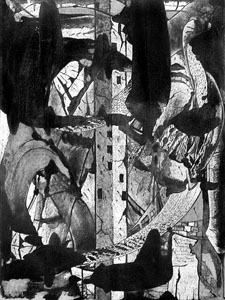 Casper Banjo's emotionally ambivalent "Forgive Them Father, and Forgive Us For What We Are About To Do, Amen" (detail) aims to deconstruct rather than reconstruct reality.