TO THE NAZIS, making a propaganda film shot entirely in the Warsaw Ghetto must have seemed like a sensible idea. With proper staging, they could prove that well-off Jews were having a soft war, while these vermin ignored ragged urchins and starving grandmothers on all sides. Yael Hersonski’s A Film Unfinished salvages and gives context to the soundless, abandoned footage shot by the Nazis. It was scrapped for some unknown reason, perhaps because there had been a change of strategy in Berlin from encirclement to extermination.
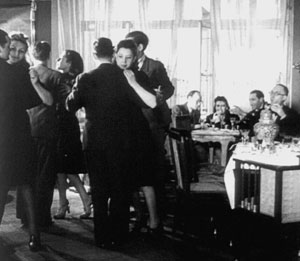
In 1954, researchers discovered the film in a German archive, in a tin labeled “Ghetto.” More recently, in 1998 at the Library of Congress facility in Dayton, Ohio, a reel of outtakes and cut footage showed how the Nazis had staged what had previously been considered documentary footage. We see a city lady primping, diners enjoying roast goose at a restaurant and a crowd guffawing at a show at the New Azazel Theater. But we also see the corpse-littered sidewalks and the look of starvation.There are several levels of discourse here. One is the testimony of Willi Wist, re-enacted by actors. A cameraman for the Nazis, he was apprehended and deposed in the 1960s. Wist’s first comment, like his name itself, is fit for a Peter Lorre character: “It is probable that I was in Warsaw in 1942.” As “Wist” speaks, Hersonski’s own camera does extreme close-ups on the magnetic reels and volume meters of a tape recorder, in the Errol Morris style. The Nazis were very thorough about keeping the actors in their documentary controlled; it’s the extra footage on sidewalks and in stinking apartments where the real story was taking place. Hersonski has some now-elderly survivors of the ghetto watch the footage. They make cries of recognition: “Oy! I remember that woman!” or “That’s Rubenstein, the dancer.” They’re a living commentary track, and they remind us that there were some fluctuations in levels of suffering. “People made jokes, they sang,” says an old woman, unidentified until the end credits. In short, they hadn’t been reduced to diseased sheep by their torturers. Mostly, A Film Unfinished is cinema as necromancy. It attempts to make dead, mute faces talk. But why does Hersonski show us these images flickering on these witnesses’ faces? Why does she study them as they watch the worst of it—the hillock of shit and rubbish, combed by scavengers; the corpses sliding into a pit? It’s either insensitivity or a valuable reminder: there’s something inside cinema that can’t be refined or cleansed, no matter what. There’s something evil that comes from its power to manipulate, from the strident way that it claims its illusion is truth.
A Film Unfinished
R; 88 min.
Opens Friday, Camera 3, San Jose