
OUR ERA offers an embarrassment of riches in romantic films, made for an audience of sophisticates who marvel in seeing their own tender hopes for love reflected on the screen. Yep.
Seriously, the clinch at the end of Avatar (“Soothe my asthma, big blue mommy!”) said it all. The typical romantic film of today is about a slobby mother’s darling looking for a supermodel to baby him. Oh, wait, there is a romantic film this week! For never was there a story of more woe/ than this of Juliet and her Gnomeo.
It’s the acting-like-kids aspect of romantic films that makes one rather watch cartoons: commonly, romantic films are either overproduced Nancy Meyers stodginess or pre-adolescent playtime. Recent successful romantic comedies include a torrid scene filmed at a miniature golf course (No Strings Attached) and a puppet show (Forgetting Sarah Marshall). Looking over the last few years of Oscar winners, for example, the closest thing to a traditional romance is Brokeback Mountain. Not to belabor the point, but if you’re looking for romantic films you need to reach into the past. I’ve tried staying out of the black-and-white zone, but it wasn’t easy.
The Lady Eve (1941) Quite a few women are scarred from the trauma of having their reputation dragged around, and social media has made the phenomenon worse. Consider this romantic film, then, with its handsome moral “The good girls are never as good as they seem to be, and the bad ones never as bad.” Shakespearean masquerade and immortal slapstick mix beautifully in the meeting of a confidence woman (Barbara Stanwyck) and an ale heir, Charles “Hopsy” Pike (Henry Fonda).
Casablanca (1942) Casablanca is an established classic and a local favorite—the Stanford Theatre, the most romantic theater around, has a national record for ticket sales to it. It endures because of the tension between the leads (surly but crumbly Bogart, demure yet feverish Bergman), expert directing (by Hungarian tyrant Michael Curtiz) and expertly turned, Victorian-style renunciation at the finale.
The Umbrellas of Cherbourg (1964) The attempt to mate a working-class romance with a Hollywood musical continues apace. There’s been some Internet rear-guarding for Cinequest guest John Turturro’s Romance and Cigarettes. This particular spoken-sung musical is one place where the crossbreeding worked, thanks to Michel Legrande’s tender score and Jacques Demy’s variations on vintage Vincente Minnelli. And then there is the star: the plaintive (and just 20) Catherine Deneuve as an unhappy small town girl left behind by a drafted boyfriend. In the face of 100-plus years of cinema’s insistence that love never dies, The Umbrellas of Cherbourg makes the soft, almost sotto voce comment that, yes indeed, it does.
Chungking Express (1996) Wong Kar-Wai’s pioneering feature has been very influential on countless mumblecore romances: from its blatant quirkiness (heavy pineapple consumption, talking to bars of soap in the sink) to its ’60s pop-tune worship. A postmodern structure meets old-fashioned romanticism and dependence on such Victorian tropes as undelivered letters, unspoken crushes and tricks of fate. Faye Wang’s update of the crop-haired Audrey Hepburn gamine is something to see.
Punch-Drunk Love (2002) I wasn’t rapt about Paul Thomas Anderson’s film on its release, but you have to change your mind about certain films over the course of the years. Unbidden, it’s growing on me. As the raging but lonely hero, Adam Sandler hasn’t done anything better, and the touching Emily Watson displays a sturdy aggressiveness to match Sandler’s. If there’s a beast in man, said Angela Carter, it meets its match in women.
Out of Sight (1998) A bright, witty and romance-laden Steven Soderbergh crime drama, set in ice-blue Detroit and bronze Miami. George Clooney took a huge step up to his current nouveau Cary Grant status as a suave, good-looking rogue. Tragically, shortly after this was made, the delightful Latina ingnue Jennifer Lopez was killed in a horrible car crash and replaced by her venal twin sister, who has appeared in every bad movie this side of Catwoman.
Morocco (1930) A waking dream about a hopeless romance between a world-weary demi-prostitute (Marlene Dietrich) and a love-struck French Legionnaire (Gary Cooper). An exercise in style and a rare one, too—made right on the cusp of sound and silent film, with bewitching shadow-and-smoke cinematography and two plainly captivated-with-each-other stars.
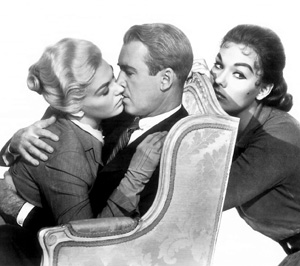
Vertigo (1958) In San Francisco, an aging former police detective (James Stewart) is crippled by a fear of heights—and his fear is worsened by a fetish for a seemingly dead lady (Kim Novak) who won’t stay dead. Alfred Hitchcock always had a healthy respect for danger in the possibilities of lovers meeting.
Shakespeare in Love (1998) Though I haven’t seen the garden gnome version, I can say that so far there hasn’t been a really ideal screen take on Romeo and Juliet. Bits and pieces work but not the whole. One of these bits and pieces is right here: Gwyneth Paltrow as a well-born, would-be actress who stars in the world premiere of Romeo and Juliet and is the beloved of Joseph Fiennes’ ink-stained but indomitable Bard.
Garden State (2004) Sometimes the arrested-development romantic film works. Natalie Portman made her first big mark as a young lover; still childlike with the preserved scraps of her security blanket, and a backyard graveyard of hamsters. Director Zach Braff makes summer in New Jersey look as verdant as a week in Costa Rica. And his use of Simon and Garfunkel’s “The Only Living Boy in New York” is, to use an overused term, romantic.