
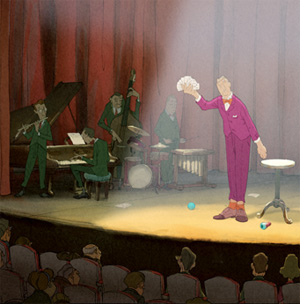
IT IS a pretty thing, but can you call The Illusionist Jacques Tati? Sylvain Chomet directs this animated feature based on an unproduced script by the auteur of M. Hulot’s Holiday, and others. If you’ve got a taste for squabbles, observe the one that Tati’s grandson, Richard McDonald, has commenced; by his lights, the Tati script was autobiographical family property, unfairly sold off. (McDonald’s open letter to Roger Ebert makes it sounds like the purloined manuscript in Nabokov’s Pale Fire, procured with a contract signed “in some peculiar form of red ink.”) Compared with Chomet’s The Triplets of Belleville this new film seems underpowered and faint. It’s hard to make an entire movie out of wistfulness.
Tatischeff (Tati’s real name) is an aging stage magician, chased out of his customary theaters by the rise of rock & roll. Heading to Scotland, the magician gets a gig in Edinburgh. He holes up in a theatrical hotel with other small-timers, among them a whisky clown and a ventriloquist slowly giving up the ghost. (The end is near; even the magician’s rabbit hates him.) But Tatischeff has company: a young girl he found cleaning up in a Scottish island pub follows him to the city, believing his conjuring tricks are authentic magic. The ligne claire cityscapes glow enchantingly; the tinted melancholy seascapes show that if 2-D animation is really on its way out, Hayao Miyazaki won’t be its only pallbearer. Staging a film in the early 1960s was a well-chosen breaking point of old and new kinds of show business. Animated characters always shine best when they sing and dance, and Chomet’s caricatures of the wildly popular mop tops “Billy Boy and the Britoons” are the funniest things in the film.
Chomet captures, without overemphasis, the changing times through moments such as a Wurlitzer jukebox’s first entrance into a rural village pub. Chomet keeps things dry and subtle; he shares Tati’s famously democratic framing of a scene, in which all characters are equal participants. But The Illusionist is more like a stray bit of Ealing Studios comedy transformed into animated form. And the moment when the cartoon version encounters the real thing (when Tatischeff enters a theater playing Mon Oncle) punctures The Illusionist’s most difficult illusion: the attempt to persuade us that we have Tati back from the grave.
PG; 80 min.