

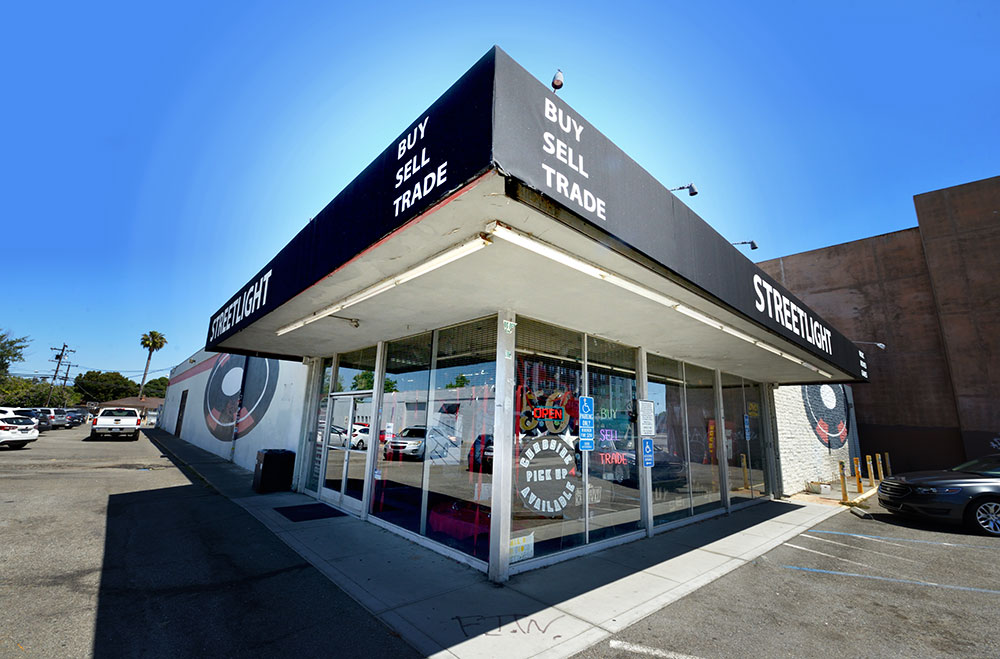
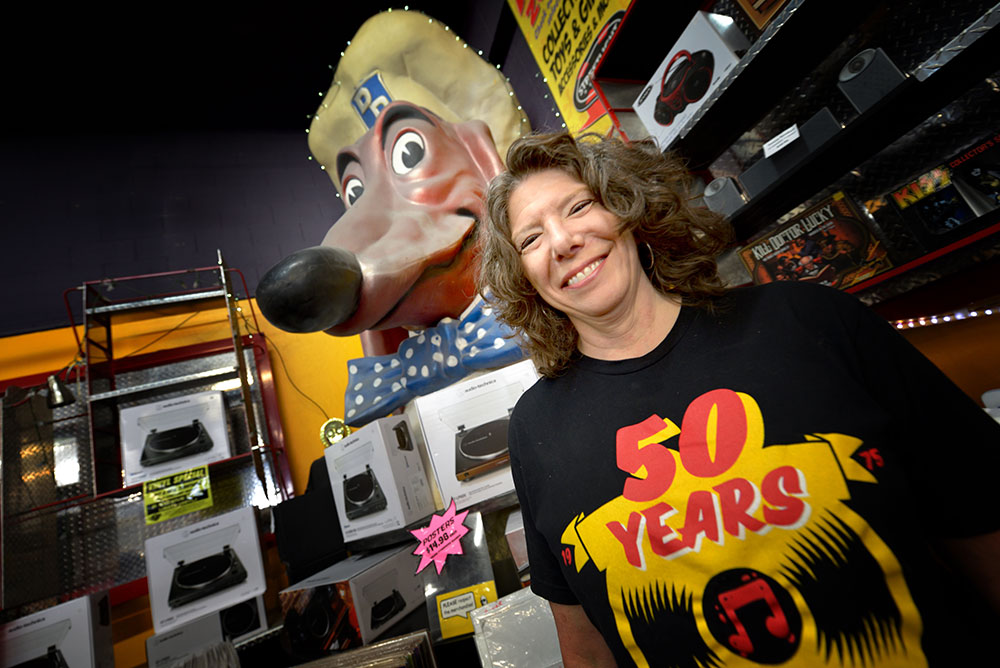
At Streetlight Records in San Jose, a giant Doggie Diner head sits in the corner, overseeing the action. It’s been there ever since the store at 980 S. Bascom opened in 1992.
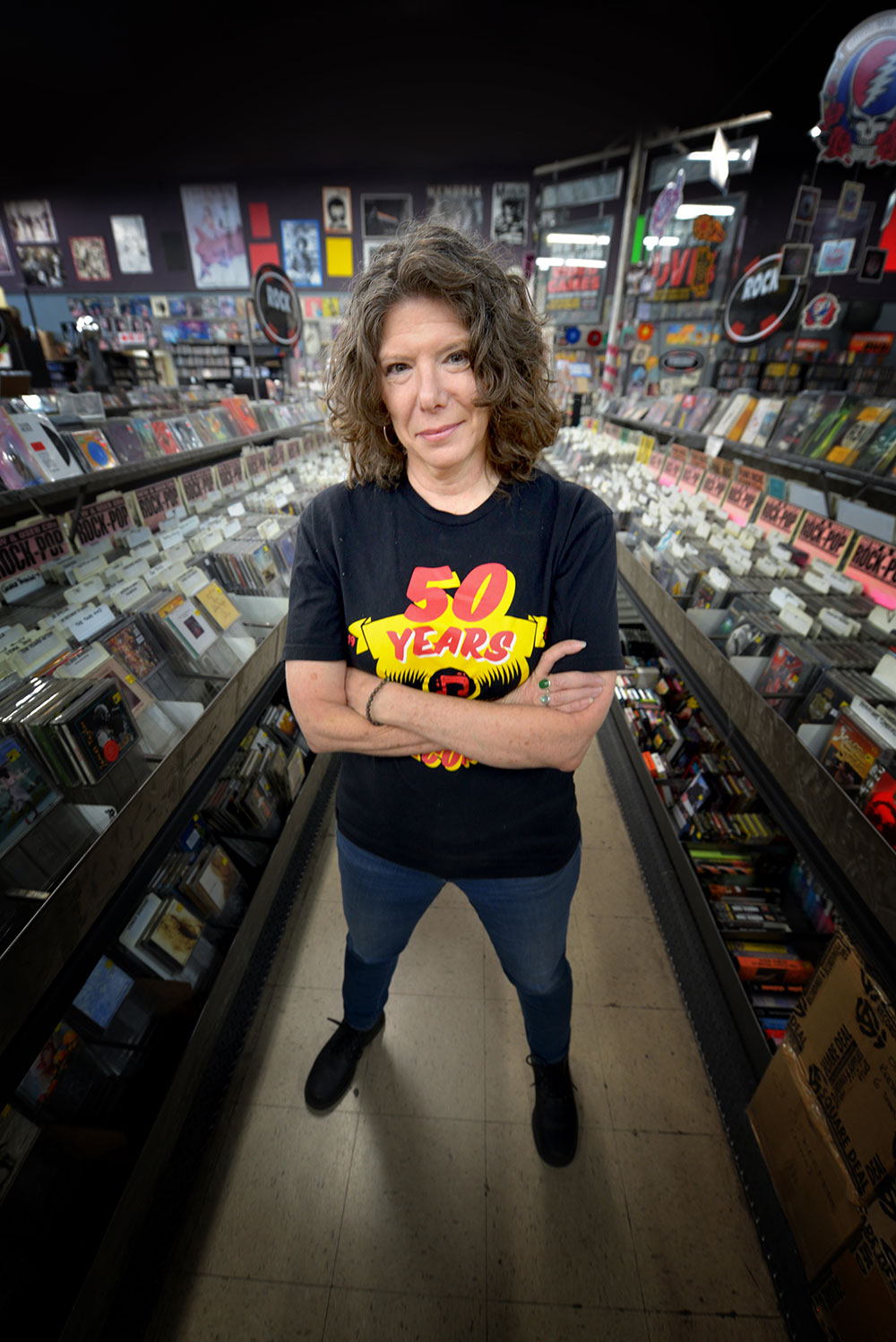
However, the history of the Streetlight chain goes back much further. One can tell by the rack of 50th anniversary T-shirts now for sale, directly underneath the giant Doggie Diner head, and a respective display in the front window.
This weekend, Streetlight will celebrate a milestone: half a century since the original San Francisco shop first opened, in 1975. Expect storewide discounts, raffles, prize wheels, DJs, book signings and goodie bags.
Mother Ship Launches
Robert Fallon first started Streetlight Records in Noe Valley 50 years ago. A second San Francisco store opened on Market Street in the Castro four years later. The original San Jose location emerged in 1981, in a single-story house farther up Bascom, followed by a Santa Cruz store in 1997. Those last two are now the only ones left.
Though both San Francisco shops are long gone, veteran Streetlight folks still refer to the Noe Valley store as “The Mother Ship,” since it opened before there was any serious used vinyl industry of any sort. Thanks to San Jose and Santa Cruz, its legacy endures.
When Streetlight first debuted in San Francisco, hardly anyone knew what a “used record” actually was. In 1975, there was no established community of people trading vinyl.
Jeffrey Moss, the Streetlight chain’s general manager from 1977 to 2013, said he was originally one of the skeptics. Yet he still remembers when he first got a job at the Noe Valley store.
“There were some poor, really overpriced, scratched-up used records in cardboard boxes that had lost their structural integrity that were hanging over the planks that were on the cinder blocks,” he said. “So first thing I did was to upgrade the cardboard boxes with melon crates from the market across the street.”
Eventually, the staff began to use colored price tags to differentiate used and new records, or even prices that ended in .95 and .98. It took a lot of explaining. At the time, the best business move, Moss said, was to let customers take the record home and try it out first, which proved to be a great way to explore music or trade in stuff that was obviously not new.
“I came into it as a skeptic and was pretty quickly a believer,” Moss said.
Eventually, Marc Weinstein, a former employee of the Noe Valley Streetlight, partnered with one of his regular customers and started Amoeba Records in Berkeley. This is partly why veteran Streetlight folks still refer to the Noe Valley store as “The Mother Ship.”
Crowded House
The original San Jose Streetlight Records opened in a nondescript house at 535 S. Bascom, a building that still exists. Before Streetlight, it was Madame Marie’s Palm Reading. Marie and her husband owned the building.
In 1981, Stretch Riedle was employee number one at the San Jose house. He was hired to convert what was initially launched as Encore Stereo into a used record store. Since the place was still a functioning house with a bedroom, a kitchen and a bathroom, he later lived in the bedroom and even started his surf band, The Shockwaves, in that same back room of the record store.
“I wasn’t even a drummer yet,” he said. “But I learned enough to play.”
Many bands did in-store appearances in that tiny house, including the late Del Rubio Triplets, the Pandoras, Hawkwind and even a young Henry Rollins before a Black Flag show at the New Varsity Theater in Palo Alto.
That house remains the stuff of legend. Many customers and employees still remember the original San Jose Streetlight.
“I remember just thinking how odd it was, us being there,” Moss said.
Madame Marie originally told peoples’ fortunes in the living room. Once Streetlight took over and began to grow, the record store operation slowly expanded, room by room.
“We thought, ‘Well, let’s turn the kitchen into part of the store, and we’ll turn the bedroom into part of the store,’” Moss recalled. “We still didn’t have enough space for records and we didn’t have enough parking. We then expanded into the building next door.”
LP Librarians
The emergence of Amoeba made the San Jose folks more fully realize they needed a bigger store, so Fallon snatched up a huge building further down Bascom, right next to Quement Electronics and across from Murray’s Bar, both of which were legacy businesses decades old.
The next incarnation of Streetlight San Jose then opened up in 1992, where it has been ever since.
Paige Brodsky has either worked at or managed the store for 30 years. But she started at the Market Street store, after moving from South Carolina to SF. She saw the sign and thought, “Maybe I can work in a record store until I figure out what I want to do with my life,” she recalls. “Thirty-six years later, this is what I’m doing with my life.”
The move to the current San Jose location “was a little bit of a bumpy transition,” Brodsky says. “It’s hard to go from a super small space to something that was this big, and they didn’t have the product to fill the bins, and it was just a whole different way of thinking about doing things.”
At this time, store manager Phil Evans installed the Doggie Diner head in the corner. They had to take out the front doors just to get the head into the store.
Especially in the pre-Internet days, record store employees were the go-to folks for any kind of musical knowledge. They were like librarians. People trusted them. Even if the employee’s musical taste did not match that of the customer, the employees, for the most part, enjoyed helping people connect to the songs and records they came searching for.
“We live for that,” Brodsky said, rattling off numerous examples. “There have been people, they didn’t know the name of the song, they didn’t know the artist, they sing you a few lines, and you know it. Or these days, you look it up on the internet and do a lyric search and find it. People will hug you because they’re so excited that you found the song. We all live for that.”
Riedle likewise rattled off similar stories. Even back in the ’80s, it was a daily occurrence.
“That happened a lot more often than you would think,” he said. “A good record store had employees who were literally historians and were record fanatics, music fanatics, because you had to be. Even though I had my preferences for personal listening, I had to know a little bit about everything. I had to know a little bit about classical, about jazz, about country, about rock, about international music, all that stuff.”
Helping Each Other Is the Point
Rebekah Ahrendt, an associate professor of musicology at Utrecht University in the Netherlands, fondly recalled her Del Mar High School years hanging out the original Streetlight.
“They knew me as the girl who liked industrial stuff, and so I eventually developed a relationship with the people working there, that they would set aside rare Skinny Puppy vinyl,” Ahrendt said.
Later in the ’90s, during her days at the SJSU School of Music, Ahrendt became a fulltime employee.
“When I was hired in 1993, they didn’t have anybody who knew anything about classical music,” Ahrendt said, adding that her role as “the classical girl” came with challenges.
“Classical music record collectors are exclusively male,” Ahrendt said, with a laugh. “So I got lots of ‘instruction’ or ‘pushback’ from a lot of those customers until I could prove I knew exactly which was the best recording of Beethoven’s ninth, and which Columbia Records issues were the most valuable, and that kind of stuff.”
Soon after Ahrendt was hired, she started an industrial/experimental section and built relationships with avant-garde labels like Soleilmoon, Staalplaat or Test Records in Santa Barbara. At that time, no other used record store was doing any such thing, with those types of labels.
“There were a few labels that were in my section that had no other physical location,” she said. “And that was fun. Then I got to meet all those people too, so whenever they came into town, we’d go hang out.”

Everyone tips their hats to Fallon—“Uncle Bob,” as Ahrendt calls him—for having the foresight to identify the suburban South Bay as a potential market in 1981.
“[He] was very forward-thinking about computers, and he thought Silicon Valley was a place to watch and a place to be,” Moss said.
Especially at Streetlight, the employees made it part of their everyday life to educate themselves. Many, even to this day, would say the best thing about working at Streetlight was the opportunity to learn more about music.
“They had a policy where you could check out ten items a week and go home and listen to them and read about them,” Ahrendt said. “And so that’s really where I learned the most about music, frankly.”
In any record store, the people make the place. It’s a great business philosophy, especially when the manager has been there 30 years.
“It’s a true community,” Brodsky said. “These are people, some of them I’ve seen customer-wise, some of them I’ve seen once a week for 25 years and watch their kids grow up and you go through family deaths and heartbreak with them, and it’s just a place where people can come and feel comfortable.”
Riding the Wave
Brodsky admits to many challenging times in the record store business, as one would expect—lean periods in terms of cash flow or moments when the store had to borrow money to stay afloat. However, she said, right now is not one of those times. LPs have gradually increased in sales, according to Luminate, for 13 years in a row.
“It’s new vinyl and used vinyl, and it’s the younger crowd that wants it,” Brodsky said. “And that’s enough to know that it’s not a trend, and it hasn’t plateaued, and it’s still significant increases.”
She refers not just to the amount of cash sales, but also the number of pieces, the quantity of records. Plus, used CD sales are just starting to return, only because kids are getting priced out of the new vinyl market.
“So the intention right now is to ride this wave,” Brodsky said. “As long as it’s going on—and I’ve gotten past the place where I think it’s going to crash suddenly, and that the demand won’t be there—then I feel like the younger generation that is responsible for a lot of this uptick, I feel like they really get it. They really get the concept of holding something in your hand and being able to open it and look at the liner notes and figure out what other bands are getting thanked, who influenced that band, and then going and researching those.”
Moss claims Streetlight never completely gave up, even during more than one era when every know-it-all seemed to think LPs were done.
“There came a time when it looked like vinyl would die away completely,” Moss said. “We still believed. And I am glad to say we were right. There is something about the size and feel and sound of vinyl that can’t be wholly replaced by downloads and streaming. There is a new generation of people passionate about vinyl, in addition to those of us who have always been partial.”
The Human Touch
On Bascom Avenue, Quement Electronics was demolished and replaced with a much-needed branch library complex in 2013. Across the street, a multistory senior living facility, also much needed, sits right where Murray’s Bar once stood. Nevertheless, Streetlight persists.
Looking back on the last half century, Moss uses terms like “fairy tale.” When he first started out, with no business acumen whatsoever, all he wanted was to work in a record store. It was never about money.
“I always thought business majors were the devil,” Moss said with a laugh. “That’s the way I thought. But just to be involved in the music scene, with music, that was really what I wanted. And what a dream it turned out to be. Before Streetlight, I was trying to get hired at Tower or Record Factory. I’m so glad they said no to me.”
Many record store employees, anywhere, break it all down to the human-based component of the job, the community, or the camaraderie, especially nowadays, when so much technology seems designed to ruin critical thinking skills and stunt everyone’s emotional intelligence.
Record store employees will be the first to point out that music enriches all of us. And many teenagers are a lot smarter than people realize. They want to discuss the imagery on the covers, they want to read liner notes and they want to share tangible products with each other.
“I have never been a big fan of online algorithms as a main tool of music discovery,” Moss said. “They tend to lead you in the direction of very similar music without venturing off the beaten track. I prefer the human touch. And if that includes our store, then I feel we’ve done our job.”
Go ask the Doggie Diner head. He will surely agree.








Great article took me back to my many visits to Streetlight. Some of them were to buy tickets to concerts which was a wonderful deal since they didn’t cost Ticket master prices. I went to Streetlight to find out who was coming to town. Before I subscribed to the daily Merc. You’re a great writer. Thanks
Gary, my friend, thank you.
I worked there for eight years, with Paige, Rebecca, and Jeff. Great folks to work with & know.
I remember an employee barbecue up in the hills, huddled over a table with Uncle Bob, mentally storyboarding a TV ad for the store involving Fred’s band, Crack, and an animated vomit transition. To this day I’m unsure whether he was serious or not, but it was a fun evening. Paige forbade me from ever mentioning it to him again.