
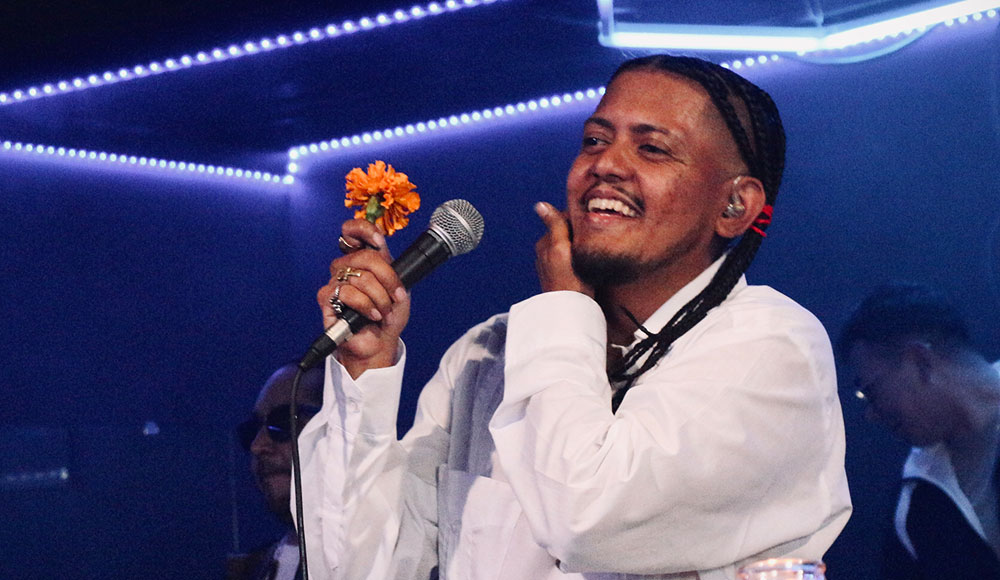
The scent of copal flowed out of Nexxus Bar and Grill onto the corner of Third and East Santa Clara streets in downtown San Jose. Inside, a young girl welcomed each visitor and handed them a cempasuchil (marigold)—all its golden petals and long stem intact. “Hold onto it until the end,” she instructed.
On this rainy Monday evening, a steady flow of supporters gathered to celebrate a local album release by Miguel Saucedo, better known as the rapper Miguel Kultura. As an artist grounded in his Indigenous identity, Saucedo intentionally chose Indigenous Peoples Day to release Mal Entendido, his first full-length project.
In the center of the bar stood a large, five-tiered altar: Saucedo’s personal Día de los Muertos ofrenda, honoring his direct ancestors and musical influences. Flanking the altar were two live painters. On the left, artist Francisco Ramírez fleshed out a hyperrealistic portrait of Saucedo in striking orange acrylics. On the right, artist Miguel Machuca used an old-fashioned draft eraser to etch a vintage microphone, haloed by rose thorns.

Around them, attendees mingled and waited for the live performances to start. As a bilingual rapper who writes primarily in Spanish, Saucedo had prepared openers with similar values. Sin Fronteras Dreams, an San Francisco-based hip-hop project, performed songs about modern-day resistance. When Saucedo took the mic, he thanked everyone for participating in his collective healing space.
“What you normally see in prayer circles or danza, I wanted to bring it to the hip-hop stage,” Saucedo says. At the end of the night, he led everyone present in a final offering, holding up their marigolds as a symbol of what clarity they seek.
Mal Entendido tackles the misunderstanding that takes place between immigrant generations, as well as between partners and friends who grow up together and apart.
“I had an intention of making an album, but it wasn’t pre-thought—it was just like, let’s make songs,” Saucedo says. “I’m in this kind of rut, and it literally just kept me alive.”
Toward the end of last year, Saucedo struggled with his mental health. “I didn’t know if I was going to make it. I was meeting my mortality, on a spiritual level.” But another vision from his ancestors—similar to the vision that first inspired his artist name—helped pull him forward.

That visit inspired the foundation of Mal Entendido. The name for this project came to him shortly after he released his single “Decisiones.” The cover art shows his parents, each with a hand on his shoulder, standing firmly behind him. “It talks about my ancestors, the world not seeing you, and how no one teaches us how to deal with the craziness of the world,” he says.
Reflecting on the pain of being misunderstood, Saucedo resolved to create a message that people could receive. Throughout the album, he weaves in Indigenous references with a modernized lingo forged by both his Mexican American experience and hip-hop roots.
The seventh track on the album, “Por Mis Pecados,” tackles personal wounds and names the native methods of healing that helped him. He raps in the first verse: “Ahora dejo mi peso suelto, estoy en ayunas/Pidiéndole a la chacruna la medicina que me ayuda.” (“Now I let my weight go, fasting/Asking the chacruna the sacred medicine that helps me.”)
Many of the songs on the album invoke divine guidance, but Saucedo tries to avoid bypassing systemic injustices with one-sided positivity. In his fourth track, “Mas y Menos,” featuring fellow artist Dali Amadeus, he reflects on the oppression he sees within his own neighborhood. Set to a beat with rapid hi-hats, the track balances playfulness with serious intent as he and Amadeus play out the mindset of someone deep in their hustle—moving product and acknowledging the bent rules of the game they play.

“I put it in a fun track, people can digest it,” Saucedo says. “But our people are doing this. They’re trying to survive. I’m not judging them, but hey, I see you. And that’s just what it is.”
When he considers who his community comprises, Saucedo feels like the kid who was around all the cliques. Different circles mean different sounds—for the neighborhood friends he was raised with, the Indigenous healers, and the creative community he rose up with.
Saucedo credits his producer, Rey Resurreccion, for that push to explore musically. “He’s been showing me not to be afraid,” Saucedo says of Resurreccion (whose own legacy as an artist from South San Jose continues to elevate the scene now as a Brooklyn-based producer). “He’s like, you don’t have to create one type of music, because you’re a little bit of everything.”