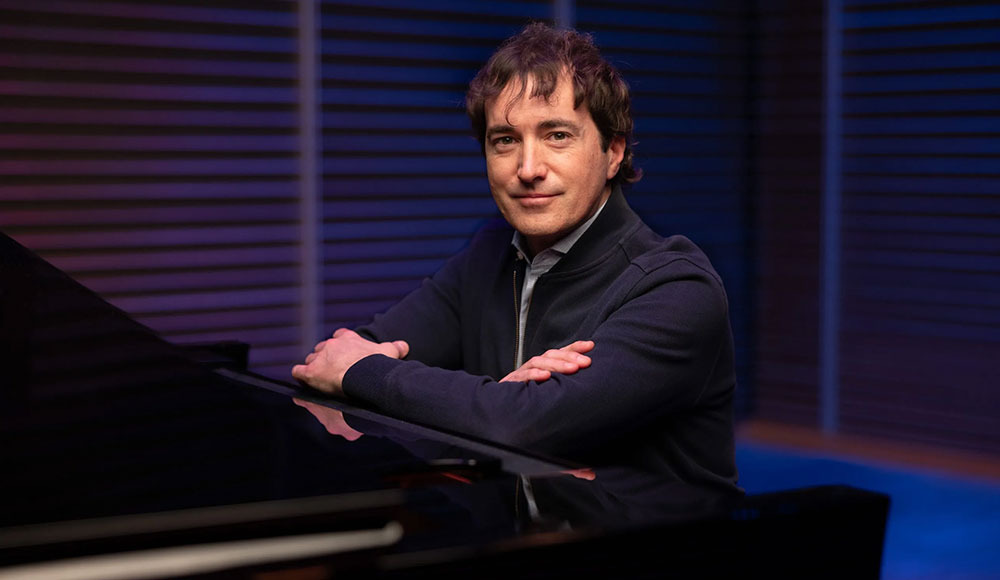
This week, music lovers have an opportunity to hear a live performance of a work by composer Mason Bates, a leading figure in 21st-century classical music. A resident of Burlingame for several years, Bates holds the distinction of being this century’s second most often performed classical music composers.
On Nov. 22, Bates will be the featured electronica soloist when his symphony Alternative Energy tops a Redwood Symphony concert bill at Cañada College in Redwood City.
Bates has collaborated with industry giants such as Michael Tilson Thomas and the San Francisco Symphony, including a “Beethoven & Bates” concert series in 2013, and with other conductors as illustrious as Riccardo Muti and Marin Alsop. John Adams, perhaps the most celebrated living classical composer, has been his most ardent mentor.
For Redwood Symphony, an all-volunteer orchestra proud of a mission combining “daring programming, technical excellence, and commitment to both classical tradition and the future of orchestral music,” Bates, 48, has long represented validation with his frequent presence.
Bates has won Grammy Awards, including one for an opera about Steven Jobs. More recently, the premiere of his opera The Amazing Adventures of Kavalier & Clay, based on a Michael Chabon novel, was the opera of the week on radio from New York’s Metropolitan Opera.
And in some ways, Redwood Symphony is blazing as many trails as Bates. As professional orchestras have been retracting for decades, especially since the pandemic, a professional-caliber amateur orchestra seems like the wave of the future, too.
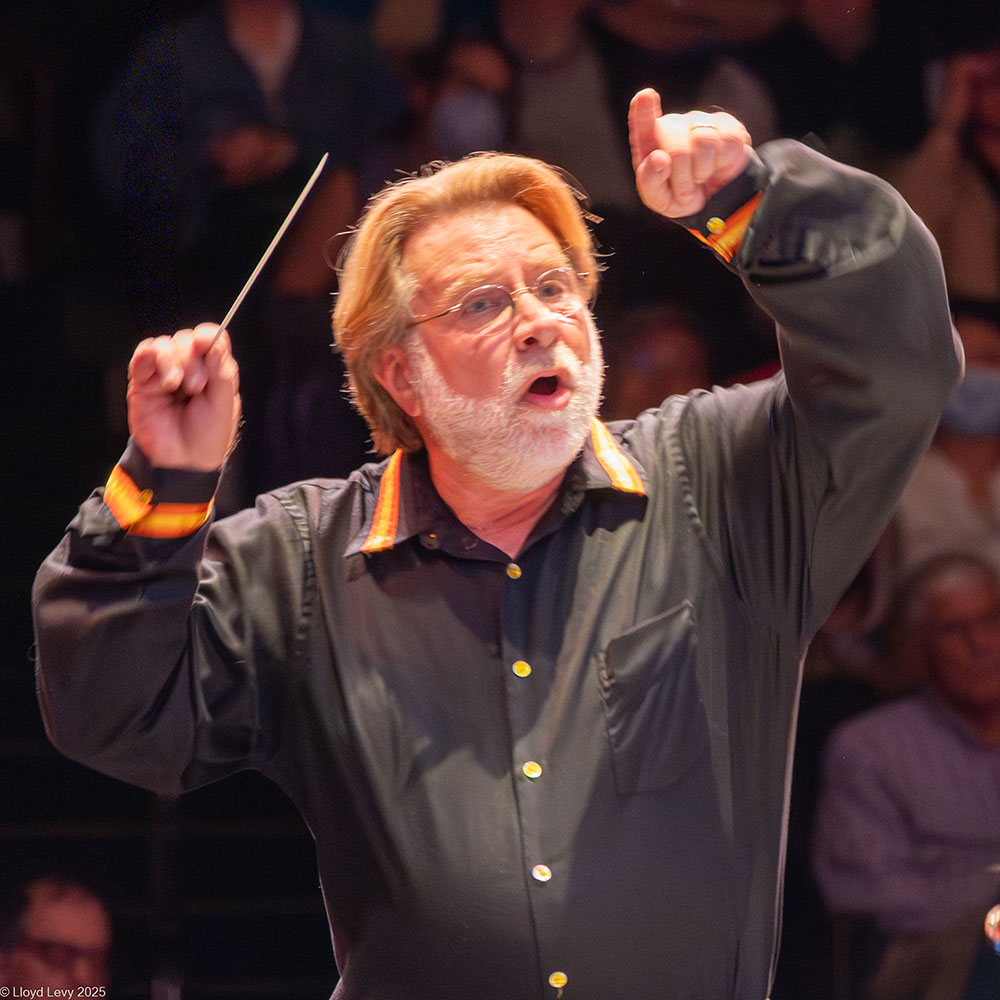
“He has universal appeal, even to people who ‘don’t like classical music,’” says Eric Kujawsky, who is reaching the 40-year mark as Redwood Symphony director with this concert, which also features Chabrier’s España Rhapsody and Tchaikovsky’s Violin Concerto, with soloist Karen Bentley Pollick.
Kujawsky has been presenting Bates’ works for more than a decade and says it is especially noteworthy that young audience members “love his music.”
The electronica element may be misleading to some. “I’m pretty much as classical a composer as you’re gonna get,” Bates says. “It is pretty much accepted in the field. I also bring new elements to it, which has always been exciting for me.”
Bates’ supporters largely agree that he and his music are approachable, certainly by modern standards.
There has always been a lot of push-pull about symphonic innovation, plenty of which has dominated the past 100 years now that we’ve reached the aftermath of Schoenberg, Stravinsky and Shostakovich. What some considered a surplus of weirdness and austerity seemed to level off before the end of the 20th century, and it’s difficult to assess where classical music stands.
Audiences still seem to prefer Mozart and Beethoven, and symphony promoters must accommodate that without ignoring those who feel innovation is crucial to every art form.
But now, even huge doses of Mozart and Beethoven don’t fill the seats.
Tradition vs. Innovation
Bold programming and stretching the definitions of classical music are probably the key to keeping the classical genre alive among increasingly diverse citizenries.
Even the San Francisco Symphony’s Davies Hall has been opening the doors to pop concerts. Symphony San Jose, although still dedicated to professionally satisfying the traditional audience, has become increasingly open to the sort of deviations that welcome jazz and, yes, electronica to the mix.
Up the Peninsula, Kujawsky, 70, has established an orchestra that is a particular asset to local musicians who don’t have the time or inclination to be professional but have the talent to produce top-notch, professional-quality music.
Bates says it’s also a gift to the community. And Kujawsky says the orchestra’s reach extends to San Francisco and the South Bay.
Kujawsky has led Redwood Symphony through entire cycles of Mahler’s symphonies, and says he likes to present Bartok and Stravinsky frequently.
“These are pieces that attract the best volunteer musicians. Many of them are professionals who play for free.”
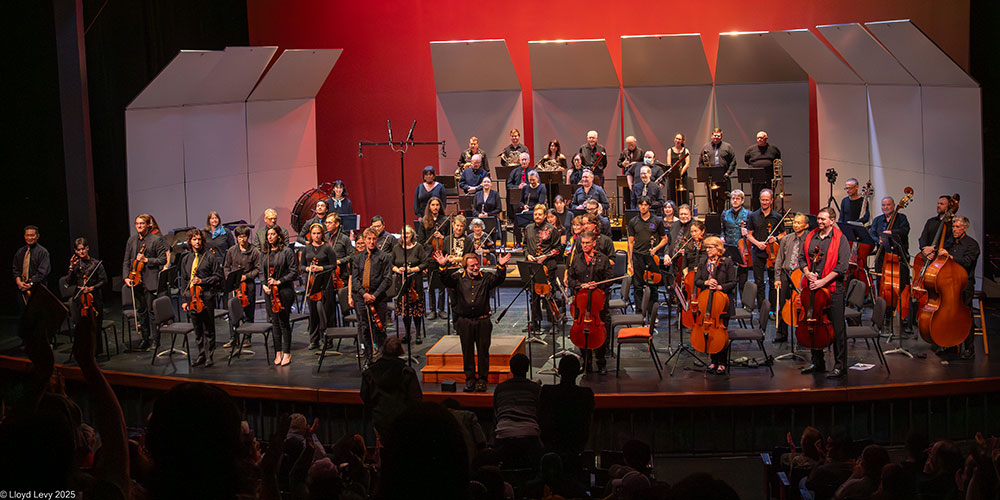
For Kujawsky and his orchestra, Alternative Energy, first performed in 2011, tops the list of those pieces.
Kujawsky says he became aware of Bates after reading a rave review of Alternative Energy in the San Francisco Chronicle. “It hit me like a thunderbolt. It has become my favorite work of the 21st century.”
He isn’t alone. It would be foolish to dismiss Bates’ legacy. But if you try to ascertain where Bates’ artistic impact ranks among 21st-century composers, you’ll find that some evaluations don’t include him at all. That’s partly because the strong infusion of electronica is his trademark, with Alternative Energy a prime example.
It’s a four-movement symphony—with Bates providing the electronica via his laptop and drum pad.
Some critics and other classical music diehards dismiss him mostly for that. But others claim his accessibility to general audiences surpasses his realization of some of his lofty artistic aims.
“You have to brush off critics,” Bates says. “They often show up for an evening and pass judgment without really separating their own opinions from what the audience is experiencing and feeling. For Kavalier & Clay we had to get past some New York critics that don’t get me. I just kind of focus on the impact that the music makes with musicians and audiences. The critics will eventually catch up.
“I kind of get it from both sides. I have some innovative elements that are quite new to the field, but they also connect with 500 years of classical history. It’s kind of the joy of mixing it up.”
Making Connections
Growing up in Virginia, Bates wrote his first works at age 15. That propelled him to Juilliard in New York, where he also expanded his electronica expertise working in the club scene.
He came to Berkeley in 2001 and earned a Ph.D. near the end of the decade.
He spent much of that time living in Oakland and starting a family while composing and working as a club DJ in San Francisco. It was a period in which he often wished he could somehow impress Tilson Thomas, which took eight years. The famed conductor had become a fan and approached Bates.
“I moved out here hoping someday I’d get a chance to work with him. One day I got a call from them saying Michael would like to create a new piece.
The Tilson Thomas connection also connected Bates with Adams, the Berkeley-based composer of Nixon in China and many other noted works.
“He reached out a little bit after Michael had commissioned a piece and said he wanted to conduct it with the L.A. Philharmonic.
“John is a real mentor in how to think about your long-term development,” adds Bates, whose expansion of his repertoire to opera is among the signs of that.
“You as the composer sort of act as the executive producer in how the libretto is created.” For an aria, he presents “lots of guidance about what I want to hear in the words. Music is the language of opera, so you have to be very involved when it comes to the libretto.”
His opera immersion has expanded his view of other composition, too.
“I’ve started to think theatrically about the orchestra, even if it’s a piece without electronics.”
And that has added to his sense of where his legacy is headed.
“As an opera composer, I’m finding now that I start to feel an understanding of people like Mozart I didn’t have before becoming a man of the theatre.”
With what other composers does he identify?
“I would start with American composers. I’ve always felt a kinship with Gershwin, because he took two kinds of music and kind of merged them into one. I do look back further because I have a connection with some of the other composers such as Berlioz (who found new forms and new orchestrations).
Berlioz met resistance, as Bates can appreciate.
“Even if you think you’re doing something very approachable, people who never listen to anything but Taylor Swift will … categorize it in their own way.”
As for his legacy, he says an important criterion is “how your music is received; how it’s performed by orchestras. As a composer you have the actual audience in the hall, but you also have the professional musician. You really have to think about both of them. Challenge them; engage audiences.
“When pieces are being performed often enough to be considered part of the repertory, that’s really fulfilling.”
And then there’s longevity, as Kujawsky can appreciate.
“I founded Redwood Symphony in October 1985,” says Kujawsky “and here I am—40 years later. … This program brings together everything I love about orchestral music.”
Redwood Symphony’s 40th Anniversary concert with Mason Bates takes place at 7:30pm on Nov. 22 at Cañada College Main Theater, 4200 Farm Hill Blvd., Redwood City. $15-$35. redwoodsymphony.org