
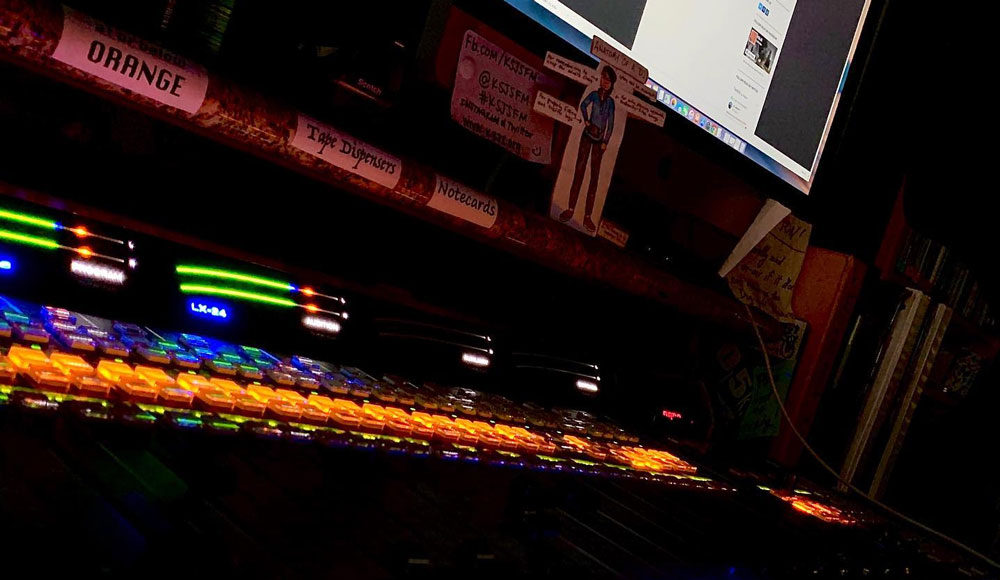
The South Bay area boasts long-standing college radio stations that defy the dominance of streaming and are currently in the midst of a quiet Gen Z revival. Amid declining FM listenership, these stations report a surge in student and volunteer interest, with applications for DJ slots overwhelming capacity.
“We’re averaging about 120 students per semester in our classes. We’re pretty close to rivaling the numbers that we had in the early 2000s at our last peak,” says Nick Martinez, KSJS’ general manager and coordinator of operations. “Things are looking up. Our thing is serving the community. We’re not worried about the bottom line.”
KSJS 90.5 FM at San Jose State University presents itself as “Ground Zero Radio,” a student-run operation dedicated to independent and wideranging music. Broadcasting 24/7, KSJS’ programming includes specialty shows spotlighting emerging indie acts and coverage of campus events. Its charts also provide feedback to labels tracking regional popularity.
Martinez, who also teaches at SJSU as part-time faculty, said of his students, “They’re actively finding the music. They’re engaged in the music. They’re engaged in the local music scene. They are doing something that is greater than themselves.” Perhaps a sentimental view but one doesn’t go unnoticed and is clearly always needed.
Other stalwart stations like KFJC at Foothill College, KSCU at Santa Clara University or KZSU at Stanford have all served as vital hubs for eclectic programming, fostering spaces where independent music can exist amid a homogenized industry.
KFJC 89.7 FM, broadcasting from Foothill College in Los Altos Hills since 1959, fully embodies the ethos of college radio, operating as a non-commercial station run by students and volunteers. It remains fully listener-funded. KFJC’s mission is to serve as a conduit for underrepresented sounds. Its website, for instance, has constantly updated album reviews; far-out stuff from 1920s gospel-blues to Japanese kraut-psych.
Leticia “Ms. Tiza” Domingo, who has been with KFJC for 25 years as both volunteer and DJ, attributed several key factors to the recent upswing, such as the recent interest in physical media, but particularly insightful was this: “I will also point to a general lack of transparency in mainstream commercial media outlets. This crosses generational boundaries. People are seeking authenticity in what they consume.”
She also noted: “It’s refreshing to hear and see the appreciation for non-commercial radio circling back around.”
A bit north, Stanford’s KZSU offers the same eclecticism from its campus perch in Palo Alto. Although smaller in wattage, 90.1’s reach extends through robust online streaming that reaches a large global audience.
The station’s DJs curate playlists and often feature live in-studio sessions. A hands-on approach that not only educates young broadcasters but also sustains a pipeline for what they consider and call “audio art.”
Arnold Raymundo, a veteran DJ and host on KZSU, has seen the ebbs and flows in college radio and put it simply: “With college radio, you have that human element of an individual featuring tracks that some algorithm or streams don’t play.”
Raymundo’s show, “MHz”, a show with live DJs and producers triggering beats on-air, is one of the South Bay’s longest-running programs. Just recently, MHz celebrated its 26th year.
Santa Clara University’s station, KSCU 103.3 FM, AKA “The Underground Sound,” dates back to 1948 when the university’s first broadcasting effort, KVSC (the “Kampus Voice of Santa Clara”) launched under the guidance of Jesuit priests and student volunteers, initially airing only classical and pop music.
Evolving through various iterations – including an AM setup in the 1960s – the station transitioned to its current FM format in the 1970s, becoming fully student-run with an emphasis on non-commercial programming, local college sports broadcasts, public affairs talk shows, and now podcasts.
KSCU has earned local acclaim, including multiple “Best College Radio Station” nods from Metro Silicon Valley through the years.
Teresa Troncoso, host of “All the Way Live with Remy Leigh!!” on Saturday evenings, touched on the undeniable human element of the format: “There is no comparison to college radio. You are guaranteed to hear something new, learn something new, and stay current, with an actual on-site, in-the-station, live on-the-air DJ who has put together a show for you to listen to.”
She adds: “I’ve experienced callers call in and actually be excited about a song I played. That’s the best feeling!”
These stations exemplify how similar college stations nationwide keep indie music afloat in an era of Spotify and TikTok. Unlike mainstream formats beholden to advertisers, college radio remains non-commercial and human-curated, allowing for risk-taking, turning these stations into real musical communities and a forum for ideas.
The recent resurgence underscores college radio’s role in cultural preservation. In the Bay Area, where music infrastructure has historically lacked robust support as compared to markets in LA or New York, these stations remain invaluable training grounds that must keep thriving if we are to face the tide of aggressive corporate playlists and unwanted algorithms.






Great piece David. . Great History of College radio. Raymundo of KZSU Stanford & Marconni of KDKA Pittsburgh are legends of The Radio Air Waves. All that this generation has: the streaming, utubing, instagram, scrolling, facebooking, and it is the little box that is making a comeback. It has what they are missing. The First time I did radio was on KFJC Foothill. What a history. Back to 1959 and still going strong. Love the Jesuits and students in the starting of KCSU Santa Clara in the 1940’s . I have roots at KFJC, KCSM and now w/ a weekly “Democracy In Action” on KZSU. This piece really helps me appreciate the talent rich environment of Bay Area College Radio.
Great piece David. . Great History of College radio. Raymundo of KZSU Stanford & Marconni of KDKA Pittsburgh are legends of The Radio Air Waves. All that this generation has: the streaming, utubing, instagram, scrolling, facebooking, and it is the little box that is making a comeback. It has what they are missing. The First time I did radio was on KFJC Foothill. What a history. Back to 1959 and still going strong. Love the Jesuits and students in the starting of KCSU Santa Clara in the 1940’s . I have roots at KFJC, KCSM and now w/ a weekly “Democracy In Action” on KZSU. This piece really helps me appreciate the talent rich environment of Bay Area College Radio.
I am really old and haven’t listened to college radio in this century, but worlds collided: A friend got me to listen to KZSU to hear her grandson play in a baseball game on the same day that I saw a Metro reader mention this article. I will forward the link.