
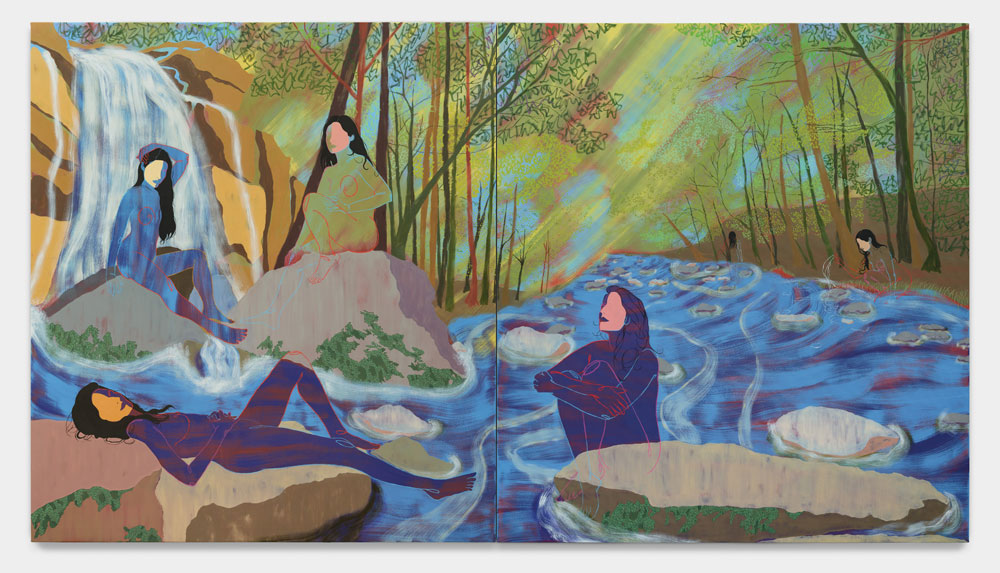
At the Institute of Contemporary Art (ICA) San José, archival stories from the Partition of India inspire paintings. Water becomes a descriptor for the flow of time.
The India-born, San Francisco-based artist Anoushka Mirchandani paints translucent female forms in various states of serenity, merging them with streams, waterfalls and rivers in fluid metamorphoses that blur the boundaries between body and land, between spatial travel and temporal travel.
The ICA show, “My Body Was a River Once,” is Mirchandani’s first ever solo institutional show. With the help of oil paint, oil sticks and oil pastels, the female forms are also inspired by Apsaras—celestial beings from South Asian mythology whose name translates to “one who moves flowingly in the waters.”
Upon deeper investigation, the connections are more personal. Thanks to the harrowing stories Mirchandani heard from her grandmothers, who fled Pakistan for India during the violence of Partition, the figures in her paintings become vessels for intergenerational movement, carrying ancestral stories with them.
The opening reception for the show jammed the ICA gallery space, creating a loud, animated scene. The extroverted energy in the room was impossible to deflect.
Mirchandani stood in the middle of the room and addressed a crowd of brand-new fans and old friends alike, as people jockeyed for positions to film the scene. Her paintings, she said, emerged from a years-long investigation into internal domestic spaces.
“I remember at some point I was painting a wicker chair for like 60 hours and I was like, ‘What is happening, what am I doing?’” she recalled. “And I went back to this archive that I’ve been building, which is an archive about my family and my grandparents who went through the Partition of India, really capturing oral history about their journey.”
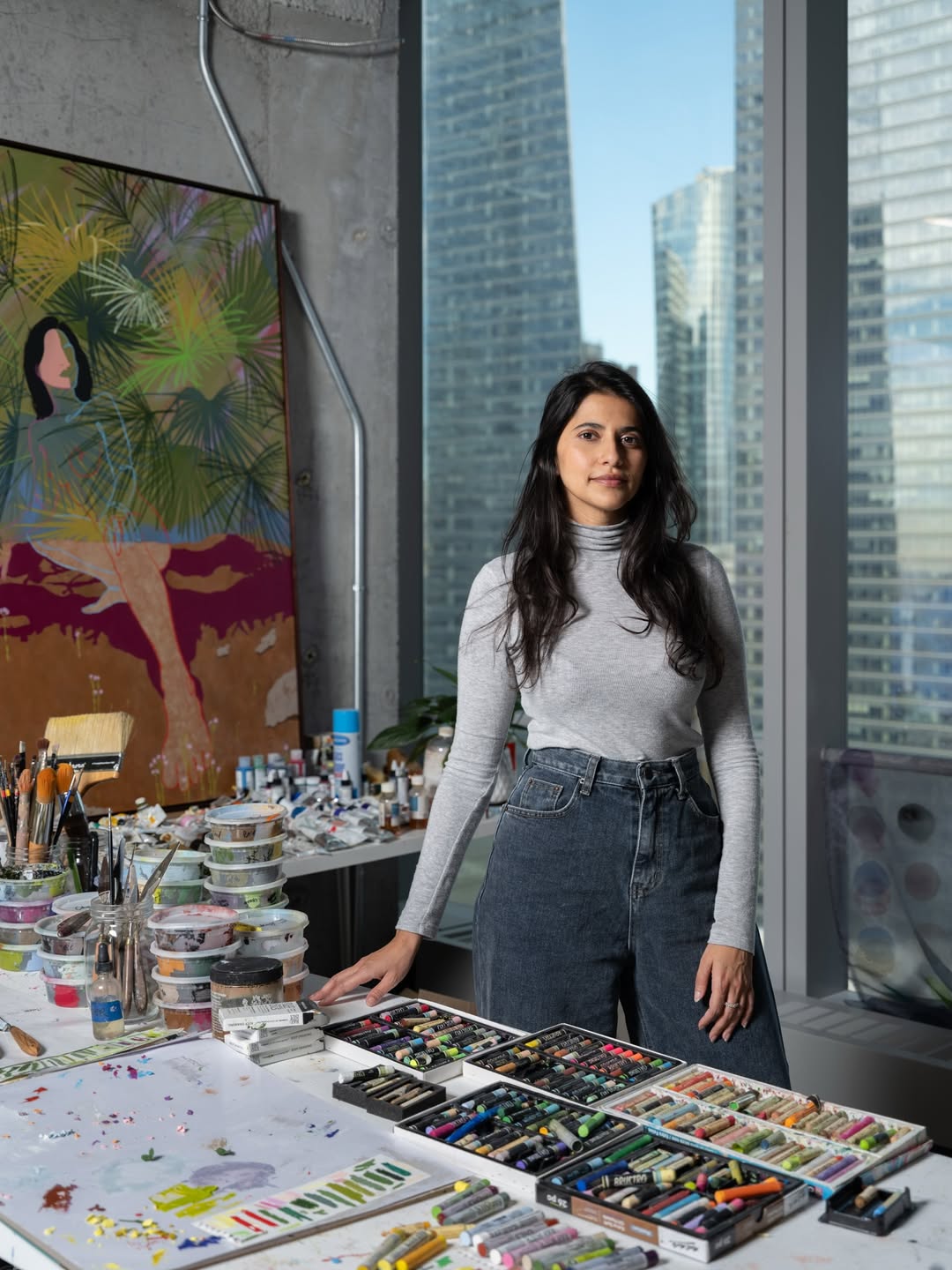
Mirchandani realized the women in her family carried an anxious attachment to space, which probably originated when her grandmother was forcibly displaced. It took them a long time to find and settle into their own permanent home. As a family, they had a way of sinking their teeth into their own space because they were so afraid of losing it at any moment.
As a result, Mirchandani deliberately depicted the female form in various states of repose. Luminous and silhouette-like, the women appear amid plants, forests and other pacifying scenarios. Bodies move alongside rivers, stones and vegetation. The figures appear and recede, dissolve and suspend themselves, moving through time and space.
“[As I was] making work that was kind of this repetitive, self-soothing action to find a sense of permanence, I wanted to break beyond the constraints of architectural space and really see what it feels like to create paintings that still have that sense of agency, freedom, but to do it in these raw, wild landscapes, and to still hold on to that feeling,” she said.
The paintings translate her research and her matrilineage into canvases, somewhere between reality and fiction. Water becomes a dominant, timeless force. For example, in the diptych, “All Us Come Cross the Water,” inspired by the 1973 Lucile Clifton children’s book of the same name, a group of ethereal women shift across different scenes, in different eras, each inseparable from the flow of the water.
Other works in the show, “Rites of Return,” “Vanishing Point,” or “Cherry Springs,” emerge from similar processes, practically confirming similar emotions from other descendants of Partition survivors: How can one still retain a sense of belonging to an undivided country that doesn’t exist anymore? To what degree does silence play in the transmission of loss? If one can never permanently heal from trauma, can one at least move through it in a much more creative fashion?
For the ICA show, Mirchandani’s journey now includes sculptural and sound works. Thorned branches of wood help activate the space, turning the boxlike room into something more flowing. A multichannel audio installation, “I Am Everywhere the Water Has Been,” features silk tapestries, painted and diaphanous, hanging from the ceiling. As one navigates the space, various archival components of Mirchandani’s ancestral story are revealed.
As water flows, so do the memories. By escorting our stories down the river of life, we can understand ourselves much better.
MY BODY WAS A RIVER ONCE
THROUGH AUG 26
ICA San José
icasanjose.org