If you build something, the students will eventually come. The CADRE Lab for New Media at SJSU proves it.
This weekend, CADRE (Computers in Art, Design, Research, and Education) celebrates its 40th anniversary with events and panel sessions at the San Jose Museum of Art. Everything is open to the public.
Originally known as the CADRE Institute, the program later changed its name to the CADRE Laboratory, a more fitting moniker. For decades now, CADRE has been a foundational force in shaping media art education—bridging experimental practice, emerging technologies, and critical inquiry.
For me, it’s personal. CADRE played a massive role in my development as a documentarian of the interstices. As a CADRE lurker in the mid-’90s, I had no plans to be a writer, but at the time, I idolized the post-structuralist philosophers Deleuze and Guattari, so the interdisciplinary gang of troublemakers at CADRE, led by director Joel Slayton, became one of my main tribes at San Jose State.
For a relatively new online journal of critical theory that CADRE started, Joel allowed me to write a sprawling essay, “Cyberthuggee and the Ridiculous World Order,” taking inspiration from the murderous Thuggee gangs of late 19th-century India and their techniques of disguise, all to suggest shadow techniques of ridicule as a tactic for resisting centralized power in cyberspace. I justified the whole thing with Nietzsche, post-structuralism, chaos theory, Zen and Robert Anton Wilson. In 1996, no other professor on campus would have allowed me to write that kind of material. I can trace several newspaper columns straight back to that essay.
At the time, many CADRE students, I soon discovered, were not even art majors. They were self-imposed exiles from every other department. I found frustrated computer science students and talented musicians that didn’t want to major in music. I met economists, network engineers, OpenGL hackers and even professors from elsewhere on campus who were fed up with their own colleagues.
In those days, many students took the same CADRE seminars over and over, just to contribute to various projects. People who already graduated often returned on a regular basis, just to help out. Students from Europe and beyond arrived to study at CADRE. It was a global community.
So what did CADRE actually do?—I hear you cry.
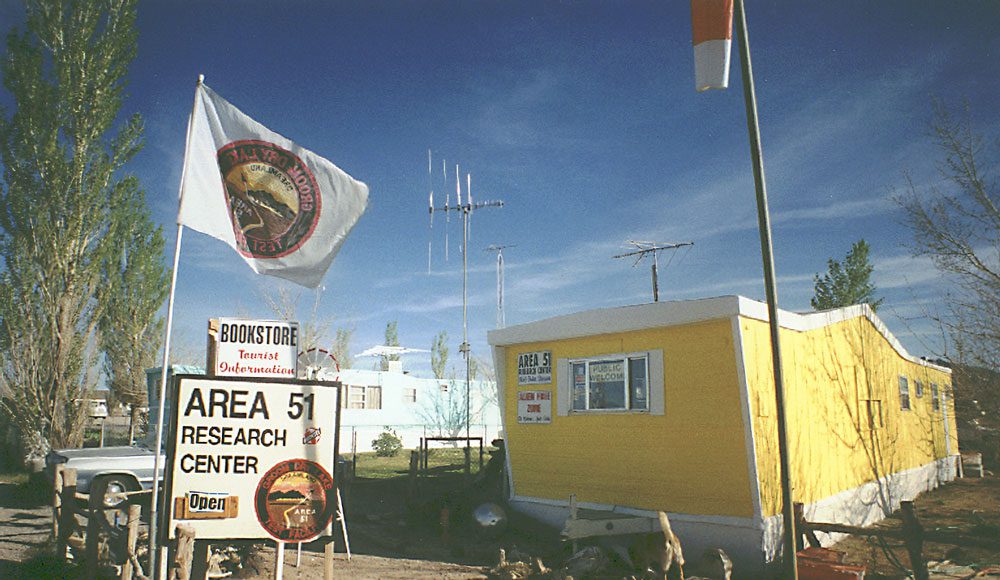
Well, for one class, the students traveled to Nevada, near Area 51, a site for decades the subject of conspiracy theories. Military and extraterrestrial research, secret nuclear testing and every possible variety of black ops supposedly went on inside the property. It was closed off to anyone except government employees. Photography and videography anywhere near Area 51 were illegal and often resulted in federal offenses. People would get arrested for trying to sneak anywhere near the property. Swarms of camouflaged security prowled the landscape, just waiting for trespassers to show up. No one seemed to know who these security dudes actually worked for.
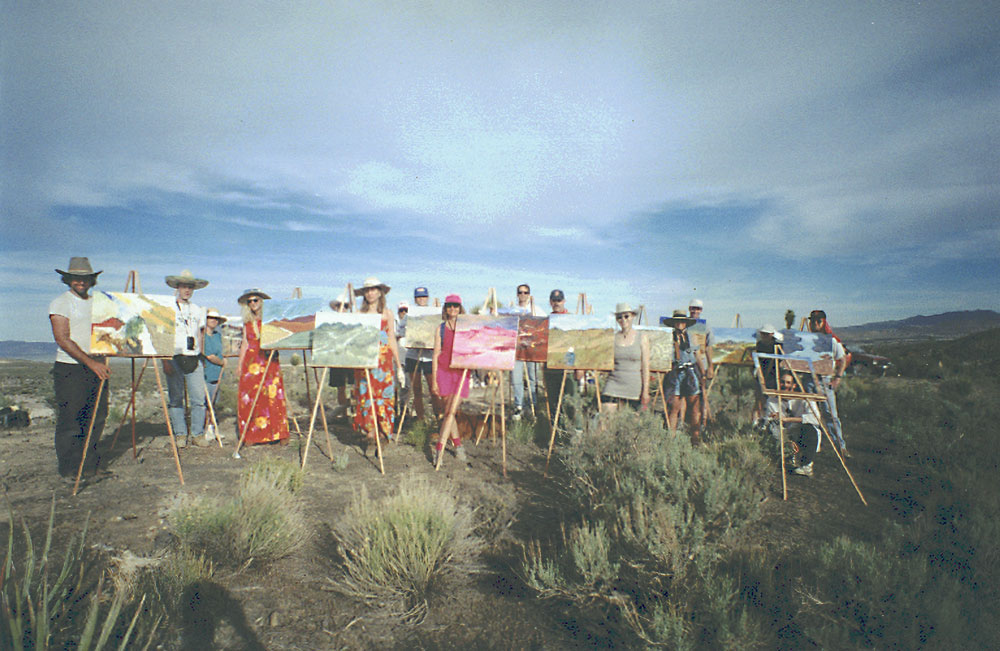
Joel’s class spent an entire semester planning a site-specific project called “Landscape Painting as Counter-Surveillance of Area 51.” It was pure genius. The class traveled in a convoy of four-wheel-drive trucks to the remote Nevada desert just to set up easels, just to stand there and paint landscape imagery of what Area 51 looked like from a distance. All while the infamous security contractors lurked in the shadows, keeping tabs on the artists.
This was just a few years after the web had emerged, spawning a welter of academic debate about privacy, surveillance, utopian aspects of cyberspace and the role of secret technologies in art practice. Artists were always the ones who intentionally misappropriated new technologies for creative purposes, but in this case the artists reverted back to old technologies, painting with analog equipment—oils, acrylics, palettes and easels—to recontextualize the surveillance issue. On one level, it was a critique of government power, but also a brilliant Dada-esque attack on the banality of landscape painting and all those geriatric plein air classes.
I was in the class, and helped plot the logistics, but I didn’t make the trip to Nevada, so at the end of the semester, Joel gave me a “certificate of remote participation.” I still have the certificate and I am still remotely participating.
Here’s to 40 more years of CADRE!