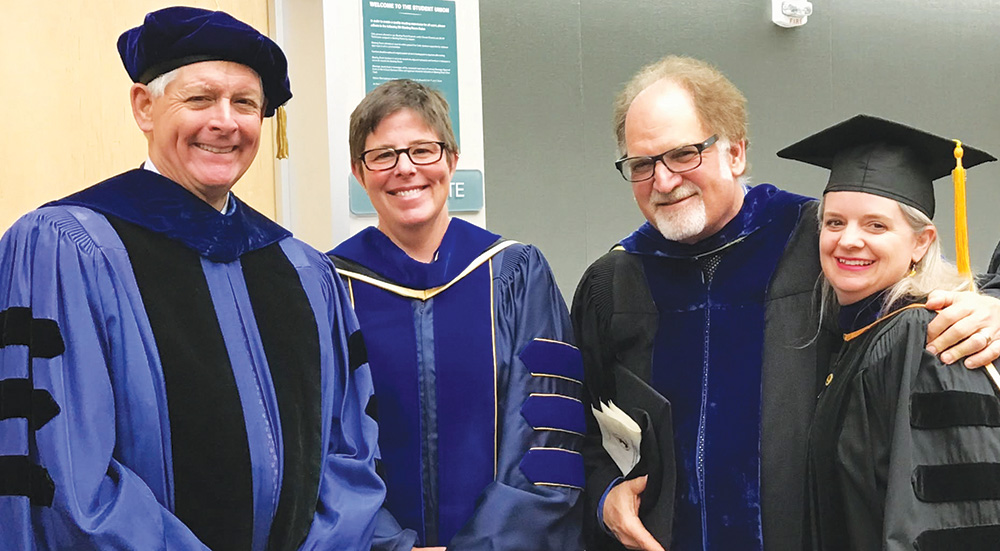
In April of 2019, Alan Soldofsky organized that year’s annual Legacy of Poetry Festival at San Jose State University (SJSU), including a reading by Forest Gander, who won the Pulitzer Prize two days before his campus appearance.
The SJSU event was Gander’s only scheduled gig at the time he learned of the Pulitzer. The column that appeared on this page, in advance of the event, was still on the streets of Silicon Valley when the Pulitzer announcement came over the wire.
Soldofsky, who sadly passed away last week, was a pivotal literary figure in the world of poetry for decades and also a mentor for many students, poets, younger faculty and even newspaper columnists. The ways he inspired, influenced and improved my interpretations of San Jose are incalculable.
He was the first one to suggest I was actually writing “lyrical essays” instead of newspaper columns. His tongue-in-cheek academic analysis of my work shifted everything about how I viewed San Jose in terms of memory, place and the ghosts who stalked the landscape. He later allowed me to sit in on many of his classes.
It was Soldofsky who turned me on to Juan Felipe Herrera’s book Zen Jose. To this day, a line from that book, “All free ways lead to Zen Jose,” is probably buried in everything I write.
That wasn’t all. Soldofsky introduced me to several faculty members whose books and projects I wrote about on the pages of Metro, all of whom remain friends of mine, wherever they happen to currently live. I can trace so many acquaintances right back to him.
The travel writer Tim Cahill, for example, spent an entire semester at San Jose State in 2010. Every week after his class, I joined the faculty at Flames across from campus, where we all talked about the writing life. Here was a guy, Cahill, who co-founded Outside magazine in the ’70s, who knew Richard Brautigan, Hunter S. Thompson and countless others, and now he was in my neighborhood. For the first time in years I felt part of an urban university environment.
Years later, at a conference, I took Cahill’s travel writing workshop and then won an award for the story we worked on. That only happened because Soldofsky originally introduced us.
But it all goes back much farther. By 2010, Soldofsky had already spent at least 20 years bringing authors to the neighborhood. Norman Mailer and Elmore Leonard were two heroes I saw when I still attended SJSU, before I even knew Soldofsky. Yet there they were, in Morris Dailey Auditorium, thanks to the Center for Literary Arts. Mailer said he hadn’t been to San Jose in decades and remembered it being a total cowtown. Before Leonard’s talk, he signed my ratty paperback copy of City Primeval. I was ecstatic to see both those legends in my neighborhood. I didn’t have to go to New York. They came here.
There were so many others, including tons I didn’t get to see. Paul Theroux. Michael Ondaatje. The legendary Russian poet and novelist Yevgeny Yevtushenko, who reportedly out-drank the entire Fairmont staff when he stayed there.
Then in 2004, Metro allowed me to interview Simon Winchester as he arrived for a visiting professor position that spring semester. Winchester told me he had never heard of San Jose State when they first called him.
All of which were inseparable from processes originally put into motion by Alan Soldofsky. I have him to thank.
More recently, when Soldofsky started bringing the Legacy of Poetry festival into the streets and the venues of downtown San Jose, including collaborations with Cinequest, it highlighted yet another example of how the university and the surrounding neighborhood could properly feed off each other, following decades of political indifference and stuffy benefactors who thought “the arts” were just opera, ballet and the symphony.
Through it all, Soldofsky remained a ’60s beatnik at heart. A lifelong Kerouac dude. An articulator of Buddhist eco-poetics. But that didn’t stop him from assigning Tupac in a few classes. It didn’t stop him from introducing prospective students to postcolonial troublemakers if that’s what they wanted. He understood these things.
We will always have Zen Jose. But it will be much less interesting without Alan Soldofsky.