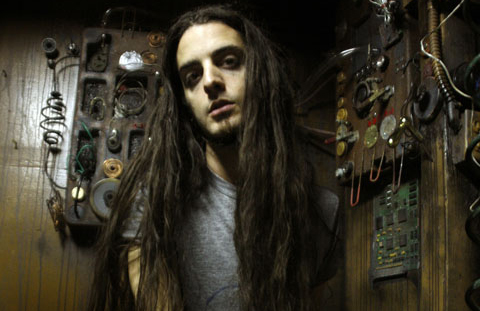
Almost hidden away amid rows of trees, a block from DeAnza Boulevard, the Cupertino Public Library is about as far as one can get from the thousands of screaming, writhing fans at the festivals and stadiums that Bassnectar plays around the country, and the world.
But embossed on the side of the building is the Jorge Luis Borges quote “I have always imagined that Paradise will be a kind of library.” And for Bassnectar, it was. Long before he became one of the most popular and respected DJs in the now-huge Electronic Dance Music (EDM) movement, Bassnectar was a 16-year-old growing up in San Jose, and known only as Lorin Ashton. A burgeoning metal guitarist at the time, he was obsessed with the extreme metal bands in the underground DIY scene centered around the Cupertino Library.
The library was remodeled eight years ago, but in the ’90s, there was a community room in its basement where he and his friends would organize shows, cramming a single setup for all the bands into one corner of a space that could probably hold about 40 people legally. That’s where Ashton got his first taste of the relentless energy that would come to define his performance style.
“I remember my band playing one time, and then after we played, Exhumed played,” Ashton says in an interview from his current home in San Francisco. “They were the San Jose death-metal heroes. They were three or four years older than me, and I looked up to them. They had hair on their arms. They were godly to me. I remember they came on, and at the first strike, the room exploded. Every single one of them, you could just see the muscles tensing in their arms as they played, and in their throats as they sang.”
The body-memory of that moment still echoes today in Ashton’s hair-whipping, sweat-soaked performances. “It really affected me, ’cause it’s how I normally felt. At that age, I needed one of my peers who I looked up to show me that that’s what you do: you let yourself be you.”
Dancing With Myself
For the 34-year-old Ashton, who returns to the South Bay on Saturday, May 5, to perform at the San Jose State University Event Center—as far as he can remember, his first-ever show in his hometown—it’s not just a persona for public consumption.
“When I’m in the studio in my boxers making music at four in the morning, I will get up and rage. I would dance so hard to ‘Ping Pong’ when I was making it, I’d have to stop because my heart was bursting in my chest. I’m not performing, I’m not doing Janet Jackson dance moves or something, I’m just letting go.”
The finished “Ping Pong,” from his new album, Vava Voom, is likely to set off the same chestbursting pangs in the listener. Though Bassnectar songs are almost exclusively between 80 and 140 beats per minute, this one feels much faster, thanks to the use of an insane ping-pong ball sample—at times digitally enhanced—underneath the bass line all the way through. It’s one of many ingenious touches on an album that skillfully captures the fractured state of EDM, and maybe even attempts to unite it a little bit, drawing on dubstep, trance, drum ’n’ bass, hip-hop, and glitch to augment his trademark bass attack. The album’s “Pennywise Tribute”—which is a remix of Pennywise’s “Bro Hymn (Tribute)”— is straight up punk rock until the drum ’n’ bass elements kick in at the end.
The easiest tag for his sound is the catch-all “electronic,” but Ashton considers it meaningless.
“People talk about ‘electronic music,’ but to me everything is electronic music. We’re listening on electronic stereos, and we’re mastering with electronic instruments in electronic studios. Hip-hop is electronically produced and rock is electronically produced. It’s all electronic. Electronic music is just an enhancement, in the way that color TV is better than black and white,” he says.
But unlike most other artists who complain about the labels put on the their music, Ashton actually came up with a better one: “omnitempo maximalism.”
“It was finding something that essentially translated to no rules and no limitations,” he says. “’Omnitempo’ means I can play at any and every tempo, I’m not constricted by that. And maximalism just means turn it up—just tons of it. Combine everything with everything. Don’t hesitate, and don’t be burdened by other people’s rules.”
That last part is particularly important to him: “As someone who has been making and playing live music for over 20 years, and doesn’t know a lick of musical theory, it’s important to me to have no rules.”
There are echoes of Ashton’s early metal obsession in the grind of what is probably his signature song, “Bass Head,” from 2010’s Timestretch EP, and others. But it obviously wasn’t the only influence on his unorthodox path from long-haired headbanger to long-haired superstar DJ, and much of the music he discovered in his South Bay years had a profound impact on him.
“I’m inspired by so much,” he says. “I’m inspired by ethereal, anthemic music like REM or the Cure or Nine Inch Nails or Tears for Fears. Growing up as a kid in America, I tuned in to the most anthemic kind of pop music. Then I got into NWA and Public Enemy and Nirvana and Metallica. Then death metal, and then deep into every subgenre of the rave scene. Now I’m into everything, from Erykah Badu to the Fugees to Cannibal Corspse to Mozart to whatever. I like good music.”
His passion for raving developed while he was at UC–Santa Cruz, preparing for what he thought would be a career as a guidance counselor. In the years before the university’s thirst for development began hacking away at the sprawling forest of Elfland (and even after), the underground music culture in those hills was unlike anywhere else. In the mid-’90s, there was the Gathering, and there were Harmony parties, and Ashton threw himself into it all.
“I pretty quickly got swept away by the underground global psychedelic trance scene, and that was where I spent all of my time,” he says. “We had a collective called the 13 Moon Tribe, and we would do free full moons every full moon. We’d get a voicemail box just for that month and go hiking out into the woods to find a place and then leave directions on the voicemail, and 1000 people would show up in the middle of the night, and go ’til sunrise.”
Road Rage
Ashton’s biggest influence on EDM has been his live shows, which have evolved into an epic spectacle of light and sound. While it’s now more common to see one guy with a laptop holding court at a big rock show, it wasn’t always like that. Fellow San Francisco DJ Justin Boland (a.k.a. J-Boogie), who remixed the Bassnectar song “West Coast Lo Fi Rides Again” when they were both on the Om label, and has opened shows for him, says Ashton made that possible.
“He was the one who kind of made it acceptable for people to be rocking that way, because he did it so well,” says Boland. “He made it OK.”
Ashton is known for drawing fans in cities way off the typical DJ map, but he says that started out of necessity when the rave scene died out in 2001. He drew on his experience with the South Bay’s DIY scene to make something happen.
“From 2001 to 2005, it was just a graveyard. I would spend most of my time on the fringe in small local communities doing very underground stuff. San Francisco was going off of course, but throughout the rest of the country it was all people I’d met at Burning Man, and throwing together a 250-person show at someone’s art gallery in Brooklyn or whatever it is, DIY type of shows,” he says. “That’s why the Cupertino Public Library was so inspirational to me.”
Around 2004, he began getting into touring festivals. It’s a bit ironic to him, since he was never a fan of the Grateful Dead’s music, but he loves the model they pioneered. In 2010, he started his own Bass Center Festivals, and after the first two sold out well in advance, he brought a third to the Bay Area last fall.
He’s also used his Dead-like “Bass head” following to advance charitable work, and still promotes the “Dollar Per Bass Head” program on his website, through which he donates $1 for every person who attends a Bassnectar show to a nonprofit organization. No one who’s heard his political-sampling streak will be surprised by the importance he places on activism. But for him, there’s a larger issue of community, and it goes a long way toward explaining his ever-increasing popularity live.
“I think when people are at a Bassnectar show, there is an atmosphere of abandon that is also supported by an atmosphere of community,” he says.
“I don’t do drugs, I’m a very health-conscious person. I’ve got a very positive, humanistic type of personality. I’m trying to create an atmosphere where people are safe to go fucking buck wild and crazy for a couple hours. I guess I lead by example.”
Bias Against the Bay
South Bay DJ Andrew Moyco, a.k.a. Audio Dru, was one of the first to promote dubstep locally, and has been following Ashton’s work closely since the Bassnectar sound began incorporating it heavily. He thinks that despite Bassnectar’s popularity, he still falls victim to a bias against Bay Area DJs in the media, who are more likely to fawn over acts like Britain’s Doctor P, or L.A.’s Skrillex.
“He’s influenced a lot of people,” says Moyco of Ashton. “And he’s way better than Skrillex.”
But Ashton is happy taking his music straight to the people. “I feel like I’ve focused my music career more on—I don’t like the word fans, so I would just say enthusiasts—but more on the people than on the other DJs,” he says. “I haven’t spent a lot of time making music for DJs, which I think is something that a lot of the UK producers did. For a while, it was basically like vinyl culture was a very exclusive trading of VIP dubs and stuff. That’s cool, and I was definitely on the receiving end of that, I was very influenced by that. But when I make music, I want something that can penetrate through the psyche of a larger, wider spectrum of human. A broader age range, a more diverse musical background, a more eclectic personality.”
Bassnectar performed at San Jose State Event Center in San Jose on Saturday, May 5, 2012.