Walls are made to come down. Nothing is permanent. Especially in Japantown.
Last weekend, as the Obon Festival erupted at Fifth and Jackson, I shuffled into the amazing Kaita Restaurant, only to remain stuck in what used to occupy the same space. I’m not just talking about the now-retired Ginza Café proprietor, Carl Hirano. I’m talking about the actual wall that used to display multiple autographs.
The Obon Festival exists to welcome ghosts back to the neighborhood and celebrate the ancestral spirits who already remain lurking in the shadows. It’s one of the most gorgeous weekends for any columnist to navigate the overlap between history and everyday life, or to fuse the spatial reconfigurations of the neighborhood with his own mental reconfigurations. In this case, the spectral entities emerged in the form of building materials, sharpies and drywall.
As soon as I walked into Kaita, an old Mercury News story stared at me from the entryway partition. The story was from 2002, when Kaita first opened. The story might have been on the wall ever since.
“Generations of Ginza-goers will be disoriented, but the San Jose restaurant at 215 E. Jackson St. is now called Kaita,” wrote the Merc. “Six months ago, Koji Sugimoto bought the closet-size Japantown landmark, ripped out its worn walls, and installed new blue carpeting and comfortable benches.”
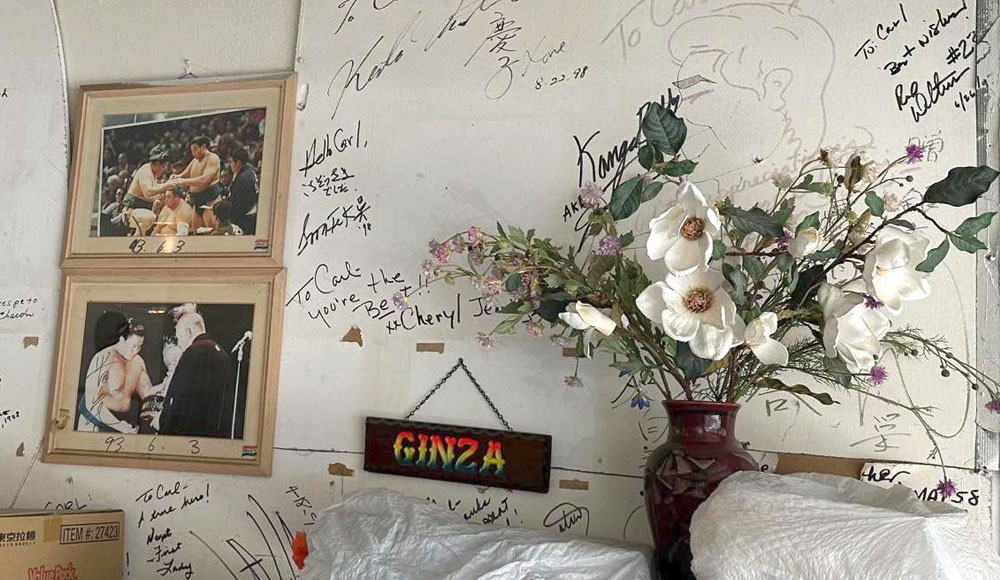
I was not disoriented at all because I knew one of those walls still existed, not just in my own mind, but in actual physical form. The wall just isn’t in the restaurant anymore. It remains in a secret undisclosed location, stashed away behind piles of storage. When Carl retired, he apparently saved the wall because many celebrities and regular customers signed it over the years.
Of Ginza Café, Metro had this to say in 1997: “It’s a terrifically lively place with a celebrity wall signed by the likes of George Takei, Jerry Rice, Norm Mineta, the Visalia Oaks baseball team and a host of other celebs.”
There were also Bronze Stars and Purple Hearts, all earned by Carl in Vietnam. Since Carl ran a Japanese-language publication for years, he knew many people. One local business owner told me that Japantown was “much quieter without Carl around.”
Even as the wall remains in storage, one can see the scratchings of Akebono, one of the most famous sumo wrestlers of all time, who passed away last year. In 1993, Akebono participated in a landmark match in San Jose. Held at the SJSU Event Center, the gathering was not the first time sumo wrestlers ever appeared in the US, but it was the first fully accredited sumo championship competition on American soil, thanks to Yosh Uchida, the judo teacher at SJSU, who set up the whole thing. Uchida also sadly passed away last year.
During the 1993 visit, Akebono and his fellow sumo wrestlers were all over the news. It was a nonstop media circus. Fanatics followed the wrestlers everywhere, including their visit to Ginza Cafe in Japantown. I don’t know how they even fit through the door, but Akebono’s handwriting still graces the wall, to this day, as it sits in storage.
On the wall, one can easily identify many of the signatures. Some were just from friends.
“To Carl, you’re the best,” wrote a person named Cheryl. Another said, “To Carl, a true hero.”
The entire wall remains covered with dedications, some from athletes like Indy driver Willy T. Ribbs, others from regular customers, all wishing Carl good luck in his retirement years. A few are in Japanese, while others are in Spanish. The legendary newscaster Rigo Chacon even signed the wall. “Con respeto,” he wrote.
In the wall’s current state, two framed sumo photographs from the 1993 San Jose competition, both autographed, are still connected. The Ginza sign hangs in the middle of it all.
I don’t even know Carl, but looking at that wall got me a little choked up. I felt like I was part of a much larger story, whatever that is.
Which is why, as I entered Kaita last weekend and surveyed the scene during Obon, I almost choked up again. Walls are impermanent. Life is impermanent. Restaurants are impermanent. And we are all the wiser for understanding.