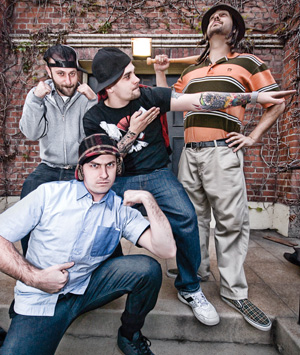
Six years ago, Language Arts Crew had all the makings of an innovative rap group busting out from the San Jose underground and penetrating mainstream hip-hop with the release of their debut album, Applied Knowledge. Unfortunately, that didn’t happen.They’d already had a taste of popularity with their first 7-inch single, “Lazy Daze in California,” which was released by an upstart indie label. “Lazy Daze” was a laid-back hip-hop jam with a cool little piano loop. The music complemented the lyrics perfectly, conjuring up images of sunny California backyard parties. It got regular airplay on KSJS, and even made the rounds in San Jose dance clubs. Gangsta rap may have dominated the ’90s, but alternative, experimental hip-hop groups were gaining momentum in the 2000s with the rise of acts like Atmosphere and Aesop Rock. “I never considered being in a hip-hop group. Not until Doug [Hughmanick] showed me early Aesop Rock,” says Language Arts Crew co-founder Clint Westwood.Westwood and Hughmanick started making hip-hop in 2000 when they moved up to San Francisco. “We started to freestyle with no intentions of it being serious. Clint was making beats on a busted Casio stereo,” Hughmanick says. Stefan Meissner would come up and join them. They later met Benny Medicina after moving back to San Jose. After a lot of shows and experimentation, they released “Lazy Daze in California.” Despite its initial success, the record label had some internal problems and ended up folding. Still, the funky, feel-good vibe of the single was the perfect soundtrack for every San Jose hip-hop-loving stoner. They carried this sound into the full-length Applied Knowledge, incorporating more complicating rapping patterns, unusual samples and cutting edge midtempo beats that were in line with the emerging underground hip-hop movement of the time. Yet they were careful not to sound like other underground groups.
“That first 7-inch bumped us up a notch. By the time our first LP came out we already had a following,” Westwood says.Despite a great debut record and putting on killer shows, they never got the opportunity to jump to the next level. But in the end, it wasn’t about breaking it big. These guys were music lovers, if not hip-hop purists. The group members had played in ska, punk and all sorts of crazy bands before they ever started rapping together. “We have punk rock energy. We have that mentality that live music needs to be entertaining. Not a lot of hip-hop artists understand that,” Westwood says. After a few years of hitting the scene hard, in 2006 Medicina got a job offer working on the TV show Veronica Mars and moved down to Southern California. The group continued on. They worked on their second full-length and played shows as time permitted. Medicina would make trips up to San Jose and work with the guys.
Meissner and Westwood started up the ska band Whiskey Avengers as a side project along the way, and it didn’t take long for that band to gain a lot of attention in the local scene as well. Playing in a band with musicians like Kevin Higuchi and Lee Pardini, Language Arts Crew further expanded their musical approach. “We started to integrate live instruments into the recording process and furthermore into our live performances. So I guess we had become a hip-hop band,” Medicina says. Medicina moved back to San Jose in 2008 to devote more energy to Language Arts Crew. Rather than slimming down on other musical projects, the guys managed to expand it. The Whiskey Avengers were going strong, and Westwood joined alt-metal band Insolence. Medicina and Westwood even decided to form another band, Trashkannon, playing crusty punk.
“The other projects we are involved in have definitely proved to diversify our audience. That’s what we’re going for. We want to do it all, and I believe other hip-hop artists respect us for that,” Medicina says.